




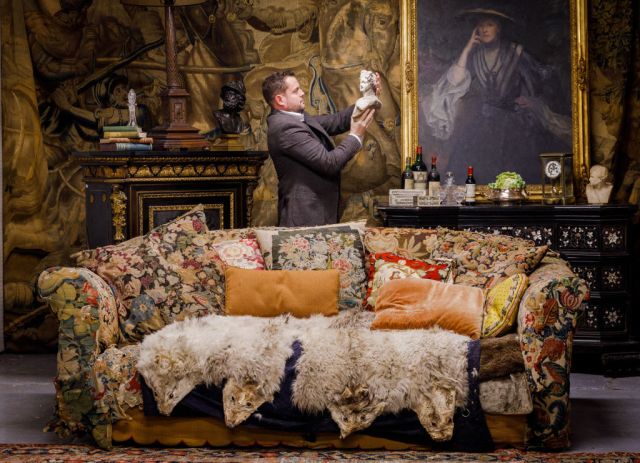
How many of the items in this sitting room — immortalised in ‘Withnail & I’ — would a member of Gen X keep? (Photo by Tristan Fewings/Getty Images)




Middle-aged heirs are rejecting their parents’ prized possessions. “The children have no room for the oak furniture, they don’t want the silver card cases and we have to explain it will be sold for whatever we can get,” one auctioneer recently told The Times. We are invited to imagine a definite rupture within family trees: storied old objects gently passed along branches from aged hands to younger ones, until they meet those of ruthless Gen X-ers, and are rushed to the auction house or the tip.
At the same time, we are told that young people these days live in thrift shops and antique stores at the weekend, and adore anything vintage or “pre-loved”. Mahogany tables feel more soulful than Ikea flat-packs, and recycling is environmentally friendly after all. It might seem there is an obvious solution: the kids could be rescuing post-loved objects directly from their grandparents’ estates, bypassing the middle-aged Marie Kondo wannabes in between. But I suspect that here, too, there is a reluctance to dutifully absorb aesthetic judgments imposed from beyond the grave. Like their rebellious fifty-something elders, Gen Z-ers appear to have little wish to be tied down by a specific familial past, though they don’t mind plundering those of strangers.
Sometimes the urge to ditch is understandable. Though it feels like a betrayal, I recently declined the opportunity to own a huge tapestry of a waterborne Newfoundland dog holding a lifeless drowning girl in its mouth, embroidered by my great-great-grandmother and left to me by my grandmother. (My mother says it is inspired by an equally dramatic Landseer.) The family mementoes I keep close by me are less alarming in the middle of the night: a sewing box, though I don’t really sew; some nested tables; a silver napkin ring with the name of some earlier Kathleen etched upon it; a tea set left by an aunt; a pot stand made by my grandfather. There is also a Huntley and Palmers biscuit tin from the Forties, with a handwritten note taped to it in familiar script: “Handle with Care. Not wanted on Voyage.” In future, I will face more difficult choices as larger numbers of objects potentially head my way: further tea sets, each the pride of a female forebear who carefully saved up for it; “best” crockery; a writing desk; a wardrobe and matching dressing table; shelves of clothbound books.
The most obvious reason for the Great Gen X Baggage Shedding — aside from all the Freudian ones — is that such items speak to a way of life that vanished rapidly, just as people of my age were growing up. When trying to scale the property ladder now, you don’t want to be dragging the dreaded brown furniture around with you. Working mothers have no need of cake stands or fish knives: relative to gregarious mid-century housewives, they barely entertain. Ancient christening gowns languish in MDF drawers for want of church services and babies. Unlike my fastidious grandparents, I let teabags stew in the mug, and I don’t keep silver polish. I hardly use pen and paper, so have scant need of a desk.
In years to come, perhaps people will face similar dilemmas: should they keep the matcha whisk and the yoga pillow in memory of granny, or toss? Do these antique hair straighteners spark joy? But as these examples suggest, it is hard to imagine which items present generations will pass on to subsequent ones. So many of our culturally prized objects are electronic, with future malfunction and technological obsolescence built in. Most of us can’t sew or build or carve anything. Generally, we don’t leave many deliberate marks on the material world for later fingers to retrace. Lost in digital landscapes, we barely notice our own homes, let alone consider which bits of them might be worth saving for posterity.
As the virtual world continues to expand, this trend is only going to deepen. More e-books instead of well-thumbed pages; digital photos in the cloud, not albums; pieces of music floating free of discernible instruments or turntables. Fewer spatiotemporally located things. Dislocated information, available everywhere simultaneously, is being prioritised over things that can only ever be in one place at a time.
In recent surveys, asking that hackneyed question — what one item would you grab in a fire, assuming that all your loved ones were safe? — laptops and phones topped the list. Obviously, this is not because these things are considered by their users to be irreplaceable objects, with particularly beautiful designs or strong emotional associations. Indeed, phones and laptops are eminently replaceable; they break or get superseded by new versions all the time. The attachment to devices is simply because they act as portals to parcels of digital information people feel they can’t do without — not even for the short time it would take to buy another one.
As the philosopher Byung-Chul Han writes in his brilliant little book Non-things, the everything-everywhere-all-once aspect of digital technology can induce a megalomaniacal mindset: “I swipe away the information that does not interest me. I zoom in on the content that I like. I have the world firmly in my grip.” Physical objects are refreshingly obstinate in comparison. They require dexterity and patience to unlock their possibilities, not just cack-handed jabs and swipes on glass. If you break something you really love, there is a cost; you can’t just turn to the cloud and recreate everything you valued about that thing, hosted in a new body.
And, as Han also notes, real objects stabilise us. Early modern philosophers fretted about what happened to physical things when human minds were not there to experience them: could they really be said to exist at all? But in truth, we owe the things more than they owe us. We need contact with entities that will stubbornly persist as themselves during radical human changeability. Otherwise our anxiously roaming minds will lose the plot. We didn’t really know this, perhaps, until the speed and insubstantiality of the digital world made it plain.
Generally, acquaintance with tangible objects reminds us that we too are finite and occupy a limited portion of space. We are not just borderless networks of information; we are not clouds. Family heirlooms do this too; but more importantly, they also locate us in time. Memories are stored up in their contours. Or as the philosopher of art Carolyn Korsmeyer puts it, there is “transitivity of touch”: in touching an heirloom, you become a link in a chain, stretching back to other earlier people. You mentally connect the object’s present, here with you now, to its past; which usually means connecting up points in your own life too. For this reason, mementoes offer psychological containment to owners hurtling through different life phases and rapidly changing conditions. Like steadfast friends, they attest to the existence of an unbroken narrative line in a life, even if its owner can’t fill in all of the gaps.
To some extent, you could say the same of any treasured objects from your own history, and never mind those that connect you to relatives and forebears. The bottle that held the wine that night you proposed; the letters from schoolfriends; and so on. So why do you need other people’s things to tell your own story?
I suppose the answer depends on whether you think of yourself as essentially part of a particular family, metaphysically speaking. I do, though I’m sure I used to deny it. We are not self-standing organisms. We each have a history that preceded our own births, involving many other characters, each with their own beloved or useful things. No matter what fantastic Victorian or Edwardian swag the Gen Z-ers are now dragging home, the most perfect vintage stuff for you, personally, is not to be found at any auction — or at least, not unless your mother took it there first.
