




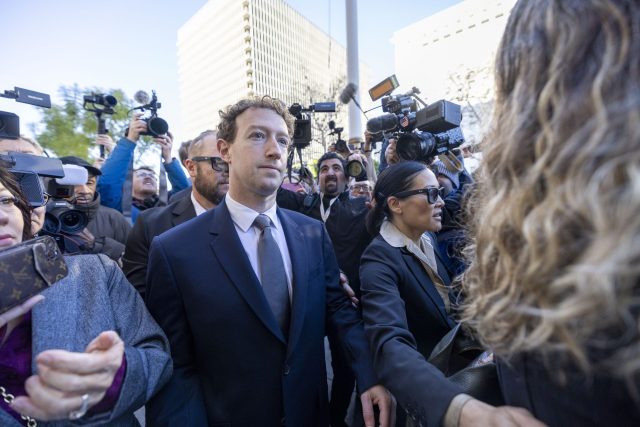
Getting Zucked... (Jill Connelly/Getty)




I dreamed about Mark Zuckerberg again. We were on a family holiday and he was just sitting there in the middle of our hotel room as I tried to get my boys ready for breakfast. He seemed disconsolate. He held his ringlets in his hands and then tapped at his laptop forlornly.
It was obvious why he was upset. It was the news from California: his company Meta, encompassing Facebook, Instagram and WhatsApp, had reached a surprise settlement in a landmark lawsuit that had been expected to last for weeks. It would pay up to $18 billion and it would be forced to make its products more safe. “Today, we have secured a settlement with Meta that will make social media less dangerous for our kids and make a world of a difference for children and their families,” the attorney general of California was saying.
So it wasn’t quite a dream, I realized as the radio alarm ushered me into the land of capital and courtrooms and the Today program. But apprehending this news between conscious and subconscious thought felt somehow apt; characteristic of the neural zone that Mark Zuckerberg has made it his business to colonize. This man has been living rent-free in our brains for decades. He has haunted our holidays, our elections, our births and deaths, our graduations and house-moves — and given the level of access we have granted him, he has not been a considerate guest.
Indeed, it was Meta’s conscious exploitation of the subconscious that formed that crux of the lawsuit. The State of California, and 28 others, were claiming something that everyone familiar with the company has long known: that Meta had deliberately designed addictive products; that it targeted them at children; that Meta knew this was having appalling effects on the children’s mental health, in some cases goading these children into killing themselves; but that it did it anyway. Indeed, it carefully surveilled these children in order to do this more effectively, harvesting the data of children under 13 without their parents’ permission in violation of several federal and state laws, so that it could keep feeding them its profitable poison. It’s not that Meta wanted to harm children. It just so happened that some of the stuff the children spent most time on was the harmful stuff — and Meta is a machine for consuming our time.
While the judgment stops short of holding Zuckerberg personally accountable — he was listed as a witness, but never actually appeared in court — it does, potentially, represent a turning point in curtailing the peculiar power he has been allowed to accumulate.
It’s worth stressing that $18 billion, while an enormous amount of money — roughly equivalent to the amount that America proposes to spend on attempting to solve homelessness — is no biggie, really, so freakishly profitable is Meta’s underlying advertising business. The tale of how Zuckerberg launched thefacebook as a Harvard student in 2004, connected the world and created a billion-dollar company, was mythologized in The Social Network (2010). But the crucial transition happened later, when Zuckerberg brought Sheryl Sandberg over from Google in 2008 and helped embed its advertising model within Facebook’s social architecture. The company thereby answered the question that had long hovered over its billions of users: namely, where’s the revenue? Over the next decade, we shared our favorite bands, we photographed our children, we argued about austerity and Scottish Independence and Brexit, and this in turn created an extraordinary database that could be sold to advertisers. The shift in emphasis from real-world social ties to politics was simply a case of noticing what made users more engaged.
Otherwise, Zuckerberg’s signature moves have been imitative and acquisitive. He bought up rivals, such as Instagram and WhatsApp, and folded them into his empire; and those rivals that he couldn’t buy, he copied. The Stories feature on Instagram is a direct lift from Snapchat; Reels is an attempt to forestall TikTok. The numbers say the users are engaged, so what does it matter if people complain that the experience is getting worse?
Meanwhile, the one mildly original idea Zuckerberg had — his own dream of luring us all into a virtual reality Metaverse, so that we could float around with an amputee Nick Clegg and have meetings — was a laughable failure. I wouldn’t bet on his deeply creepy AI glasses being any more of a success; Meta’s innovation division has generated a cumulative operating loss of around $80 billion since 2020. Yet Zuckerberg is insulated from the consequences of such terrible decisions. This is partly thanks to the extraordinary power he holds as CEO/chairmen (he has majority voting rights despite only technically owning around 14% of the company); but mostly thanks to the enormous revenues generated by surveillance advertising: over $200 billion in 2025. And, in a purely cynical sense, those shareholders are correct to grant him such unparalleled power. If there is a way of making the user experience worse in the pursuit of greater measurable engagement, he will take it.
This is why the promises to alter that business model are significant. The line that everyone always returns to is that moment when he watched his fellow students at Harvard surrendering their data and said: “They ‘trust me’. Dumb fucks!” But when he was forced to sell his political philosophy, the classic Zuckerbergian line was simply that connection was good: the more we connect, the more we will understand each other, and the happier everyone will be. This always put me in mind of Gustave Flaubert’s response to the railway lines that were springing up across 19th century France, promising speed, commerce, connection, progress. Flaubert feared that railways would simply allow stupid people to go and be stupid in other places; this is essentially the problem of politics in the internet age. Still, for years the Zuckerberg defense ran something like: “All we are doing is connecting you guys! There’s nothing harmful about that, is there? Friends are fun! And hey, if you’re spending too much time online — that’s on you! Maybe take a break? In the meantime, we promise, we are doing everything we can to deal with the very tricky problems of fake news and viral hate mobs crying death to the Rohingya and anorexia influencers and the like!”
In reaching the settlement, Meta has effectively been forced to admit that this is nonsense; its underlying behavioral moderation mechanisms are indeed exploitative. Otherwise it wouldn’t need to introduce a two-hour daily limit for under-18s; or no notifications during school hours, an overnight block from midnight to 6am, or stronger age verification, or an end to the ‘like’ as we know it.
This is precisely the case that Shoshanna Zuboff made in her book Surveillance Capitalism (2019), still the essential guide to the Zuckerbergian universe. Zuboff’s insight was that the internet had inadvertently uncovered a new kind of raw material: not our labor, but the “behavioral surplus” left behind by our ordinary lives — our searches, movements, purchases, even our near purchases. The extraordinary business that grew around it was not simply surveillance but the creation of systems capable of predicting what we will do and, eventually, capable of nudging us towards doing the predictable thing. Facebook’s tracking pixel was estimated to be present on 30% of the world’s 1,000 most visited websites. The company’s own advertising materials told advertisers that, with the Pixel, they could identify people who had looked at a particular kind of shoe and then abandoned it in a shopping cart — and then target them accordingly.
The actual material purpose of all this — the stuff that the finest minds of a generation have devoted their careers towards honing and perfecting — is in fact staggeringly banal. A tiny proportion of us might be prompted to think: yes, maybe I do will have those shoes after all. But the inquest into the death by suicide of the British teenager, Molly Russell, showed how lethal this apparatus can be when it is trained on the vulnerable. During the trial, Meta disclosed that Russell, 14, had interacted with 16,300 pieces of Instagram content in the six months before her death. Over 2,000 of these were related to depression, self-harm or suicide; Instagram recommended that she follow at least 34 accounts with “sad” or depressive content in their handles. Russell’s father, Ian — now a formidable campaigner — has described his discovery of what his formerly happy-seeming daughter was seeing online as “a missing piece of a jigsaw.” “There was no sign of any mental ill health in Molly before her death, and we couldn’t work out what could possibly triggered it,” he told CNN. “It’s a ghetto of the online world… once you fall into it, the algorithm means you can’t escape it and it keeps recommending more content.”
During the inquest, Meta took the classic Zuckerbergian line that, actually, “content which touches on suicide and self-injury can be shared in a positive context” and “can play an important role in destigmatizing mental health difficulties.” Russell’s lawyers argued in turn that Instagram was not a neutral host; instead, it was actively making decisions that it knew would harm people like Russell and the inquest upheld that she “died from an act of self-harm while suffering from depression and the negative effects of online content”. Meta has, apparently, learned from all this. Only years later, the US litigation essentially points towards the same conclusion. Meta is not a place where people do things. It is a place that does stuff to you.
One of the more curious results is that Meta has become, overnight, an advocate for regulation of the entire tech sector — the “DO IT TO JULIA!” move. Terrified that TikTok or Snapchat will now lure its users away, Meta has now demanded that its competitors likewise face similar restrictions. Well, good. Still, until the machine is dismantled, it seems likely that all the tech companies continue to view humans as users and emotions as engagement. Much as Alphabet simply regards the EU’s massive fines as the costs of doing business, I suspect Meta will simply seek to get away with as few sacrificial alterations — a streamline ‘like’ experience here, a wholly ignorable prompt there — and figure out some other way that it can boast to advertisers that it can increase the chances of us buying a pair of shoes by 2 or 3%. Only when its fundamental model is challenged will it truly change.
A more open question is what now happens with Big Tech politics. It seems hard to believe now that as recently as 2017, just before the Cambridge Analytica scandal broke, Mark Zuckerberg was semi-seriously spoken of as a Presidential candidate for the Democrats. Since then, his aesthetics and his rhetoric — the MMA fixation, the “free speech” talk — have shifted toward MAGA. This development seems less like someone who has experienced a political awakening, beyond the paranoid misanthropy that seems to come over most billionaires, and more commensurate with the basic amorality that Sarah Wynn-Williams describes in Careless People. Zuckerberg, she relates, made extraordinary concessions to the Chinese Communist Party in order to further his dream of connecting people. If Alexandria Ocasio Cortez or Jon Ossoff were to gain the presidency in 2028, I suspect his vibe would shift again.
But in sucking up to Donald Trump and JD Vance — and attempting to use the might of the US State Department to subdue any middle powers who might be thinking about reining in unaccountable foreign billionaires who insist on messing with their affairs — both MAGA and the oligarchs have only succeeded in making themselves even more unpopular. Anti-tech politics, whether it takes the form of antitrust lawyers, opposition to data centers, or groups of parents rallying around smartphone bans, is likely to be a significant battleground of the next US election, and it’s hard to imagine there are many votes to be gained in doing what Zuckerberg wants.
The thing that is genuinely sad about social media is that it didn’t really have to be this way. The domain upon which Zuckerberg has built his empire is the domain of human emotion — a domain in which he himself seems hopelessly adrift on such occasions as he does have to display any of it himself. (Indeed, without being too deterministic about it, it feels notable that the most consequential critics of Meta have tended to be women, supposedly more adept at human relationships: the whistleblowers Frances Haugen and Sarah Wynn-Williams; the academic Shoshanna Zuboff, the journalist Carole Cadwalladr, the former data scientist Sophie Zhang). But what was being extracted from us? Our lives, really. That instinct that people have to connect, to share, to leave a trace — it is not an evil one. It’s a very human one, and it is powerful enough that despite kind of hating it, despite knowing what is being done to us even as we hover over the advert, we can’t quite give up our accounts. For one thing, it is incredibly hard to live a full 21st century life without interacting in some way with the Zuckerberg machine. But also, the shrines we made on these site to our children’s birthdays, to our graduation proms, to that one blissful weekend may be tacky and covered in advertising hoardings; but they’re still the traces of our lives. Multiply that by billions of people, every day, for twenty years, and the scale of the theft becomes almost impossible to comprehend.