




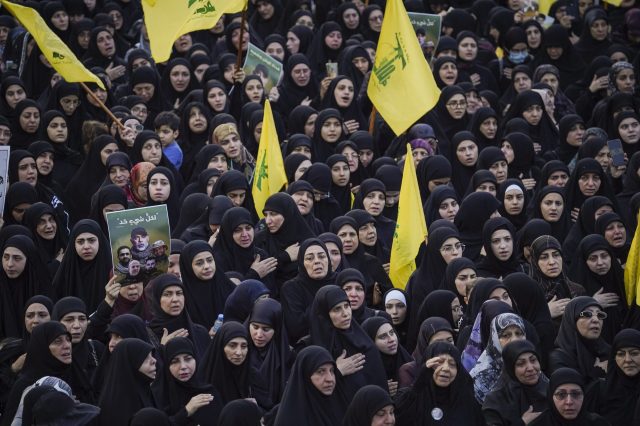
Women mourn the Hezbollah commander Haytham Ali Tabatabai in Beirut, Lebanon. (Adri Salido/Getty)




For 900 years, Beaufort Castle has dominated the villages and olive groves of South Lebanon. Yet even before its recent capture by the IDF, this crusader stronghold was far more than a medieval relic. For almost two decades, Beaufort became a symbol in stone of the futility of Israeli occupation. IDF troops first dislodged Palestinian militants from the fortress back in 1982, but then spent the next two decades trapped behind its walls, its tiny garrison often little more than prisoners of the Hezbollah fighters beyond. The steady stream of Israeli casualties at Beaufort helped spark the country’s peace movement, while movies and books vividly depicted what soon became known as the IDF’s very own Vietnam.
Now, this ancient castle has reprised its role: in what has become Israel’s largest incursion into South Lebanon since its 2000 retreat from the region. With IDF forces pushing past the Litani River, a natural barrier that’s played a major role in military operations dating back centuries, Benjamin Netanyahu seems intent on occupying South Lebanon once more. Yet with Hezbollah showing no sign of surrender, the risk is that Beaufort once again becomes emblematic of Israeli hubris.
Hezbollah has long been Israel’s more effective opponent. But after exploding pagers and airstrikes gutted the group’s leadership in September 2024, both Tel Aviv and Washington dismissed the Shia militants as a spent force. Following a ceasefire that autumn, giving IDF Northern Command a much-needed break, Netanyahu finally had the confidence to launch a ground invasion of Hezbollah’s stronghold in South Lebanon — especially after the cold war with Hezbollah’s patron in Tehran went hot. “There was an earned sense of satisfaction after decades of frustration in dealing with the most dangerous terrorists Israel has ever faced,” says Avi, a former Israeli intelligence operative specializing in Hezbollah, and who continues to consult the IDF as a reservist.
And so, in March 2026, IDF tanks rolled north once more. To be sure, Hezbollah retained significant military capabilities, not least thousands of rockets. Yet after eviscerating its leaders, Israel thought it would take years for the group to rebuild, particularly given a distracted Iran, and when the end of the Assad regime robbed the militants of strategic depth. As Avi now admits, however, “our enemies in Lebanon regrouped”. That’s something of an understatement. Now in its fourth month, Israel’s latest Lebanese incursion is proceeding far more slowly, and much more bloodily, than Tel Aviv expected. Over two-dozen IDF troops have been killed in South Lebanon since early March, with one medical captain dying near Beaufort just the other day.
Israel’s problems are largely a matter of strategy. While IDF forces, backed by heavy armor and relentless air strikes, have made physical progress, pushing some 15 kilometers into Hezbollah’s rugged stronghold, two new tactics by the militants have greatly increased the cost.
The first is a flatter organizational structure, focused on small-unit guerrilla tactics. The second is an expanded campaign of cheap-but-deadly drones, ideal for harassing the Israelis at every turn. Beyond the human toll, this approach has damaged or destroyed dozens of tanks and other armored vehicles, while also targeting sophisticated radar, intelligence gathering, and missile-defense systems on Israel’s northern border.
Speaking by encrypted messenger last month, Has’n, a veteran Hezbollah commander based in Beirut, speaks with open confidence about the conflict. Technical innovations aside, he seems bullish about leading the enemy deep into Lebanon. Grudgingly respectful of IDF operations in Israel itself — they fight, Has’n says, “for their land” — just 500 meters across the border “the resistance” and its hit-and-run tactics are paying off.
This didn’t happen overnight. After the 2024 debacle — which saw Hassan Nasrallah, Hezbollah’s famous leader, killed alongside dozens of other commanders — the group didn’t attempt to restore its conventional military capacities. Instead, according to Israeli and Lebanese security officials, as well as Hezbollah commanders interviewed by UnHerd, the group pivoted back to its roots as a guerrilla group: deploying the same tactics that caused Israel grief back in the Eighties and Nineties.
This reorganization was directly led by Iran’s Islamic Revolutionary Guard Corps, which sent hundreds of operatives to Lebanon, and which for the first time in decades appears to directly command Hezbollah fighters in the field. “The IRGC sent officers to take a much more hands-on approach in the wake of the ceasefire,” says Nick Blanford, an analyst at the Atlantic Council. “And they’ve streamlined the group.”
The relationship between Hezbollah and the Iranian regime has always been public: Tehran funds Hezbollah, by some estimates to the tune of $700 million a year, and supplies much of its advanced arsenal of weapons. But the command and control structure of the group — the extent to which Iran directly runs its operations — has historically been less clear.
“Hezbollah has always been free to operate in Lebanon as it sees fit,” says one Lebanese security official. “Iran didn’t have any interest in micromanaging Hezbollah, and both leaderships had close personal relationships for decades. There’s no need to command when everyone is on the same page.” Avi makes a similar point, noting that there’s always been “a level of compartmentalization” between the Lebanese and Iranian wings of the operation.
But, by all accounts, this formerly opaque relationship changed after September 2024. As Blanford explains, the group’s earlier decimation offered opportunities, with the Revolutionary Guards replacing various aging commanders with younger alternatives, battle-hardened from fighting rebels in Syria.
Of course, Israel hardly missed these developments. IDF airstrikes have habitually targeted hotels and apartment blocks suspected of housing Iranian officials in Lebanon, ceasefires be damned. But these don’t seem to have disrupted Hezbollah’s transformation; both Iran and the militants showing an uncanny ability to replace slain leaders, highlighting the perils of equating organizational decapitation with reduced military capacity.
Competent institutions, particularly militaries, can easily account for casualties among both the leadership and the rank-and-file. To put it another way, competent institutions can heal. And even their enemies agree Hezbollah and Iran are competent — especially after more than 40 years of on-off conflict with Israel and the West. “Hezbollah has surprised Israel with its resilience,” Blanford says, “and is fighting much harder in South Lebanon than anyone, including the Israelis, expected.”
What of the future? Frustrated by Hezbollah’s drone campaign, Netanyahu this week threatened to expand military operations to Beirut — and Lebanon’s already creaky civilian infrastructure. Iran, for its part, promised to resume its operations in the Persian Gulf, alarming a Trump administration desperate to finally reopen the Strait of Hormuz. In an apparently angry phone call between Trump and Netanyahu, all sides have agreed to a renewed ceasefire. But few in either Beirut or Tel Aviv trust the deal, and expect fighting to continue for as long as the IDF remains in Lebanon.
A longer campaign in the country would likely end in stalemate, as Hezbollah and Iran work together to bleed the IDF. As the Israeli reoccupation of Beaufort so vividly implies, this also would raise the ghosts of history. In 1982, at the height of Lebanon’s sectarian civil war, IDF troops invaded the country to combat the Palestinian Liberation Organization (PLO) and similar factions ensconced in the country. And if the result was 20 years of quagmire, Hezbollah’s evolving tactics imply a similar outcome today.
Even Israeli insiders now seem to accept this. “Obviously the fighting has been harder than expected,” says Avi, “but maybe it should have been predicted considering Hezbollah’s long history of resilience. They’ve rebounded quite impressively.”
And with Israel expressly stating it plans to reoccupy much of South Lebanon, just as they did through 2000, when it was finally driven out by Hezbollah’s resistance, it’s no wonder that militant commanders are increasingly optimistic — especially after a string of surprising defeats. “This occupation will be a gift to the resistance,” says Has’n. “It’s much easier to kill Israeli soldiers on our own land than in Palestine. We will fight like in the Nineties, and send them back their dead sons until they leave. We did it before and, God willing, we will do it again.” Expect more fighting at Beaufort — and soon.