




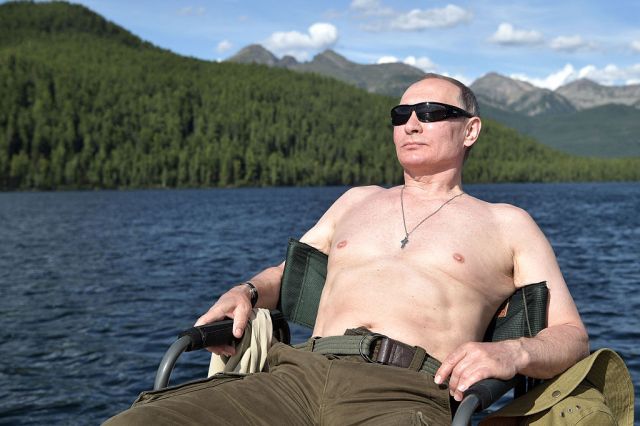
‘Putin has long been the master of the muscly political stunt.’ (Alexey Nikolsky Sputnik/AFP/Getty)




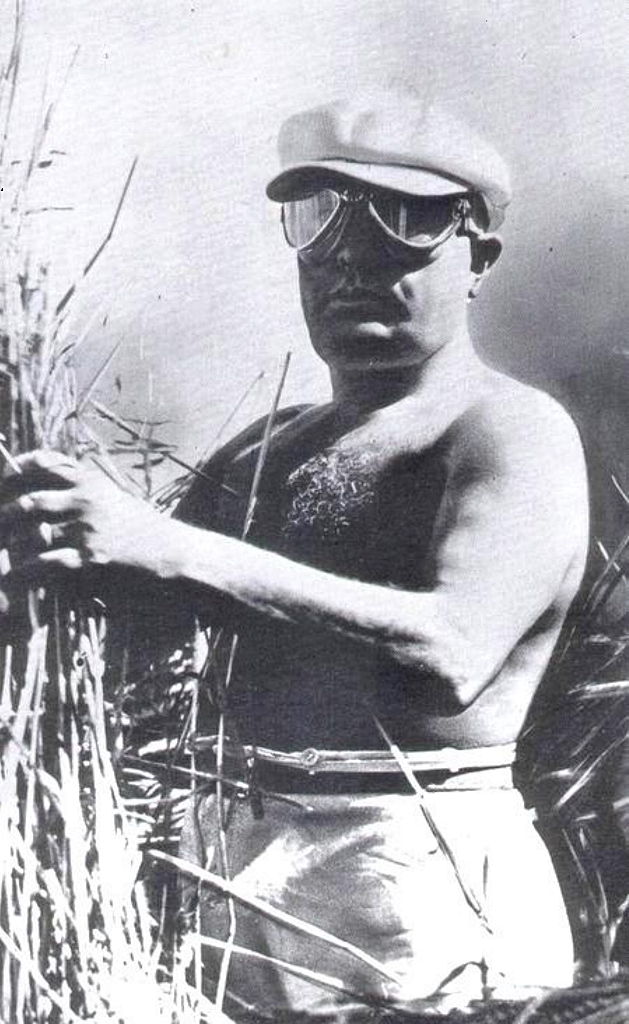
In Sabaudia, a Rationalist town newly built on the reclaimed swamps of the Pontine Marshes, Benito Mussolini emerged from his Alfa Romeo. It was 1934, and Italy was in the throes of its “Battle for Grain”. Mussolini’s 50-year-old physique contained the ideal of Fascist self-sufficiency; this body politic was stripped to the waist outside Farm Number 685, ready for waiting cameras. As watching peasants sang folk songs, he pitched wheat into a government threshing machine for an entire hour, “sweating mightily” according to one bemused Time report. Afterwards, he pocketed a farm labourer’s wage, then climbed the machine and addressed his public. His vision — for the town, for the state — was strong, and so was he.
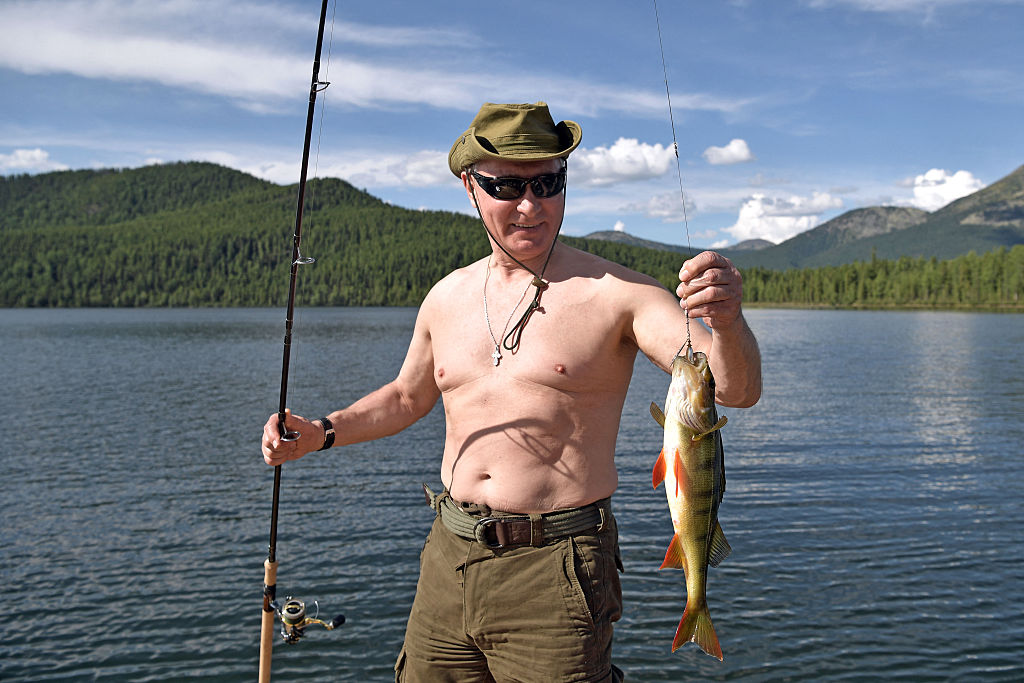
Mussolini has analogues the world over today, as leaders of all stripes stage photo ops framing them as godlike and invulnerable physical embodiments of the state. Podgy Kim Jong-un exhausts a poor white horse with symbolic gallops at Mount Paektu, then commissions paintings about it. Nicolás Maduro, pre-abduction, drilled with Venezuelan troops in airport hangars, looking for all intents and purposes like a divorcée at zumba. And, of course, Vladimir Putin stalks Siberia in Y2K shades, baring his torso to the wilds of Tuva like a Muscovite Action Man. One 2009 photoshoot baked his outdoorsman image permanently into the global imagination: there he fished, he rode, he swam butterfly, he sat in a tree wearing khaki. The horse in question belonged to a local shepherd; by way of thanks for the lift, Putin gave the shepherd’s son his Swiss watch. At a time when Russian oligarchs were flouncing about on yachts in Monaco, Putin — who had just been replaced as president by Dmitry Medvedev — was busy embodying rugged Russian masculinity (while holding on to most levers of power). Three years later, he was back in office.
Putin has long been the master of the muscly political stunt. He’s done spearfishing, judo, ice hockey; he’s been to the bottom of Lake Baikal in a submarine. But the president is now 73, and his body, Russia’s sovereign instrument, has changed. For years there have been rumours that Putin has employed a fleet of body doubles. This would make sense: for a leader whose somatic strength stands in for the nation’s, being seen to be physically present matters; lookalikes make you safer and more available. Ukrainian intelligence officials have long pointed to changes in Putin’s height, ear shape and so on to suggest the use of “at least three people [body doubles] who periodically appear”, Kyrylo Budanov, Ukraine’s spy chief, said in 2022; others say anti-ageing procedures or even the use of steroids are more likely to account for the president’s changing looks. Putin himself naturally denies all these theories; even so, apparent slip-ups keep happening; last week, the deputy prime minister for agriculture called the president a different name — “Pal Laich” — which sleuths claim is a nickname for a supposed body double called Pavel Nikolaevich.
Whether the president uses stand-ins or not is small potatoes in the grand sweep of dictatorial precedent; historians suggest that figures from Saddam Hussein to Joseph Stalin probably dodged assassinations and bamboozled foreign intelligence with their own doubles. In Stalin’s Soviet context in particular, deception and staged imagery were entirely normalised, part of the grammar of leadership. The greater concern for Putin seems to be longevity.
Because presidential fixations seem so often to become government fixations — consider Trump’s upcoming 80th birthday UFC match at the White House — the Kremlin has made anti-ageing research a priority. As such, according to the Wall Street Journal, Russian scientists are cooking up experiments with organ printing, cryotherapy and xenotransplantation, in which human organs are grown inside the bodies of miniature pigs. They claim to have their sights on perfecting organ replacement by 2030 — probably little more than a political fantasy unanchored in published research, given that many Russian programmes have been tourniqueted from Western funding since the invasion of Ukraine. Nevertheless the “New Health Preservation Technologies” initiative has enjoyed an injection of $26 billion, and is developing a gene-therapy treatment, “one of the most promising avenues in the fight against ageing”, according to the Kremlin’s deputy science minister.
Much of this has to do with the president’s well-known fear of physical decline. Putin is known to be a fan of cryotherapy, and during Covid he was a notorious germophobe, making use of comically long meeting tables to enforce distance and intimidate visitors. Commissioning cripplingly expensive longevity research during a meat-grinder war might seem the move of an egotist, but it reflects the paranoia shared by many a tyrant. Democracy replaces its leaders; continuity of power does not rest on the discontinuity of flesh. In Putin’s strongman mythos, by contrast, l’etat c’est moi; the survival of the ruler is that of the regime — and nowhere is this more true than in states as subject to subterfuge as cabal-ready Russia.
Even in democracies, the strongman’s bodily anxiety pervades his public image. In America, President Trump seems constantly to be negotiating media speculation about his physical frailty. The thousands of cameras he encounters each day threaten to catch him nodding off at cabinet meetings, or “hiding a limp”, or pastily prowling the halls of the White House “out of drag”. The press loves nothing more than ogling at bruising on his hand — frequently covered by the cakiest foundation this side of Sunderland. Putin and Kim, who are tougher on unfriendly cameramen, are rarely caught out like this. But what Trump (so far) lacks in press-bullying power he makes up for with continuous references to his own virility, starting in 2015 when a doctor’s letter supposedly prophesied the ascent of “the healthiest individual ever elected to the presidency”.
A century on from Mussolini’s strongman stunts, the heft of the god-king still stands in for a nation’s solidity. Yet as Putin, Trump, Kim and Maduro continue to age in public, they are subject to unprecedented scrutiny — unavoidable even for those who tightly control the press. For these social media-age leaders, transparency and availability presents a mortal quandary: how can I continue to flex my muscles to a public who can now watch, analyse and publicise my decay? Gaits and grimaces are the ageing strongman’s Achilles heel. For Putin at least, the solution lies with regime scientists and, horrifyingly, perhaps even pens of organ-bearing miniature pigs.
Trump meets this challenge in a different way, with constant verbal assurances of his fitness. Over the weekend he claimed to have achieved a perfect cognitive test score, amounting to “extreme intelligence”; compare this with his taunts over “Sleepy Joe” Biden’s latter-day dodderiness and it becomes clear that virility is as critical in the political sphere in America as in Russia and North Korea. Jill Biden’s memoir View from the East Wing, published yesterday, anatomises the real danger of presidential frailty; Joe’s cognitive decline amounted to a sort of zombie government run by unelected advisers, a sickness in democracy itself. The former first lady recounts her husband’s nighttime agony with undiagnosed prostate cancer, and her astonishment that “the most powerful man in the world, a man who has a medical team — not just a doctor, a medical team — around him 24 hours a day could wind up with cancer so advanced”.
And perhaps that’s the real anxiety, one that unites all leaders, autocratic or otherwise: unlike the fortunes of parties and political alliances, the mysterious processes of the body cannot always be spied on or wrangled. The ravages of age are utterly democratic, and sometimes elude fleets of medics and billions in government research funding. No wonder some rulers make a fetish of health: it’s one of the only things they cannot control.
