




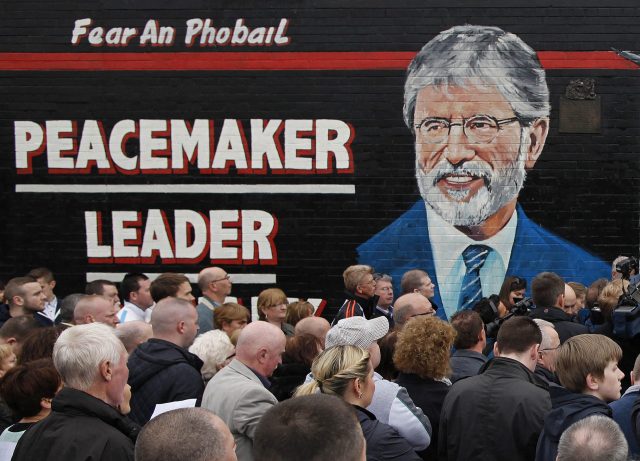
“Peacemaker”. (Credit: Peter Muhly / AFP via Getty Images)




Gerry Adams has a story and he’s sticking to it, even under close questioning. He was never a member of the IRA.
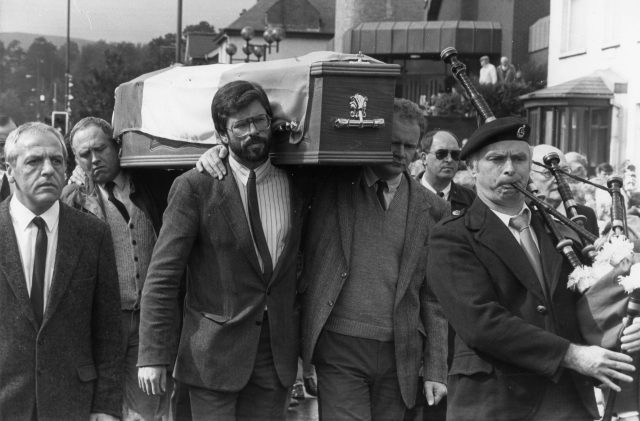
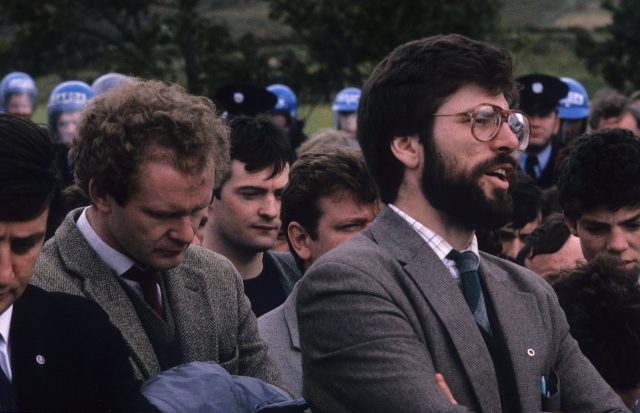
Not in 1971, when he was photographed in a black beret, marching in a guard of honour at the funeral of a Provisional IRA man. Not in 1972, when he was flown to London with Martin McGuinness and the IRA chief of staff Sean Mac Stíofáin for secret talks with the British government (Mac Stíofáin later categorised the delegation as “All IRA”). Not in 1987, when he was asked about the murder of Charles McIlmurray — a West Belfast taxi driver whose body had been found with a plastic bag over his face, his hands tied behind his back, and a gunshot wound to the head. He responded by saying on camera, almost indignantly: “Mr McIlmurray, like anyone living in West Belfast, knows that the consequence of informing is death.” Not in 1993, when he helped to carry the coffin of Thomas Begley, an IRA man who died when a bomb he was carrying prematurely exploded in a Shankill Road fish shop, killing 9 Protestants, including two children. And never in the Nineties, when both he and McGuinness were central to the drawn-out negotiations that ultimately led to the 1998 Belfast Agreement and the cessation of the IRA’s long campaign.
By his own account, Adams himself was more of a loyal, if prominent, camp follower of the IRA, a reliable defender and justifier of the “armed struggle”, although not of everything it did. His fealty, however, ran deep: as he told the 2019 Ballymurphy Inquest, “I have never disassociated myself from the IRA, and I never will, until the day I die.” And, as he also informed the court in a Dublin libel action last year, “I have never resiled from my view that the IRA’s campaign, whatever about elements of it, was a legitimate response to military occupation.”
So, if he argues that he wasn’t an IRA member, what does he want or expect the public to believe he was? An intensely supportive yet occasionally questioning political co-traveller, it seems, who never joined the organisation yet nonetheless was involved in much of its most crucial decision-making over a period of more than 30 years.
Others have a very different story to tell. They include diehard but outspoken IRA men and women; British and Irish intelligence and security services and politicians; and journalists steeped in decades of reporting on the Troubles. Over the years, Adams’s continuing assertion that he had never joined the IRA began to rankle with a lot of people, including a number who had formerly been his close associates and freely admitted their own past membership. As time wore on, some former friends in the “republican movement” felt that Adams’s denial had become more than a pragmatic strategy to avoid arrest — the IRA was, and is, a proscribed organisation — and more of a long-term psychological and moral get-out clause. Some, such as his old Long Kesh comrade Brendan “The Dark” Hughes, felt Adams was managing somehow to distance himself from the blood and misery of the IRA’s long campaign, and from any direct responsibility for the suffering of its victims. Nor did Hughes favour the Good Friday Agreement, which he felt rendered the IRA’s campaign, and its heavy toll in human suffering, meaningless by settling for less than its original aim of a united Ireland.
Hughes himself had engineered the appalling “Bloody Friday”, 21 July 1972, when more than 20 IRA bombs went off simultaneously in Belfast, killing nine and injuring over 130 others. But when interviewed in later life by the former IRA man Anthony McIntyre, Hughes said that Adams, in a strategic role, “was the man who made the decisions”. Troubled by the long shadow of the conflict, Hughes died early, at 59. Of Adams’s IRA membership, he had said frustratedly, “Everybody knows it. The British know it. The people on the street know it. The dogs on the street know it. And he’s standing there denying it.”
*****
The dogs on the proverbial Belfast street, famously alert to politics as they are, are not habitually called upon to give evidence in British courtrooms. That task is left to others. Earlier this month, in Court 16 of the Royal Courts of Justice, Gerry Adams — by now the senior statesman of republican politics — sat on a court bench for hours, then days, as he calmly listened to barristers and witnesses debating his CV. Now and then he got up to stretch his back.
The space next to him was frequently occupied by his longstanding friend Richard McAuley, who was also a fellow prisoner in Long Kesh in the Seventies. McAuley has a long history in Sinn Féin public relations. Back in 1981, in his role as Provisional Sinn Féin press officer, he helpfully explained the rules of IRA “punishment” shootings of youthful miscreants to a curious New York Times reporter. “No one is kneecapped who is below the age of 16. If he is under 16, he might get a beating.” Most people, he said, were in fact shot in the thigh and not the knee: “They’re in the hospital for a day or two and they hobble around for a week after. It’s more the scare that’s effective than the injury itself. It’s awfully frightening to sit and watch a man pointing a gun at your leg. You have to be very bad to be shot in the knee, and if you are very, very bad you are shot in the kneecaps and elbows.” The Belfast orthopaedic surgeon quoted immediately after McAuley was not so sanguine about the level of long-term damage: he said that roughly 10% of such shootings resulted in amputations, and one-in-five victims would walk with a permanent limp.
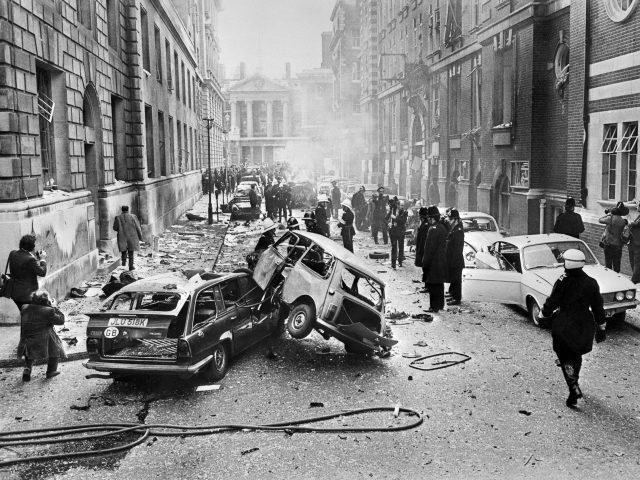
Also in the courtroom, sitting on the long bench behind Adams, was Barry Laycock, 86, one of three claimants in this crowd-funded civil action brought against the former Sinn Féin leader. Laycock, a British Rail worker at the time, was injured when the IRA’s 1996 bomb in Manchester’s Arndale shopping centre blew him across the room. He has lived with constant pain ever since, which he dulls with morphine patches. His expression was stoically impassive, but his blue eyes watched proceedings intently. His co-claimants, John Clark and Jonathan Ganesh, were victims of the 1973 Old Bailey bombing and the 1996 Docklands bombing, respectively.
The three claimants sought to establish that Adams was not only a member of the IRA, but was instrumental in directing the bombing campaigns which had caused them lasting pain and distress. They were asking for “vindicatory” damages of just £1 each, but the real point of the exercise, Laycock explained, was that “I want to see justice in the end, and I want to see closure”. The witnesses on behalf of the claimants — testifying to Adams’s pivotal role within the IRA — included a former IRA letter-bomber, a former RUC special branch intelligence officer, a BBC investigative journalist, and a retired Army commander.
Some spoke from beyond the grave. At the end of the court sitting on Monday 16 March, Gerry Adams sat listening carefully, stroking his beard with a greater frequency than usual. The rasping, confiding voice filling the courtroom was that of the late Dolours Price, a former IRA member. Along with her sister, Marian, she had gained notoriety for her active role in a series of London bombings in 1973: as two good-looking young Belfast women, they had attracted unusual levels of publicity and opprobrium when put on trial, and had been force-fed during their hunger strike in jail. In an interview with The Sunday Telegraph a year before her death at the age of 62, Price recounted how, in advance of the London campaign, Adams had attended a meeting in Leeson Street, Belfast, and warned those present: “This is a dangerous operation, but a big operation.” He had told those who did not wish to be involved that they could leave, she said. It was clear that Price still retained a certain pride in being one of the women who stayed, when so many men had left: “I said: ‘Hey, lads, don’t knock me down in the rush’. Swear to God, they ran out the door.”
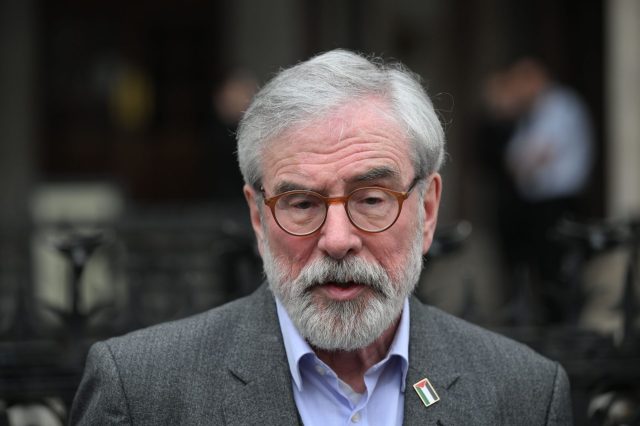
On Wednesday, an immaculately besuited Adams took to the witness stand for his second day. The previous day, March 17, had been his first experience of cross-examination in an English court: he had taken the time to wish the judge, Justice Swift, “Happy St Patrick’s Day”. Throughout the questioning from Sir Max Hill KC, acting for the claimants, the former Sinn Féin leader’s manner was measured, if occasionally prickly, and impeccably evasive. Bespectacled and silver-bearded, dutifully scouring the court papers — with a recurrent difficulty in locating relevant detail that may or may not have had an intended effect of breaking up Hill’s flow — he had the puzzled yet attentive air of a retired sea captain invited to pore over a fusty log book.
Over the decades, Adams has perfected a response when directly confronted with indignation over IRA killings. He regrets the suffering of all the victims of violence during the Troubles, he says, including those of the IRA. When particularly horrific cases of IRA murder are pointed out to him, he doesn’t hesitate to say that a particular act was “wrong”. Then he goes on to talk with practised certainty and cadence about civil rights and British occupation and armed struggle and the republican movement. He proclaimed himself “stunned” by the 1996 IRA Docklands bomb.
Alongside such lulling assurances, he doggedly continues to celebrate IRA members who committed sectarian horrors against their fellow Northern Irish men and women. On his X/Twitter account, where he now describes himself as an “Optimistic and Hopeful Activist”, Adams recently retweeted a commemoration for Brendan “Bik” McFarlane, remembered “with pride”. The president of Sinn Féin, Mary Lou McDonald, staunchly echoed the sentiment, saying of the late IRA man that he “dedicated his life to the pursuit of freedom, unity, peace and equality…it was a life well lived.” McFarlane, as the 24-year-old leader of a three-man unit of the IRA’s Belfast Brigade, was the driver for a 1975 IRA gun and bomb attack on the Bayardo Bar in the Protestant Shankill Road. In it, five people were killed, and 31 injured. One, a 17-year-old girl called Linda Boyle, was pulled out of the rubble. She took a week to die of her injuries. Her younger sister Anne, who was 15 when Linda died, said last year, “Me and Linda shared a bedroom together. I remember the exact clothes she wore that morning going to work. It never goes away.”
It is this frequent clash between an official republican narrative and victims’ reality that leads many Northern Ireland Protestants to mistrust Adams in particular and Sinn Féin in general, along with their own future position in any united Ireland where the party plays a leading role. They know that — behind Sinn Féin’s palatable talk of inclusivity — if it ever faces a choice between mythologising IRA members and acknowledging the human misery that they caused, the former will win out. This has its dark mirror in the Loyalist paramilitaries and their grotesque commemorations for the sectarian killers of Catholic civilians: these organisations, too, publicly confirm their existence by riding roughshod over the pain of the bereaved. But the political traction of Sinn Féin, and therefore its domination of the narrative across Ireland and beyond, is far greater. It is now the biggest single party in Northern Ireland, and the second largest party in the Republic of Ireland.
There was one moment, on his second day of giving evidence, when the net did seem to tighten somewhat around Adams’s IRA membership. It related to Adams’s authorship of the “Brownie” columns in the Seventies, which were written under a pseudonym from inside Long Kesh and published in Republican News. He admitted that he had written some of them, but not all. In one, entitled “Double Talk”, published in May 1976, the author said outright, “Rightly or wrongly, I am an IRA volunteer”. That particular one, Adams said, was in fact written by Richard McAuley. But the column spoke of the author’s wife and young son, said Hill, and at that point McAuley had neither — yet it accurately described Adams’s own family set-up. And the last “Brownie” article, published five days after Adams was released from Long Kesh in 1977, once again referenced his wife and child, and their reunion.
Throughout the trial, Adams had produced some form of answer, most often that anyone who said he was in the IRA had a political axe to grind. But on “Brownie”, he seemed temporarily to have run out of arguments: the column, and its contents, has dogged him for decades. Only The Irish Times, which reported the case in some detail, gave the exchange its proper weight. But then, two days later, all the carefully accumulated evidence fell away, because the case collapsed. The judge raised the issue of “abuse of process” — in which a case brought for one reason appears to be a proxy for another — and with it the prospect that the claimants might become liable for Adams’s legal fees, something they had previously been assured would not happen. Suddenly facing the possibility of terrifying personal bills, the claimants felt compelled to discontinue their case with no order as to costs. Barry Laycock, who had hoped for closure, said he was “completely devastated”.
Although the case has succeeded in airing an argument, its conclusion on Adams now remains legally undetermined. Many in the public at large, and perhaps the British establishment, are content to let it stay that way. The appetite for news on Northern Ireland and its sorrowful histories has sharply waned in England. In Ireland, in recent years, Sinn Féin has been retrospectively refashioning the chief impetus for the IRA’s campaign from an “armed struggle” for a united Ireland into one for Catholic civil rights (an argument most neatly, if fiercely, skewered by the late dissident republican Kevin Hannaway, Adams’s cousin and a former IRA man, who was quoted in 2019 saying: “If they were out for an Irish Republic, they failed. If they were out for civil rights, they got it in 1973. So what the fucking hell was the other 30 years of war for?”).
The veteran BBC journalist John Ware, explaining why he was giving evidence for the claimants, said quietly, “as journalists you have an obligation to prevent falsehoods of this magnitude from becoming settled in history… I’m interested in objective truth.” While Adams had indeed played a key role in bringing about an IRA ceasefire, he said, the “rather important missing bit” was the part he had played in the conflict.
Yet, internationally, objective truth is at present having a particularly rocky time. In the multiple fragmented perspectives thrown up by online media, there’s increasingly only “your truth” and “my truth” rather than “the truth”. For many people, facts are a shrinking source of interest: they want stories instead. It’s a cultural shift that has found its ultimate political expression in Donald Trump, and his constant generation of unreliable assertions. Adams was, in many ways, ahead of his time in realising that if you only expound a line doggedly enough, the public memory of what actually happened fades and blurs — apart from for those most directly affected — to be replaced by a narrative of choice. And Sinn Féin’s narrative, in which Provisional IRA freedom fighters reluctantly but bravely took up arms in Northern Ireland primarily to claim their civil rights from the “Orange State”, is one that strongly appeals to many younger voters — so long as the bereaved and the body parts can be successfully kept in the background. The party has been bolstering its position with a high volume of legal actions against journalists, at times raising concerns among press freedom organisations.
At one point during the case, Adams seemed to step back and take a more detached view. Watching proceedings, he said, “I listened to what I thought was old men squabbling over a war that’s over.” Somewhat disarmingly, he included himself, now 77, among that number. But the impression of spent forces is disingenuous. The IRA’s war might indeed be over, but Sinn Féin’s battle for Ireland and control of its narratives is very much alive. And the party is keeping firmly in mind a lesson drawn from Orwell’s Nineteen Eighty-Four: “Who controls the past controls the future. Who controls the present controls the past.”
Jenny McCartney is a journalist, commentator and author of the novel The Ghost Factory.
 mccartney_jenny