



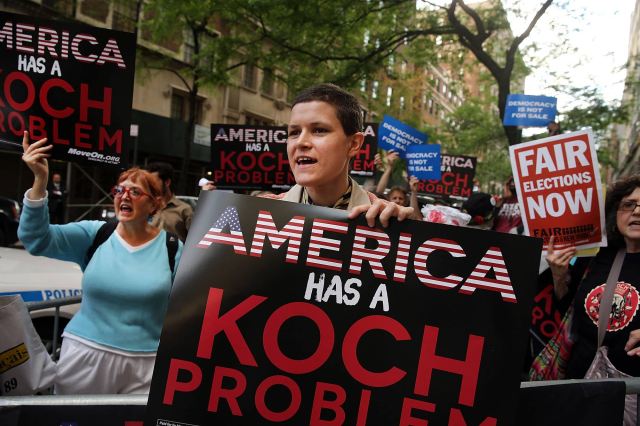
Getty Images News / Spencer Platt / Staff



“To talk about doing serious cutbacks to entitlements, that’s out of order. The first thing we have to get rid of is entitlements for the wealthy, and at the same time, open up the economy to the disadvantaged. You can’t start taking away benefits if people don’t have any opportunities.”[1. Jim Tankersley, ‘‘I don’t like the idea of capitalism’: Charles Koch, unfiltered’, The Washington Post, 1 August 2016]
These are words you might expect from Bernie Sanders, or Jeremy Corbyn. Or someone on the Left at least. You probably wouldn’t expect them to be the words of Charles Koch, one half of the infamous Koch brothers, and number eight on Forbes’ 2017 Billionaires list.
Yet Charles Koch has for decades been one of the loudest voices against crony capitalism, or what he refers to as “corporate welfare”. He sees it as “destroying opportunities for the disadvantaged and creating welfare for the rich.”[2. Stephen Dubner, ‘Why Hate the Koch Brothers? (Part I)’, Freakonomics, podcast transcript, 21 June 2017] Charles Koch vehemently believes that markets should be free – to innovate and to fail – and that government intervention in the form of subsidies, tax cuts and complex regulation are harmful. And while his anti-crony capitalism stance is staggeringly hypocritical given his lobbying spend – more on that later – it doesn’t make him wrong.
The US Government Accountability Office reported that, in 2011, corporate tax expenditures cost $181 billion in lost tax revenue.[3. CORPORATE TAX EXPENDITURES: Information on Estimated Revenue Losses and Related Federal Spending Programs, United States Government Accountability Office, 18 March 2013] Last year they reported that in each year between 2006 and 2012 “at least two-thirds of all active corporations had no federal income tax liability”.[4. Corporate Income Tax: Most Large Profitable U.S. Corporations Paid Tax but Effective Tax Rates Differed Significantly from the Statutory Rate, United States Government Accountability Office, March 2016] There’s various reasons for that, but among them they name tax deductions and incentives. The Washington Post has dubbed the annual ‘tax extenders’ bill process – which sees Congress extend expiring tax provisions – a “full-employment exercise for lobbyists”.[5. ‘Congress needs a fiscally responsible ‘tax extenders’ bill’, Editorial Board, The Washington Post, 20 January 2014]
“Corporate welfare” in America can be seen in numerous sectors – from renewable energy subsidies (maintained well beyond seed-funding) to financial services tax loopholes (“carried interest”, which enables hedge fund managers to pay less tax, is one example). Market-distorting sugar subsidies and protections have on average kept US sugar prices 64-92% above world prices and cost consumers around $3.7 billion. A paper by Harvard Business School points out that sugar production makes up just 1.9% of the value of all US crop production, yet the sugar industry accounts for more than one-third of lobbying spend by crop producers.[6. Malcolm Salter, Crony Capitalism, American Style: What Are We Talking About Here?, Harvard Business School, 22 October 2014] All of these examples benefit the producer over the consumer and the powerful over Charles Koch’s “disadvantaged”.
While Democrat and Republican politicians alike are cosying up to vested interests – remember it’s not just big business, unions spend upwards of $45 million on lobbying each year, and spent $207 million on the 2016 election campaign[7. See opensecrets.org, Center for Responsive Politics] – Charles Koch is putting his money where his mouth is. In 2014 Koch Industries wrote to Congress opposing the tax extenders bill’s reinstatement of “corporate subsidies”, saying the company “oppose[s] ALL subsidies, whether existing or proposed, including programs that benefit us”.[8. Phillip Ellender, Letter in opposition to H.R. 5771, 3 December 2013] Charles Koch has also set his mighty political machine against the proposed ‘border adjustment tax’ – which would effectively tax imports while subsidising exports. As a domestic producer, Koch told Freakanomics radio it would “make us over a billion dollars a year.”[9. Stephen Dubner, ‘Why Hate the Koch Brothers? (Part I)’, Freakonomics, podcast transcript, 21 June 2017]
But the Koch brothers don’t quite preach what they practise
Of course, lobbying on the scale of the Koch brothers is a luxury that the “disadvantaged” can’t afford – it is itself a key part of the crony capitalism the brothers say they abhor. In 2015 an investigation by Politico highlighted the sheer scale of the Koch’s shadow political operation – and it is jaw-dropping.[10. Kenneth Vogel, ‘How the Koch network rivals the GOP’, Politico, 30 December 2015] Americans for Prosperity (AFP) is their main group, but there are numerous spin-offs and associated bodies. All in all their machine was found to employ three and a half times as many people as the Republican National Committee and its congressional campaign arm. In 2014, Politico reported, AFP and its foundation had a budget of $104 million. Freedom Partners Action Fund, another part of the machine, spent $31.5 million during the 2016 election cycle.[11. See opensecrets.org, Center for Responsive Politics] In a long-read in The New Yorker Jane Mayer provides a history of Koch spending.[12. Jane Mayer, ‘Covert operations. The billionaire brothers who are waging a war against Obama’, The New Yorker, 30 August 2010] As well as highlighting the anti-environmental regulation activities of some of the Koch-funded groups, she details the brothers’ investment in think tanks and universities who share their ideological perspective.
It is this alignment of ideology and self-interest that in 2004 led the National Committee for Responsive Philanthropy to claim:
“these foundations give money to nonprofit organizations that do research and advocacy on issues that impact the profit margin of Koch Industries. For example, the foundations supported the Cato Institute, Citizens for a Sound Economy, the Competitive Enterprise Institute and the Foundation for Research on Economics and the Environment. Each of these organisations—in its own way—works to limit or remove government regulation and taxation of the industrial sector.”[13. Jeff Krehely, Meaghan House and Emily Kernan, Axis of ideology. Conservative Foundations and Public Policy, National Committee for Responsive Philanthropy, 2004]
Action against crony capitalism must apply to all
No doubt such extensive involvement with non-profits and third-party interest groups should concern any defender of open democracy. But there is equally no doubt that the Kochs are as much pariahs for their dislike of big government and taxes as their well-funded political activities.
Mayer mentions in passing that “Of course, Democrats give money too” and cites the $100 million a year spend of George Soros’ Open Society Institute. That, she implies, is OK – because his “spokesman” explains the expenditure is not self-interested. ‘Liberal’ spend is afforded 400 words in an almost 10,000-word critique of the Koch’s “ideological network”. Just last week, The Center for Responsive Politics detailed the role of “dark money” in the 2016 election for Colorado state’s House of Representatives.[14. Sara Swann, ‘Dark money trail reveals significant influence in Colorado elections’, Open Secrets blog, Center for Responsive Politics, 27 July 2027] Eighteen Democratic candidates received money from the third-party group Common Sense Values. Started just ahead of the elections and closed just after, the Center points out it raised $2.5 million in five months. Following the money trail reveals a murky web of donors – though left-leaning unions and social welfare organisations rather than big business. Hilary Clinton’s 2016 Presidential campaign coffers were boosted by almost $85 million from the Securities and Investment industry – essentially Wall Street – and $19 million from non-profits.[15. Top Industries, federal election data for Hillary Clinton, 2016 cycle, opensecrets.org, Center for Responsive Politics, accessed 1 August 2017] The TV, Music and Movies industry donated more than $16 million to Clinton groups.
Such vast expenditure and reach, aimed at influencing politicians and the policy and regulatory decisions they make, is unquestionable crony capitalism. It doesn’t matter which side of the partisan divide it comes from. This is the real threat to prosperity for all. As John Kerry said in his farewell speech to the Senate:
“The alliance of money and the interests it represents…is steadily silencing the voice of the vast majority of Americans who have a much harder time competing, or who can’t compete at all.”[16. Text of John Kerry’s farewell speech, Boston.com, 30 January 2013]
The time and energy spent on hating the Koch brothers and their Libertarian politics would be better spent on breaking the stranglehold of big business and big unions; on taking the Kochs at their word and destroying “corporate welfare”. Now that really would be a win for the “disadvantaged”.
***
FURTHER READING AND LISTENING
Stephen Dubner, ‘Why Hate the Koch Brothers? (Part 1)’, Freakonomics, podcast, 21 June 2017
Stephen Dubner, ‘Why hate the Koch Brothers (Part 2)’, Freakonomics, podcast, 22 June 2017
Charles Koch Opens Up About Politics, Business Innovation and Climate Change, Fortune interview, 11 July 2016
Jane Mayer, ‘Covert operations. The billionaire brothers who are waging a war against Obama’, The New Yorker, 30 August 2010
Kenneth Vogel, ‘How the Koch network rivals the GOP’, Politico, 30 December 2015
Join the discussion
Join like minded readers that support our journalism by becoming a paid subscriber
To join the discussion in the comments, become a paid subscriber.
Join like minded readers that support our journalism, read unlimited articles and enjoy other subscriber-only benefits.
Subscribe