




X Close

Trump campaign attacks neocons in final days of race

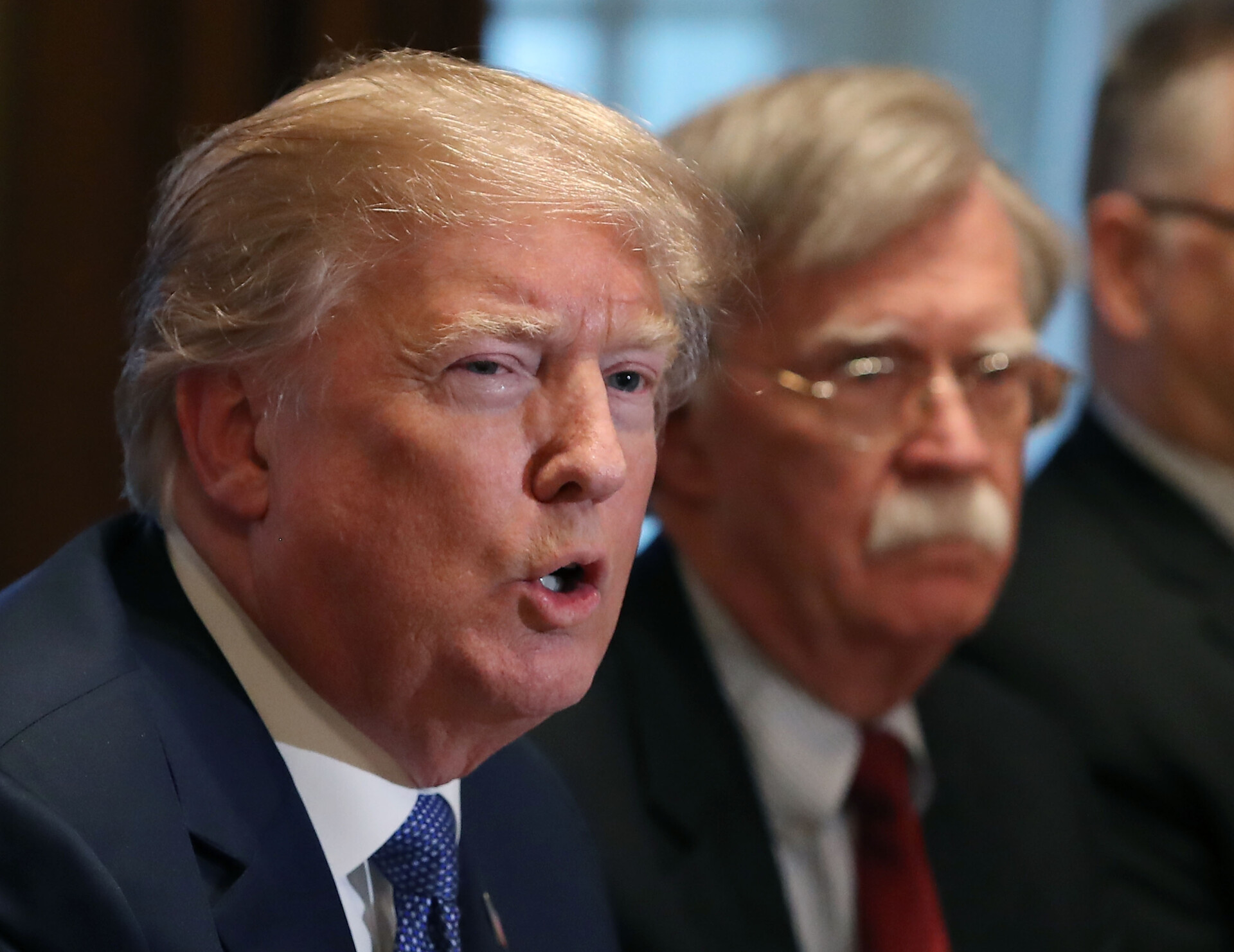
The former president is mocking John Bolton and the Cheneys. Credit: Getty

The former president is mocking John Bolton and the Cheneys. Credit: Getty

November 2 2024 - 5:00pm

In the final days of the presidential election, Donald Trump and his running mate are launching public attacks on the foreign policy hawks who have opposed his candidacy.

At a Thursday campaign event, the former president called former Congresswoman Liz Cheney a “radical war hawk” and suggested that, as a supporter of foreign wars, she should serve in one. “Let’s see how she feels about it when the guns are trained on her face,” he said. “You know, they’re all war hawks when they’re sitting in Washington in a nice building saying, ‘Oh, gee, let’s send 10,000 troops right into the mouth of the enemy.”

In response, Cheney characterised the comments as a death threat, writing, “This is how dictators destroy free nations.” Cheney, a former Republican, has been a fixture in Kamala Harris’ campaign.

Trump also mentioned Cheney’s father, former Vice President Dick Cheney, who recently endorsed Kamala Harris alongside his daughter. “I don’t blame him for sticking with his daughter, but his daughter is a very dumb individual,” Trump said.

Some of Trump’s most prominent allies-turned-enemies have been Republicans, and former Republicans, who oppose his foreign policy. As a candidate in 2016, Trump became one of the first national Republicans to express that the Iraq war was a mistake, and he frequently touts the fact that there were no new wars involving the US started while he was in office. Since Trump left office, the GOP has been divided over US support for the war in Ukraine and, to a lesser extent, the war in Gaza.

At the same Thursday event, Trump mocked John Bolton, the former national security advisor who has become a vocal critic of the former president. “If somebody shot down a little, tiny, crappy drone that cost about $15, he’d want to go to war with Russia,” Trump said. “He was great for me though for a period… I took this moron with me and he never said anything, but when Kim Jong Un saw him, he said, ‘Oh shit, I think the guy wants to go to war.'”

Trump’s vice presidential pick has been making similar arguments, and addressing the pushback from the more hawkish representatives of the pre-2016 GOP. In an interview with Joe Rogan published the same day, JD Vance argued that there are three issues on which one is “not allowed to question the establishment”.  These include free trade, immigration, and foreign policy, the latter of which is driven both by politicians’ financial interests and by an enduring belief in “the post World War II American consensus” that the US can “remake the entire world in America’s image”.

Vance, too, criticised the Cheney family for their support for various wars. He suggested Liz Cheney was supporting the war in Ukraine in anticipation of a lucrative job on the board of a defense contractor, and brought up her father’s widely scrutinised relationship with Halliburton, a defense contractor that received federal funding during the Iraq war while Cheney was receiving deferred compensation from the company. “I think they’re much better at rationalising their financial motivation as somehow good,” Vance said.

In Trump’s own camp, there’s been a push for more hawkish foreign policy. He has stated on the campaign trail that his policy is “peace through strength”. He told conservative commentator Ben Shapiro last month that he’s “not an isolationist”, adding, “I helped a lot of countries. I kept countries out of war.” Weeks later, Shapiro claimed that he had privileged knowledge of Trump’s plans for the coming administration, and that Trump would likely bring Mike Pompeo or David Friedman onto his team.

But the distance between Trump and the hawks is apparent, and growing. Nikki Haley, a vocal supporter of US involvement in Israel and Ukraine, has been largely absent from the Trump campaign, and took to television last week to criticize Trump on unrelated issues, saying the campaign’s appeals to young men were “going to make women uncomfortable”.

While the foreign policy realignment has splintered the Republican Party and pushed prominent hawks toward the Democrats, it’s also won over a new type of GOP voter who’s skeptical of foreign entanglements, who helped Trump win midwestern swing states in 2016. With polls showing a tie between Harris and Trump in the final days of the race, the former President’s attacks on the hawkish former establishment may be an appeal to those very same pivotal voters.

is UnHerd’s US correspondent.

laureldugg

China is threatening America in the AI race

Reports sugget Zhipu AI  has released a new model that can rival leading US systems. Credit: Getty

Reports sugget Zhipu AI has released a new model that can rival leading US systems. Credit: Getty

July 1 2026 - 10:18am

China is trying to catch up with America on artificial intelligence. The Wall Street Journal has reported that Zhipu AI — one of China’s six “AI tiger” LLMs — has released a new model that can rival leading US systems, including Anthropic’s Mythos, in cybersecurity tasks such as pinpointing security bugs. While this marks a milestone in China’s drive to catch up with Western AI capabilities, strong performance on a single benchmark does not mean it has taken the lead. Chinese models still lag behind their Western counterparts in broader capabilities, such as autonomous operation. Skepticism is therefore warranted before resorting to hysterical conclusions, but complacency about the geopolitical implications of China’s AI advances would be an even greater mistake.

On the infrastructure side, Chinese AI is still constrained by access to advanced chips, with American labs way ahead in computing capacity as well as investment. Analysis from earlier this year suggests that Chinese models are likely to be at least a few months behind those in the US. But they are still continuing to make progress, or that the geopolitical importance of AI will be decided only by whose LLM has ventured deeper into the technological frontier. The practical applications of AI, countries’ to capture foreign markets, and the application of AI into the real economy will matter just as much.

Here, China may hold an advantage. As with its dominance across many critical supply chains, Beijing may not need to produce the most advanced AI systems — only those that are affordable and widely deployable. In doing so, it could consolidate global influence by supplying functional, low-cost AI at scale.

Beijing seems to be pursuing exactly that path, developing an AI “open-source” strategy that offers affordable, widely available AI models for companies and individuals to use and modify as they wish. The production of the DeepSeek AI model, which matched the performance of Silicon Valley tools such as ChatGPT at a fraction of the cost for users, created goodwill among Chinese models with developers.

The four most popular models on OpenRouter, an AI hardware platform for developers, are now all Chinese. The goal for China is not only to win the frontier-model race, but to make its systems the default layer of AI adoption across industries and global markets. For most economies, the choice is increasingly between an affordable tool they can deploy now and a more robust one that may be out of reach.

And while the countries adopting Chinese models may be exposed to political pressure and cyber threats from Beijing, safer and more capable alternatives matter little if they are unaffordable. American AI companies are already under pressure to monetize products whose operating costs are rising. If Chinese open-source models become the cheap default for startups, universities, governments and businesses across the developing world, then America’s AI lead will be eroded from below.

Perhaps more concerning for America in the long run is how AI can give Chinese manufacturing even more strength, through the ongoing integration of AI as a general-purpose technology. China’s new Five-Year Plan mentioned AI more than 50 times and includes an “AI+” action plan aimed at spreading AI across the economy.

Beijing has been pioneering automation of its critical infrastructure for years, with promising recent results in increasing warplane production capacity. In that regard, China’s open-model strategy and manufacturing dominance will reinforce each other. Cheap, adaptable models accelerate deployment across the real economy while those deployments generate real-world data and use cases that can feed back into further model improvement.

The United States should not dismiss the importance of its lead in the AI race. That lead worries Beijing, not least because a more automated Chinese economy would also become more vulnerable to AI-generated cyber threats. But nor should Washington assume that China cannot catch up with American capabilities over time.

This AI competition represents part of a broader struggle over tech supply chains and geopolitical influence. Decisions over whether to adopt US or Chinese models could produce a more fragmented global reality, with different regions relying on different cloud providers, chips and security structures. The result will likely be a global economy which is divided into competing spheres, rather than one which produces a single winner.


Miquel Vila is a political and geopolitical risk consultant focusing on industrial strategy, critical infrastructure and global supply chains.

miquelvilam