




X Close

RFK Jr’s appointment is a victory for Trump’s ‘brokenists’

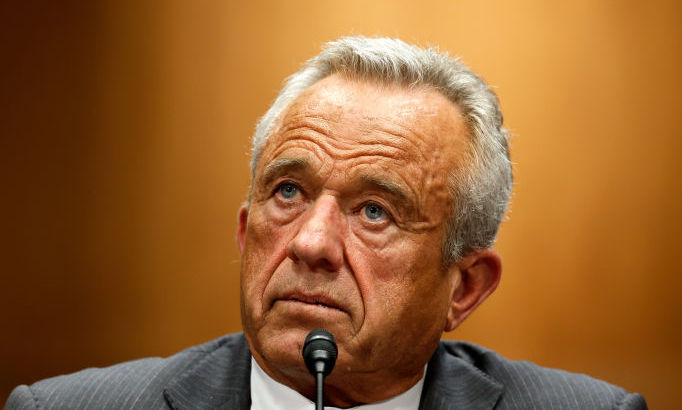
America, meet your new health secretary. Credit: Getty

America, meet your new health secretary. Credit: Getty

February 13 2025 - 6:10pm

With the confirmation of Robert F. Kennedy Jr. as Secretary of Health and Human Services, Donald Trump has added a key player to his team of brokenists.

The historian Doris Kearns Goodwin popularized the concept of Abraham Lincoln’s Cabinet as a “team of rivals,” but Trump has instead assembled a coalition of brokenists. In a viral 2022 essay, Alana Newhouse divided American politics into “status quoists,” who believe that most American institutions are essentially functional, and “brokenists,” who hold that “our current institutions, elites, intellectual and cultural life, and the quality of services that many of us depend on have been hollowed out.” More than any ideology, this sense of radical critique brings together a team as disparate as Elon Musk, Tulsi Gabbard, and Pete Hegseth.

Descended from one of the most storied families in American politics, RFK has become one of the leading avatars of brokenism. His environmental activism has grown into a full-spectrum suspicion of the American healthcare and food-production sectors. He has tilted against the “military industrial complex” as well as corporate America, and he has mused that the CIA was somehow involved in the assassinations of his uncle and father. In his aborted independent run for the presidency, Kennedy wrapped himself in these outsider themes.

Kennedy’s endorsement of Trump in August 2024 set the stage for a grand brokenist alliance and gave him considerable leverage in the new administration. Pushing Republican senators to confirm Kennedy, JD Vance said that RFK represented an important part of “the new coalition of our party.” In the Republican Party of the past, Kennedy’s former positions on abortion and gun control, among other issues, might have been disqualifying, but his stinging indictments of the American establishment have made him an important factional lieutenant for the GOP of the Trump era.

Trump knows how much he can lean on party loyalty as president, which makes RFK’s confirmation less surprising. The last Cabinet nominee to be defeated in a Senate vote while the president’s party held the Senate was a century ago, when Calvin Coolidge’s attorney general nominee was voted down. Some nominees have been withdrawn, but — given RFK’s role in the 2024 election — Trump had considerable incentive to stand with his nomination throughout.

RFK mustered the support of even Republican senators who were viewed as possible tossups, including Maine’s Susan Collins and Alaska’s Lisa Murkowski. The only Republican to vote against RFK was Mitch McConnell, the former Republican leader who has mounted a (sometimes lonely) campaign of resistance against Trump’s more-outsider nominees.

In announcing their support for Kennedy, many senators said that they hoped he could help drive down medical costs and speed up innovation in that sector. Many of these senators have also agreed with RFK that there needs to be a new approach to nutrition in order to combat obesity and chronic illness. In an op-ed endorsing RFK, Kansas senator Roger Marshall (a physician himself) praised the nominee for wanting to ensure that “all Americans have access to nutrient-dense whole foods, safe medicines and effective primary care along with addressing the soaring mental health crisis that our youth and young adults face.”

The healthy living parts of the MAHA agenda could garner congressional and public support. But Republican senators also drew a red line: vaccines. In that same op-ed, Marshall claimed that Kennedy “will not change vaccine policy.” Lisa Murkowski and Louisiana’s Bill Cassidy (another doctor) made their support for RFK conditional on him not going to war against vaccines. An HHS-led campaign against vaccines could alienate another important part of the Republican coalition: the normie working families who signed onto the disruptor agenda in the first place out of frustration with the failures of the old institutional elite.

Kennedy’s appointment thus reveals the bigger challenge facing the brokenist coalition. Americans have turned to this disruptor alliance in hopes of a remedy to elite-led chaos. To avoid a similar political rebuke, brokenists will have to show that they can repair, not just destroy.

Fred Bauer is a writer from New England.

fredbauerblog

China is threatening America in the AI race

Reports sugget Zhipu AI  has released a new model that can rival leading US systems. Credit: Getty

Reports sugget Zhipu AI has released a new model that can rival leading US systems. Credit: Getty

July 1 2026 - 10:18am

China is trying to catch up with America on artificial intelligence. The Wall Street Journal has reported that Zhipu AI — one of China’s six “AI tiger” LLMs — has released a new model that can rival leading US systems, including Anthropic’s Mythos, in cybersecurity tasks such as pinpointing security bugs. While this marks a milestone in China’s drive to catch up with Western AI capabilities, strong performance on a single benchmark does not mean it has taken the lead. Chinese models still lag behind their Western counterparts in broader capabilities, such as autonomous operation. Skepticism is therefore warranted before resorting to hysterical conclusions, but complacency about the geopolitical implications of China’s AI advances would be an even greater mistake.

On the infrastructure side, Chinese AI is still constrained by access to advanced chips, with American labs way ahead in computing capacity as well as investment. Analysis from earlier this year suggests that Chinese models are likely to be at least a few months behind those in the US. But they are still continuing to make progress, or that the geopolitical importance of AI will be decided only by whose LLM has ventured deeper into the technological frontier. The practical applications of AI, countries’ to capture foreign markets, and the application of AI into the real economy will matter just as much.

Here, China may hold an advantage. As with its dominance across many critical supply chains, Beijing may not need to produce the most advanced AI systems — only those that are affordable and widely deployable. In doing so, it could consolidate global influence by supplying functional, low-cost AI at scale.

Beijing seems to be pursuing exactly that path, developing an AI “open-source” strategy that offers affordable, widely available AI models for companies and individuals to use and modify as they wish. The production of the DeepSeek AI model, which matched the performance of Silicon Valley tools such as ChatGPT at a fraction of the cost for users, created goodwill among Chinese models with developers.

The four most popular models on OpenRouter, an AI hardware platform for developers, are now all Chinese. The goal for China is not only to win the frontier-model race, but to make its systems the default layer of AI adoption across industries and global markets. For most economies, the choice is increasingly between an affordable tool they can deploy now and a more robust one that may be out of reach.

And while the countries adopting Chinese models may be exposed to political pressure and cyber threats from Beijing, safer and more capable alternatives matter little if they are unaffordable. American AI companies are already under pressure to monetize products whose operating costs are rising. If Chinese open-source models become the cheap default for startups, universities, governments and businesses across the developing world, then America’s AI lead will be eroded from below.

Perhaps more concerning for America in the long run is how AI can give Chinese manufacturing even more strength, through the ongoing integration of AI as a general-purpose technology. China’s new Five-Year Plan mentioned AI more than 50 times and includes an “AI+” action plan aimed at spreading AI across the economy.

Beijing has been pioneering automation of its critical infrastructure for years, with promising recent results in increasing warplane production capacity. In that regard, China’s open-model strategy and manufacturing dominance will reinforce each other. Cheap, adaptable models accelerate deployment across the real economy while those deployments generate real-world data and use cases that can feed back into further model improvement.

The United States should not dismiss the importance of its lead in the AI race. That lead worries Beijing, not least because a more automated Chinese economy would also become more vulnerable to AI-generated cyber threats. But nor should Washington assume that China cannot catch up with American capabilities over time.

This AI competition represents part of a broader struggle over tech supply chains and geopolitical influence. Decisions over whether to adopt US or Chinese models could produce a more fragmented global reality, with different regions relying on different cloud providers, chips and security structures. The result will likely be a global economy which is divided into competing spheres, rather than one which produces a single winner.


Miquel Vila is a political and geopolitical risk consultant focusing on industrial strategy, critical infrastructure and global supply chains.

miquelvilam