




X Close

Merz’s Washington visit cools EU-US tensions

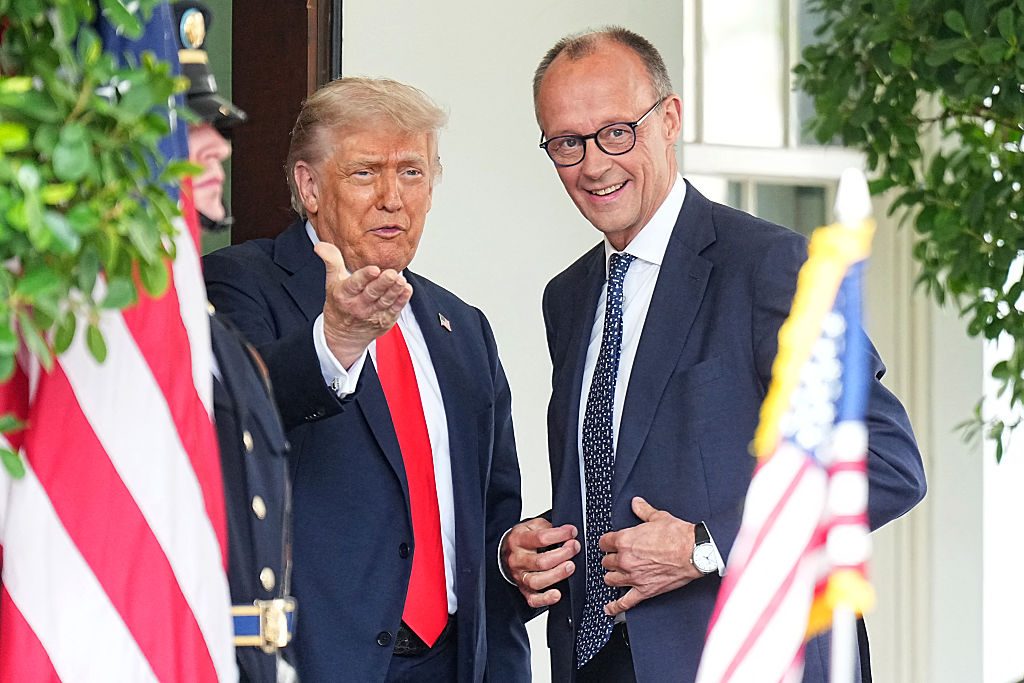
The two men showed fondness for each other. Credit: Getty

The two men showed fondness for each other. Credit: Getty

June 6 2025 - 11:50am

Looking like he was sitting on a kid’s chair, the tall and lanky Friedrich Merz started his inaugural meeting in the White House as German chancellor by presenting Donald Trump with the birth certificate of the US President’s grandfather.

The document was from 1869 from a small town in what’s now southwest Germany and was accompanied by a copy translated into English and written in the same style of calligraphy. It was placed appropriately in a golden frame, fitting the taste of its recipient.

The first name of Trump’s grandfather was “Friedrich,” Merz emphasized with a grin. The message was clear: the connection between the president and Germany is long and deep. “The U.S. and Germany share the same DNA,” Merz posted on X. “We are partners. We are friends. We are literally family.” Trump was gracious and noted it was “a serious German name” and heartily shook Merz’s hand.

According to the standards of international diplomacy, it was a well-executed maneuver. While cringey at times, it broke the ice and defused what could have otherwise been a testy exchange, given the tensions between Germany and the US and Trump’s running feud with Elon Musk. Back in February, Merz admitted that Germany’s defense must be independent of the US security umbrella after Trump’s calls for European nations to pay their way.

Merz heeded advice from other international leaders and let Trump do most of the talking, and he did ramble on for most of the 40 minutes that the press were allowed into the meeting, boasting about his successes and blaming his predecessor Joe Biden for setbacks (and repeatedly pointing to what Trump perceives as scandalous use of an automated signing tool).

But Merz did pick his moments, mainly pushing Trump on support for Ukraine. The German chancellor claimed that in contrast to the Kremlin, Kyiv was only hitting military targets, while Russia was kidnapping children.

He appealed to Trump’s ego by pointing to the 6 June anniversary of D-Day, which paved the way for the fall of the Nazis, and saying that Trump and America were again in a position to achieve something historic by ending another war in Europe.

In Germany, the visit was covered feverishly and closely with live blogs, streaming and commentary. The verdict was a collective sigh of relief. And Merz and his team will walk away with a sense of achievement.

Trump praised Merz on a number of occasions, calling him “a very good man to deal with” but also “difficult”. In the President’s vernacular of gamesmanship, that’s positive. He appreciated Germany’s more aggressive stance on defense spending and indicated that the two were on the same side on migration and the controversial Nord Stream 2 gas pipeline from Russia to Germany, taking a swipe at former Chancellor Angela Merkel (a nemesis for both men). Trump even claimed that while he wasn’t really close to Vladimir Putin, he and Merz were “friends”.

Importantly, the touchy topic of the far-right Alternative für Deutschland was avoided, despite concerns by Merz’s teams in the run-up. The recent move by Germany’s domestic intelligence service to classify the largest opposition party as a right-wing extremist group was called “tyranny in disguise” by Secretary of State Marco Rubio, who sat on the couch next to Trump alongside Vice President JD Vance, who previously accused Germany of repressing free speech through its treatment of the AfD. Both were quiet during the meeting, unlike in some past Oval Office showdowns.

In the end, Merz is not leaving Washington with anything to offer the German people. But given President Trump’s volatility, Merz won by not losing. While he has a lot of work to do to re-establish German industry as a global player and calm domestic tensions, he has managed to calm relations with Washington and keep his name intact.

Chris Reiter and Will Wilkes are the authors of Broken Republik: The Inside Story of Germany’s Descent into Crisis, out now with Bloomsbury.


China is threatening America in the AI race

Reports sugget Zhipu AI  has released a new model that can rival leading US systems. Credit: Getty

Reports sugget Zhipu AI has released a new model that can rival leading US systems. Credit: Getty

July 1 2026 - 10:18am

China is trying to catch up with America on artificial intelligence. The Wall Street Journal has reported that Zhipu AI — one of China’s six “AI tiger” LLMs — has released a new model that can rival leading US systems, including Anthropic’s Mythos, in cybersecurity tasks such as pinpointing security bugs. While this marks a milestone in China’s drive to catch up with Western AI capabilities, strong performance on a single benchmark does not mean it has taken the lead. Chinese models still lag behind their Western counterparts in broader capabilities, such as autonomous operation. Skepticism is therefore warranted before resorting to hysterical conclusions, but complacency about the geopolitical implications of China’s AI advances would be an even greater mistake.

On the infrastructure side, Chinese AI is still constrained by access to advanced chips, with American labs way ahead in computing capacity as well as investment. Analysis from earlier this year suggests that Chinese models are likely to be at least a few months behind those in the US. But they are still continuing to make progress, or that the geopolitical importance of AI will be decided only by whose LLM has ventured deeper into the technological frontier. The practical applications of AI, countries’ to capture foreign markets, and the application of AI into the real economy will matter just as much.

Here, China may hold an advantage. As with its dominance across many critical supply chains, Beijing may not need to produce the most advanced AI systems — only those that are affordable and widely deployable. In doing so, it could consolidate global influence by supplying functional, low-cost AI at scale.

Beijing seems to be pursuing exactly that path, developing an AI “open-source” strategy that offers affordable, widely available AI models for companies and individuals to use and modify as they wish. The production of the DeepSeek AI model, which matched the performance of Silicon Valley tools such as ChatGPT at a fraction of the cost for users, created goodwill among Chinese models with developers.

The four most popular models on OpenRouter, an AI hardware platform for developers, are now all Chinese. The goal for China is not only to win the frontier-model race, but to make its systems the default layer of AI adoption across industries and global markets. For most economies, the choice is increasingly between an affordable tool they can deploy now and a more robust one that may be out of reach.

And while the countries adopting Chinese models may be exposed to political pressure and cyber threats from Beijing, safer and more capable alternatives matter little if they are unaffordable. American AI companies are already under pressure to monetize products whose operating costs are rising. If Chinese open-source models become the cheap default for startups, universities, governments and businesses across the developing world, then America’s AI lead will be eroded from below.

Perhaps more concerning for America in the long run is how AI can give Chinese manufacturing even more strength, through the ongoing integration of AI as a general-purpose technology. China’s new Five-Year Plan mentioned AI more than 50 times and includes an “AI+” action plan aimed at spreading AI across the economy.

Beijing has been pioneering automation of its critical infrastructure for years, with promising recent results in increasing warplane production capacity. In that regard, China’s open-model strategy and manufacturing dominance will reinforce each other. Cheap, adaptable models accelerate deployment across the real economy while those deployments generate real-world data and use cases that can feed back into further model improvement.

The United States should not dismiss the importance of its lead in the AI race. That lead worries Beijing, not least because a more automated Chinese economy would also become more vulnerable to AI-generated cyber threats. But nor should Washington assume that China cannot catch up with American capabilities over time.

This AI competition represents part of a broader struggle over tech supply chains and geopolitical influence. Decisions over whether to adopt US or Chinese models could produce a more fragmented global reality, with different regions relying on different cloud providers, chips and security structures. The result will likely be a global economy which is divided into competing spheres, rather than one which produces a single winner.


Miquel Vila is a political and geopolitical risk consultant focusing on industrial strategy, critical infrastructure and global supply chains.

miquelvilam