




X Close

Liver King’s arrest: a window into the strange alt-health world

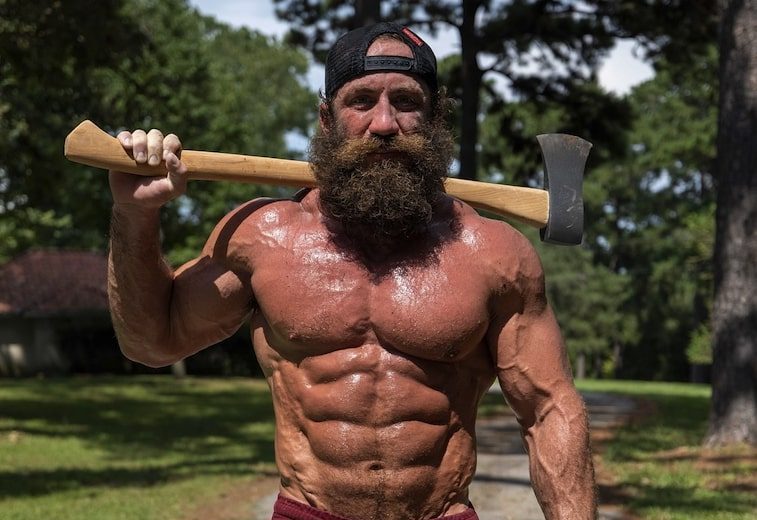
Brian Johnson admitted his physique had been achieved by using steroids. Credit: Getty

Brian Johnson admitted his physique had been achieved by using steroids. Credit: Getty

June 28 2025 - 4:15pm

To anyone who thought that raw liver and goat testes could be reliable substitutes for anabolic steroids, these have been disappointing years. From 2022, influencer Brian Johnson, known as the Liver King, built a three million-strong Instagram following on the back of a gospel of eating organ meat, sunbathing, and hardcore calisthenics. But the truth of the balloon muscles he sold to others as his “Nine Ancestral Tenets” bodybuilding plan rested on the unspoken tenth tenet: “inject testosterone intra-muscularly”.

It took a keen analyst of steroid use — Derek Munro, who runs a YouTube channel called More Plates More Dates — to finally knock the Liver King out of the ring, by forensically running through the many signs in his physique that pointed to its chemical composition. Most notable was his “Palumboism” — the characteristic distended abdomen that comes with chronic use of human growth hormone. Famously, Joe Rogan then invited Munro on his interview show, and the pair of them chuckled as they live-reviewed Johnson’s hammy, disingenuous apology video.

Now, the Liver King is back. Or, at least, he would like to be. In a series of deranged Instagram posts, Johnson has turned up in Austin, Texas, where Rogan now lives, and offered to fight him. “I have no training in jiu-jitsu; you’re a black belt, you should dismantle me. But I’m picking a fight with you. Your rules, I’ll come to you, whenever you’re ready,” he said in a video. This climaxed with Johnson’s wife capturing on camera the moment of his arrest by Austin police, on charges of “making terroristic threats”. He then released a video of himself crawling on all fours with a visible ankle tag.

The King is not in a good way. Still only in his mid-40s, in the new videos his skin is vellum, his pupils are different sizes, and his mouth bears a blue tincture which could be a result of methylene blue use. Methylene blue is a voguish “nootropic”, promoted by alt-health influencers such as Ray Peat, which at high doses acts as a monoamine oxidase inhibitor, potentially disrupting vital brain chemistry.

Why pick on Rogan? After all, the podcast king and the Liver King have never met. And Rogan was certainly not the only one laughing at him in 2022. The enmity is entirely one-sided, and the Liver King has now taken as real what was always just kayfabe for the crowds. He exists in a WWE world of call-outs and smack downs. He has minced his brain through prodigious use of the juice, certainly, but also by staring into the abyss of social media for too long. In his cosmology, he and Rogan are in some way bound together in a great online circus. Rogan, sitting at the apex of that manosphere world, becomes the natural adversary.

It’s perhaps a fitting epilogue. The Liver King was the most totemic and ruthless of a generation of post-Covid health influencers,  from Sol Brah — salesman of filtering your shower water — to Mikhaila Peterson’s meat-only “Lion Diet”.

From the start, the Liver King set about enacting his path to fame with an eye on the clock. A former businessman, he built an entire video team to grow his brand, methodically setting follower targets by the quarter. One of his videographers lived at his house. A live-in social media and marketing team is, naturally, what our ancestors would have been used to.

But at some point he seems to have forgotten that it was all built on a central lie. He maintained that his physique was all natural. His Method-level belief in the character lost sight of the fact that it was only ever a character. Rogan — MMA enthusiast, comedian, podcaster — is in a sense a character, or a composite of many characters. To play the online fame game, these people give society what it cheers for — but somewhere they must also know it isn’t real. This has always been true of fame.

And so the Liver King seems to have forgotten that, as with a WWE Raw pantomime, that character would have its turn on the dunking stool. His fall was the equal of his rise. The Rogan “beef” appears to be the last stand of a drama channel that now has only drama to sell. The deeper sadness is that the drama is one-sided; its only conflict is internal. it is the drama of cataloging your own psychological breakdown, even as your Instagram followers tick ever upwards.

Gavin Haynes is a journalist and former editor-at-large at Vice.

@gavhaynes

China is threatening America in the AI race

Reports sugget Zhipu AI  has released a new model that can rival leading US systems. Credit: Getty

Reports sugget Zhipu AI has released a new model that can rival leading US systems. Credit: Getty

July 1 2026 - 10:18am

China is trying to catch up with America on artificial intelligence. The Wall Street Journal has reported that Zhipu AI — one of China’s six “AI tiger” LLMs — has released a new model that can rival leading US systems, including Anthropic’s Mythos, in cybersecurity tasks such as pinpointing security bugs. While this marks a milestone in China’s drive to catch up with Western AI capabilities, strong performance on a single benchmark does not mean it has taken the lead. Chinese models still lag behind their Western counterparts in broader capabilities, such as autonomous operation. Skepticism is therefore warranted before resorting to hysterical conclusions, but complacency about the geopolitical implications of China’s AI advances would be an even greater mistake.

On the infrastructure side, Chinese AI is still constrained by access to advanced chips, with American labs way ahead in computing capacity as well as investment. Analysis from earlier this year suggests that Chinese models are likely to be at least a few months behind those in the US. But they are still continuing to make progress, or that the geopolitical importance of AI will be decided only by whose LLM has ventured deeper into the technological frontier. The practical applications of AI, countries’ to capture foreign markets, and the application of AI into the real economy will matter just as much.

Here, China may hold an advantage. As with its dominance across many critical supply chains, Beijing may not need to produce the most advanced AI systems — only those that are affordable and widely deployable. In doing so, it could consolidate global influence by supplying functional, low-cost AI at scale.

Beijing seems to be pursuing exactly that path, developing an AI “open-source” strategy that offers affordable, widely available AI models for companies and individuals to use and modify as they wish. The production of the DeepSeek AI model, which matched the performance of Silicon Valley tools such as ChatGPT at a fraction of the cost for users, created goodwill among Chinese models with developers.

The four most popular models on OpenRouter, an AI hardware platform for developers, are now all Chinese. The goal for China is not only to win the frontier-model race, but to make its systems the default layer of AI adoption across industries and global markets. For most economies, the choice is increasingly between an affordable tool they can deploy now and a more robust one that may be out of reach.

And while the countries adopting Chinese models may be exposed to political pressure and cyber threats from Beijing, safer and more capable alternatives matter little if they are unaffordable. American AI companies are already under pressure to monetize products whose operating costs are rising. If Chinese open-source models become the cheap default for startups, universities, governments and businesses across the developing world, then America’s AI lead will be eroded from below.

Perhaps more concerning for America in the long run is how AI can give Chinese manufacturing even more strength, through the ongoing integration of AI as a general-purpose technology. China’s new Five-Year Plan mentioned AI more than 50 times and includes an “AI+” action plan aimed at spreading AI across the economy.

Beijing has been pioneering automation of its critical infrastructure for years, with promising recent results in increasing warplane production capacity. In that regard, China’s open-model strategy and manufacturing dominance will reinforce each other. Cheap, adaptable models accelerate deployment across the real economy while those deployments generate real-world data and use cases that can feed back into further model improvement.

The United States should not dismiss the importance of its lead in the AI race. That lead worries Beijing, not least because a more automated Chinese economy would also become more vulnerable to AI-generated cyber threats. But nor should Washington assume that China cannot catch up with American capabilities over time.

This AI competition represents part of a broader struggle over tech supply chains and geopolitical influence. Decisions over whether to adopt US or Chinese models could produce a more fragmented global reality, with different regions relying on different cloud providers, chips and security structures. The result will likely be a global economy which is divided into competing spheres, rather than one which produces a single winner.


Miquel Vila is a political and geopolitical risk consultant focusing on industrial strategy, critical infrastructure and global supply chains.

miquelvilam