




X Close

Guardian fails to label Hamas chief terrorist in obituary

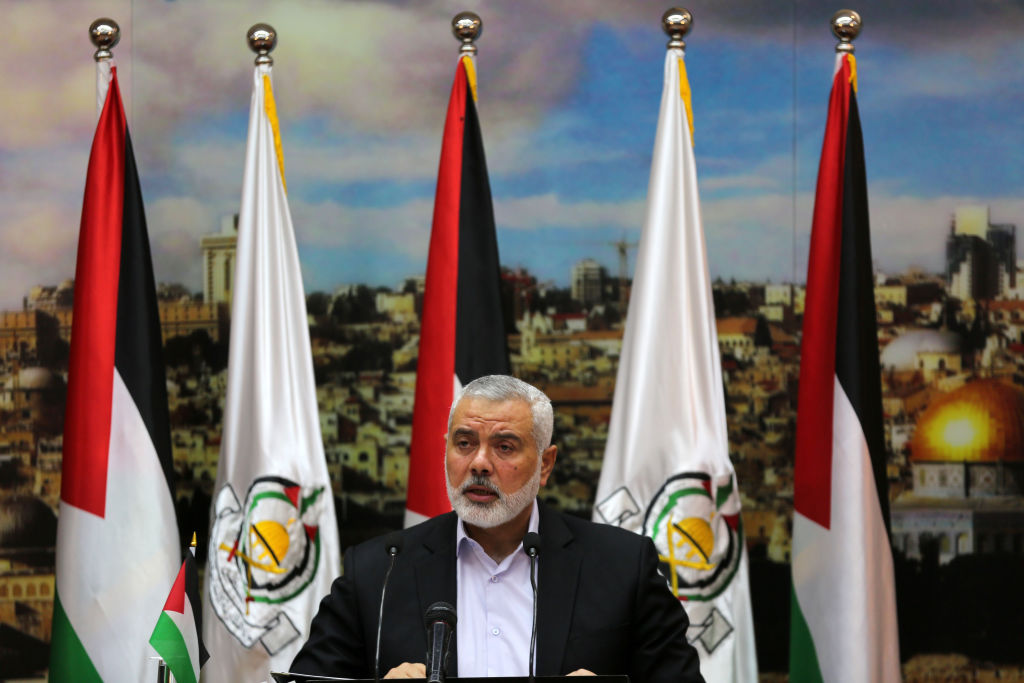
The US designated Ismail Haniyeh a terrorist in 2018. Credit: Momen Faiz/NurPhoto via Getty

The US designated Ismail Haniyeh a terrorist in 2018. Credit: Momen Faiz/NurPhoto via Getty

August 2 2024 - 4:00pm

The Guardian‘s obituary of Hamas chief Ismail Haniyeh, who was recently assassinated in Tehran, labeled him a ‘politician’ rather than a terrorist, despite him leading a proscribed terrorist organization.

In the tribute, Haniyeh was described as ‘burly and genial in demeanor’ and a ‘keen soccer player and devout Muslim’. Having lived in Doha, Qatar since 2017, he was the leader of the 15-member political bureau that runs Hamas.

Haniyeh led Hamas — of which The Guardian says ‘Europe and the US called [it] a prohibited terrorist group’ — to political victory in the 2006 legislative elections in Gaza. In the same year, ‘renegade Palestinian commandos’ killed two Israeli soldiers and kidnapped a third, sparking an Israeli invasion which The Guardian says ‘hardened’ Haniyeh’s ideological stance. ‘We will never recognize the usurper Zionist government and will continue our jihad-like movement until Jerusalem’s liberation,’ he said.

He was jailed by Israel three times after 1989. Haniyeh was then deported to Lebanon in 1992 with ‘415 fellow Hamas activists where they learned suicide bombing techniques from Hezbollah, which they used against Israeli civilians from 1994 onwards.’ In 1993, Hamas rejected the Oslo accords and accused Yasser Arafat, head of the PLO, of conspiring with the ‘Zionist enemy’.

Yet, there is a wide consensus that he was more ‘moderate’ than his fellow Hamas officials and members. In 2007, he was instrumental in the release of the BBC journalist Alan Johnston when he was taken hostage by an Islamist group. Haniyeh went on to gain a doctorate, become dean of the Islamic University and chair Gaza’s Islamic Society Club. In 2018, the US State Department designated him a ‘terrorist’.

Still, his moderate credentials are further outlined in the Guardian piece: ‘He hinted at extending a truce with Israel, eschewed ‘global terror’, equated Hamas with America’s 1776 revolutionaries, and even gave interviews to Israeli television.’ This vision is, however, contradicted in the following paragraph: ‘Yet Haniyeh still refused demands from the US, Europe, Israel and the Arab League to recognize Israel, disarm Hamas’s military wing, or abide by agreements signed by the PLO.’

The obituary gestures at the difficulties Gazans have experienced while living under Hamas’s authoritarian rule, saying that the ‘International Crisis Group said Palestinians were tiring of ‘principles over bread’, given economic hardship, plus Hamas harassment of civilians and enforcement of religious laws’.

Last October, questions were raised over his commitment to the safety of Gazan civilians when he said: ‘The blood of the women, children and elderly […] we are the ones who need this blood, so it awakens within us the revolutionary spirit, so it awakens with us resolve.’

It has been widely reported that Hamas’s Gaza leader Yahya Sinwar and military leader Mohammed Deif (who was killed last month) planned the 7 October operation without informing him. In May, however, the prosecutor for the International Criminal Court Karim Khan said he had ‘reasonable grounds to believe’ that Haniyeh, along with other Hamas leaders, were responsible for ‘war crimes and crimes against humanity‘, in the wake of 7 October. And whatever his involvement, his reaction was certainly gleeful.

The Guardian sign off reads: ‘Ismail Abd al-Salah Ahmad Haniyeh, politician, born 8 May 1963; died 31 July 2024’.

Max Mitchell is UnHerd’s Assistant Editor, Newsroom.

MaxJMitchell1

China is threatening America in the AI race

Reports sugget Zhipu AI  has released a new model that can rival leading US systems. Credit: Getty

Reports sugget Zhipu AI has released a new model that can rival leading US systems. Credit: Getty

July 1 2026 - 10:18am

China is trying to catch up with America on artificial intelligence. The Wall Street Journal has reported that Zhipu AI — one of China’s six “AI tiger” LLMs — has released a new model that can rival leading US systems, including Anthropic’s Mythos, in cybersecurity tasks such as pinpointing security bugs. While this marks a milestone in China’s drive to catch up with Western AI capabilities, strong performance on a single benchmark does not mean it has taken the lead. Chinese models still lag behind their Western counterparts in broader capabilities, such as autonomous operation. Skepticism is therefore warranted before resorting to hysterical conclusions, but complacency about the geopolitical implications of China’s AI advances would be an even greater mistake.

On the infrastructure side, Chinese AI is still constrained by access to advanced chips, with American labs way ahead in computing capacity as well as investment. Analysis from earlier this year suggests that Chinese models are likely to be at least a few months behind those in the US. But they are still continuing to make progress, or that the geopolitical importance of AI will be decided only by whose LLM has ventured deeper into the technological frontier. The practical applications of AI, countries’ to capture foreign markets, and the application of AI into the real economy will matter just as much.

Here, China may hold an advantage. As with its dominance across many critical supply chains, Beijing may not need to produce the most advanced AI systems — only those that are affordable and widely deployable. In doing so, it could consolidate global influence by supplying functional, low-cost AI at scale.

Beijing seems to be pursuing exactly that path, developing an AI “open-source” strategy that offers affordable, widely available AI models for companies and individuals to use and modify as they wish. The production of the DeepSeek AI model, which matched the performance of Silicon Valley tools such as ChatGPT at a fraction of the cost for users, created goodwill among Chinese models with developers.

The four most popular models on OpenRouter, an AI hardware platform for developers, are now all Chinese. The goal for China is not only to win the frontier-model race, but to make its systems the default layer of AI adoption across industries and global markets. For most economies, the choice is increasingly between an affordable tool they can deploy now and a more robust one that may be out of reach.

And while the countries adopting Chinese models may be exposed to political pressure and cyber threats from Beijing, safer and more capable alternatives matter little if they are unaffordable. American AI companies are already under pressure to monetize products whose operating costs are rising. If Chinese open-source models become the cheap default for startups, universities, governments and businesses across the developing world, then America’s AI lead will be eroded from below.

Perhaps more concerning for America in the long run is how AI can give Chinese manufacturing even more strength, through the ongoing integration of AI as a general-purpose technology. China’s new Five-Year Plan mentioned AI more than 50 times and includes an “AI+” action plan aimed at spreading AI across the economy.

Beijing has been pioneering automation of its critical infrastructure for years, with promising recent results in increasing warplane production capacity. In that regard, China’s open-model strategy and manufacturing dominance will reinforce each other. Cheap, adaptable models accelerate deployment across the real economy while those deployments generate real-world data and use cases that can feed back into further model improvement.

The United States should not dismiss the importance of its lead in the AI race. That lead worries Beijing, not least because a more automated Chinese economy would also become more vulnerable to AI-generated cyber threats. But nor should Washington assume that China cannot catch up with American capabilities over time.

This AI competition represents part of a broader struggle over tech supply chains and geopolitical influence. Decisions over whether to adopt US or Chinese models could produce a more fragmented global reality, with different regions relying on different cloud providers, chips and security structures. The result will likely be a global economy which is divided into competing spheres, rather than one which produces a single winner.


Miquel Vila is a political and geopolitical risk consultant focusing on industrial strategy, critical infrastructure and global supply chains.

miquelvilam