

X Close

Donald Tusk is powerless to stop Poland’s Right-wing wave

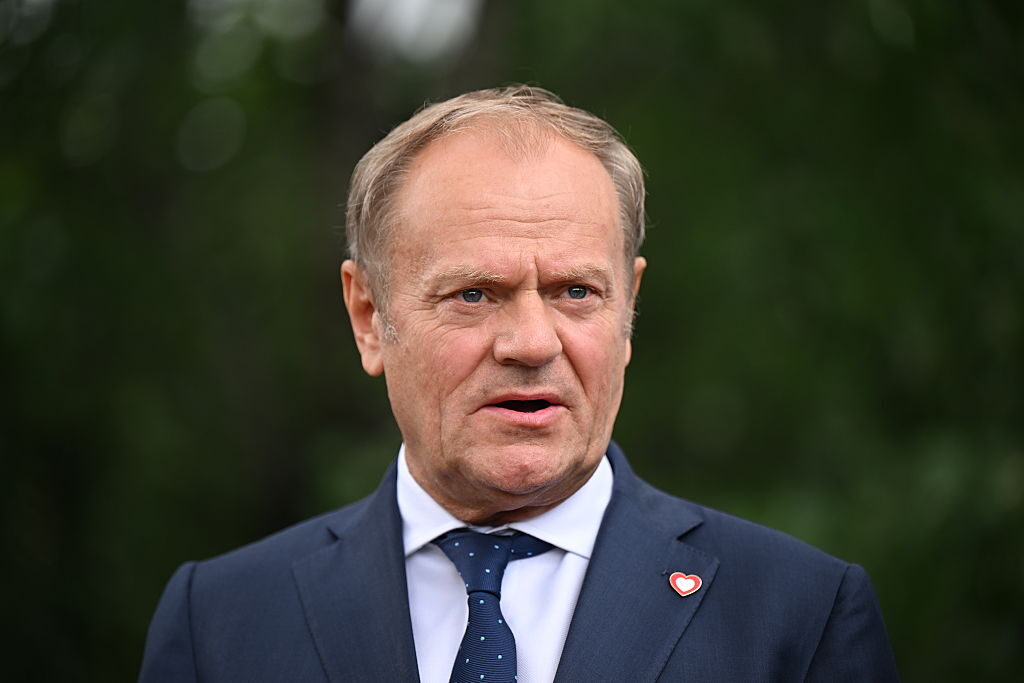
Tusk’s embrace of Poland First-style rhetoric has left him backed into a corner. Credit: Getty

Tusk’s embrace of Poland First-style rhetoric has left him backed into a corner. Credit: Getty

May 19 2025 - 7:00am

Donald Tusk’s candidate won the first round of Poland’s presidential election last night — but the Prime Minister still likely went to bed sweating. According to exit polls, Tusk’s ally, Warsaw Mayor Rafał Trzaskowski, has eked out a win in the first round of the country’s presidential election with 30.8% of the vote. He will face off in the next round against Karol Nawrocki from the former ruling party, Law and Justice (PiS), who came second.

On the surface, this may seem like good news for Tusk and his coalition: despite forming a government back in 2023, their agenda has since been repeatedly stymied by PiS-aligned President Andrzej Duda, who under Poland’s semi-presidential system was able to veto Tusk’s efforts to turn back the clock on eight years of PiS’s Catholic-conservative rule. With Trzaskowski in power, Tusk and his allies would finally be able to pass the institutional reforms and judicial changes that the EU had mandated for years — although reforming Poland’s infamously restrictive abortion laws, a longtime liberal dream, may continue to evade them.

But, despite appearances, last night’s result represents a political earthquake not only for Tusk and his party but for PiS as well. Not only did Trzaskowski edge out Nawrocki by a mere 1.7%, but — in stark contrast to pre-election polling — the candidate from the far-Right Confederation Party won over 15%, more than doubling the party’s share of the vote from both the previous presidential and parliamentary elections. Fourth place, in turn, went to Grzegorz Braun, who has spoken openly in support of Russia and labelled Jews “the enemies of Poland”. If supporters of these candidates flock to Nawrocki in the second round, he will likely carry the day.

Of course, years of infighting on the Polish Right mean that many of PiS’s nationalist opponents may well stay home for the run-off on 1 June. But, whatever happens, last night’s result served as undeniable proof that the battle for the future of Polish politics will be fought on Right-wing turf, and that PiS is losing its grip on conservatism in the country.

Poland’s attitude toward Russia and its war in Ukraine will likely remain unchanged regardless of who is in charge. But even if Trzaskowski unifies the center and the Left to win the second round, this election will have left its mark on Tusk’s party, which will likely only double down on the Rightward turn it has taken over the last year. For Europe, this means an increasingly nationalist Poland which, while squarely situated within the EU’s top brass, will drive the conversation in the bloc not from the traditional center but from the Right.

Despite being painted historically as an urban progressive, Trzaskowski’s campaign was hardly centered around liberal values. In response to rising energy on the Right, he criticised certain programmes for Ukrainian refugees in Poland, emphasised his security credentials, and played down his support for LGBT rights in debates. He condemned the EU migration pact, supported Tusk’s move to suspend asylum rights along Poland’s border with Belarus, and even hinted at closing the border with Germany to keep refugees out.

Transformations like these are here to stay. With parliamentary elections in 2027, Trzaskowski and Tusk will have little room to retreat from their new embrace of Poland First-style rhetoric. A win for Nawrocki, meanwhile, would do little in the immediate term other than hamper Tusk’s agenda for the next two years. But with Confederation hot on his tail, PiS would have no choice but to scramble to save whatever it can of its slice of Poland’s political pie.

What happens in the near future will depend on how much Tusk can enact his agenda and pull Poland back from the brink of a populist takeover of its institutions. But what does not appear up for debate is the country’s long-term direction, which will be dictated in large part by increasingly vocal nativists. Tusk and Trzaskowski understand this well, and will prepare accordingly — if begrudgingly — for the second round.


Michal Kranz is a freelance journalist reporting on politics, society and defence in Eastern Europe and the Middle East. He runs The Eastern Flank, a Substack newsletter focused on Eastern European geopolitics.
Michal_Kranz

China is threatening America in the AI race

Reports sugget Zhipu AI  has released a new model that can rival leading US systems. Credit: Getty

Reports sugget Zhipu AI has released a new model that can rival leading US systems. Credit: Getty

July 1 2026 - 10:18am

China is trying to catch up with America on artificial intelligence. The Wall Street Journal has reported that Zhipu AI — one of China’s six “AI tiger” LLMs — has released a new model that can rival leading US systems, including Anthropic’s Mythos, in cybersecurity tasks such as pinpointing security bugs. While this marks a milestone in China’s drive to catch up with Western AI capabilities, strong performance on a single benchmark does not mean it has taken the lead. Chinese models still lag behind their Western counterparts in broader capabilities, such as autonomous operation. Skepticism is therefore warranted before resorting to hysterical conclusions, but complacency about the geopolitical implications of China’s AI advances would be an even greater mistake.

On the infrastructure side, Chinese AI is still constrained by access to advanced chips, with American labs way ahead in computing capacity as well as investment. Analysis from earlier this year suggests that Chinese models are likely to be at least a few months behind those in the US. But they are still continuing to make progress, or that the geopolitical importance of AI will be decided only by whose LLM has ventured deeper into the technological frontier. The practical applications of AI, countries’ to capture foreign markets, and the application of AI into the real economy will matter just as much.

Here, China may hold an advantage. As with its dominance across many critical supply chains, Beijing may not need to produce the most advanced AI systems — only those that are affordable and widely deployable. In doing so, it could consolidate global influence by supplying functional, low-cost AI at scale.

Beijing seems to be pursuing exactly that path, developing an AI “open-source” strategy that offers affordable, widely available AI models for companies and individuals to use and modify as they wish. The production of the DeepSeek AI model, which matched the performance of Silicon Valley tools such as ChatGPT at a fraction of the cost for users, created goodwill among Chinese models with developers.

The four most popular models on OpenRouter, an AI hardware platform for developers, are now all Chinese. The goal for China is not only to win the frontier-model race, but to make its systems the default layer of AI adoption across industries and global markets. For most economies, the choice is increasingly between an affordable tool they can deploy now and a more robust one that may be out of reach.

And while the countries adopting Chinese models may be exposed to political pressure and cyber threats from Beijing, safer and more capable alternatives matter little if they are unaffordable. American AI companies are already under pressure to monetize products whose operating costs are rising. If Chinese open-source models become the cheap default for startups, universities, governments and businesses across the developing world, then America’s AI lead will be eroded from below.

Perhaps more concerning for America in the long run is how AI can give Chinese manufacturing even more strength, through the ongoing integration of AI as a general-purpose technology. China’s new Five-Year Plan mentioned AI more than 50 times and includes an “AI+” action plan aimed at spreading AI across the economy.

Beijing has been pioneering automation of its critical infrastructure for years, with promising recent results in increasing warplane production capacity. In that regard, China’s open-model strategy and manufacturing dominance will reinforce each other. Cheap, adaptable models accelerate deployment across the real economy while those deployments generate real-world data and use cases that can feed back into further model improvement.

The United States should not dismiss the importance of its lead in the AI race. That lead worries Beijing, not least because a more automated Chinese economy would also become more vulnerable to AI-generated cyber threats. But nor should Washington assume that China cannot catch up with American capabilities over time.

This AI competition represents part of a broader struggle over tech supply chains and geopolitical influence. Decisions over whether to adopt US or Chinese models could produce a more fragmented global reality, with different regions relying on different cloud providers, chips and security structures. The result will likely be a global economy which is divided into competing spheres, rather than one which produces a single winner.


Miquel Vila is a political and geopolitical risk consultant focusing on industrial strategy, critical infrastructure and global supply chains.

miquelvilam