





 Prefer us on Google

November 6 2024 - 8:30am
Donald Trump didn’t just outperform expectations for the 2024 election — he likely redrew the electoral map for a generation to come. His impressive performance wasn’t merely about swing states or suburban voters but something far more profound: the complete realignment of America’s two staid political coalitions.
The story of Trump’s improbable comeback from felony convictions and endless bad publicity isn’t found in the usual metrics of male versus female voters or red states versus blue states. Instead, it’s written in the faces of young voters, black Americans, and Latinos who abandoned the Democratic Party’s increasingly out-of-touch messaging for Trump’s brash, countercultural appeal.
The numbers tell a stark tale. According to AP VoteCast data, Trump captured more than 40% of voters under 30, a dramatic increase from the roughly one-third who backed him in 2020. This shift among young voters — traditionally a Democratic stronghold — signals more than just campaign success. It represents a fundamental transformation of the Republican Party’s image and appeal.
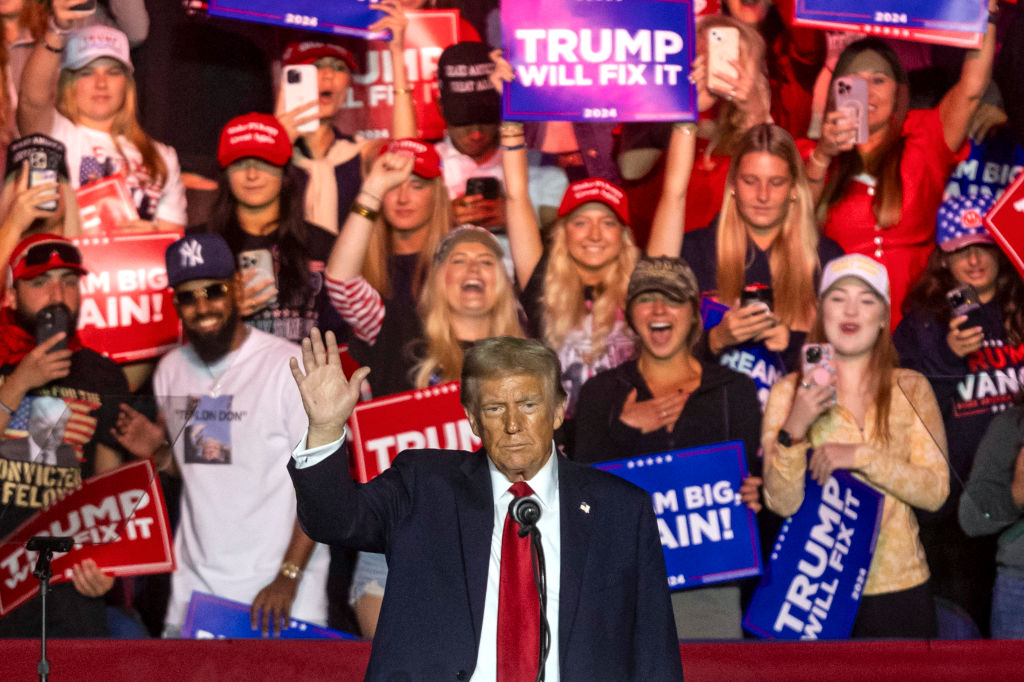
In Michigan, a “blue wall” state essential to a Kamala Harris victory, the reversal was even more dramatic. Exit polls show that voters aged 18-29, who gave Joe Biden a commanding 61% of their support in 2020, appear to have narrowly backed Trump in 2024. The shift was particularly pronounced among young men, who seemed to respond to Trump’s unconventional alliance-building with figures such as Joe Rogan, Elon Musk, and even Hulk Hogan — moves that mainstream media figures regularly mocked as desperate or misguided.
But Trump’s coalition-building went beyond young voters. He secured 45% of Hispanic voters nationwide, trailing Harris by just eight points — a 13-point improvement from 2020. Among black voters, traditionally the Democratic Party’s most reliable constituency, Harris’s support dropped to around 80%, down from the roughly 90% who backed Biden four years earlier.
The Harris campaign’s response to these demographic shifts revealed the fundamental weakness of the Democratic establishment’s strategy. Rather than addressing the economic anxieties of working-class voters struggling with inflation, Harris pursued educated moderates and anti-Trump Republicans. Her campaign events, complete with carefully staged Saturday Night Live appearances and legacy media coverage, seemed to be lifted directly from Hillary Clinton’s failed 2016 playbook — only with less substance behind them.
Harris never underwent the rigorous vetting of a primary campaign, and it showed. Her messaging focused on abstract “vibes” rather than concrete solutions, alienating lower-income households who had felt the sting of rising prices since 2020, as well as young people unable to enter a tight entry-level labor market. The contrast with Trump’s direct, often unpolished style couldn’t have been starker.
The magnitude of Trump’s coalition shift becomes clear in the state-by-state numbers. Buoyed by youth turnout and defections from reliable voting blocs, traditionally Democratic strongholds such as New York and New Jersey showed a nine to ten-point Republican shift from 2020. Florida, once considered a perpetual swing state, moved decisively into the Republican column.
This realignment suggests something more significant than a single election victory. Trump has effectively positioned the Republican Party as today’s counterculture — a genuine youth movement that finally matured after years of online activism and memetic warfare. By selecting J.D. Vance as his running mate, Trump further cemented his appeal to younger, digitally-native voters who see through the carefully curated “authenticity” of establishment politicians.
The Democratic Party’s embrace of what critics call “woke politics” — long stripped of any economic populism that made Bernie Sanders a compelling figure to young people in 2016 and 2020 — left it vulnerable to Trump’s unconventional coalition-building. While Democratic strategists focused on maintaining their grip on educated suburban voters, Trump’s team recognised that the real opportunity lay in expanding its base among working-class voters of all backgrounds.
The implications of this realignment will likely reverberate through American politics for the next decade or more. Trump made the Republican Party’s coalition younger, more diverse, and more working-class than at any point in recent history. The Democratic Party, meanwhile, finds itself increasingly dependent on affluent, educated voters — the very establishment figures it once defined itself against.
What emerges is a political landscape that would have been unrecognisable to those of us who came of age during George W. Bush’s presidency: a Republican Party beginning to embrace youth energy and working-class multiracial solidarity, facing off against a Democratic Party that increasingly represents well-off Boomers, the professional-managerial class, and corporate interests. The only question now is whether the Democrats can adapt to this new reality, or if they’ll continue running campaigns better suited to the political landscape of 2016 — where they bungled a near-certain victory — than the transformed America of 2024 and beyond.
Oliver Bateman is a historian and journalist based in Pittsburgh. He blogs, vlogs, and podcasts at his Substack, Oliver Bateman Does the Work
 MoustacheClubUS