



X Close

Biden’s BBC interview: an outdated vision of US power

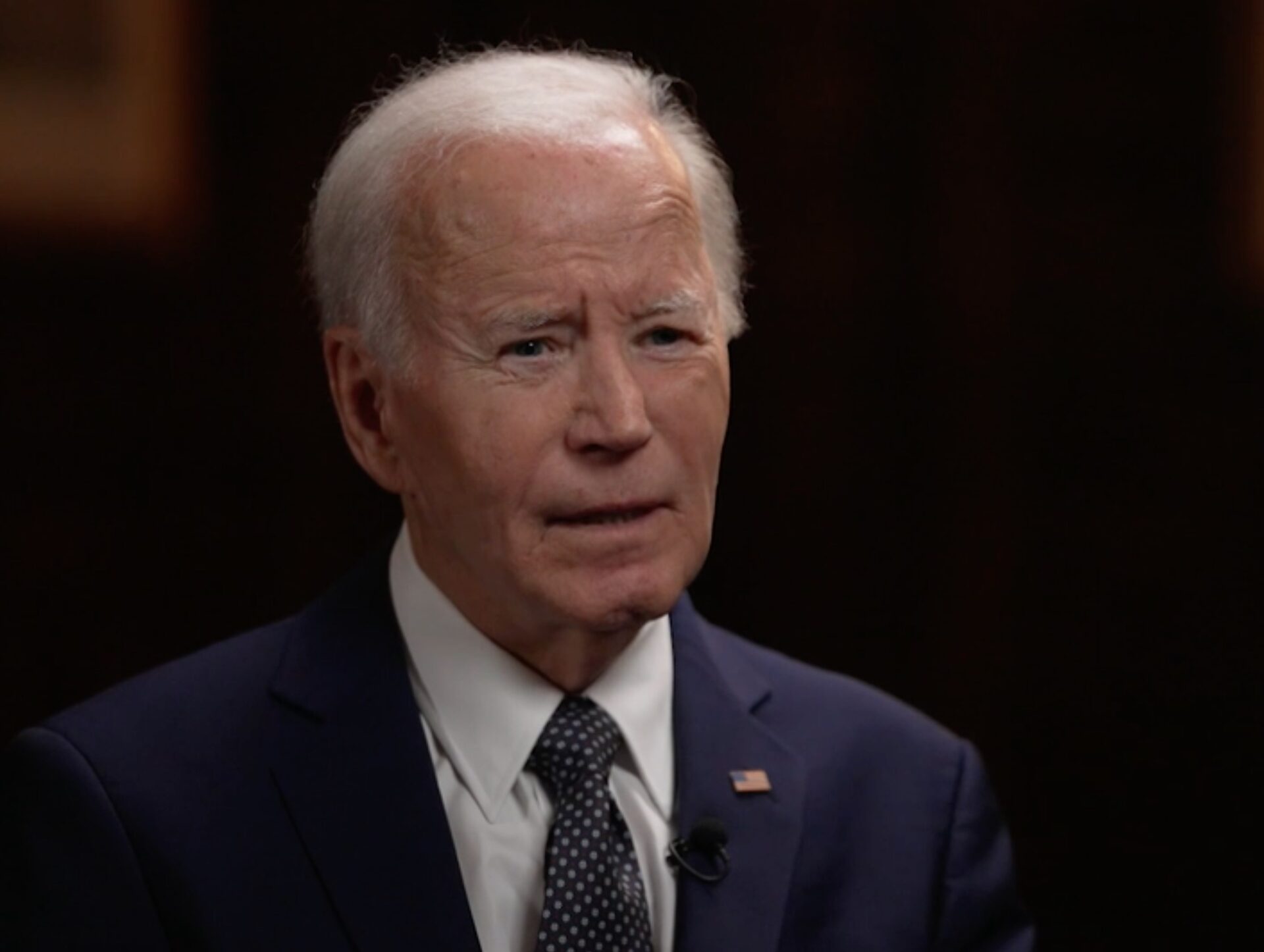
Joe Biden speaks to the BBC's Nick Robinson. Credit: BBC

Joe Biden speaks to the BBC's Nick Robinson. Credit: BBC

May 7 2025 - 3:00pm

Joe Biden’s re-emergence on the political stage, after a long silence, came with a warning and an implicit reminder of how much has changed even in the few months since he left office. In an interview with the BBC published today, the former president defended his decision to remain in the 2024 race and condemned Donald Trump’s approach to ending the Ukraine war as “modern-day appeasement”.

Biden chose the BBC and VE Day — a commemoration more resonant in Europe than in the United States — as the setting for his return. For him, the legacy of the Second World War is not just history but a lodestar: the war against totalitarianism, the necessity of American engagement, the birth of an international order in which the US bore extraordinary burdens to guarantee freedom abroad and stability at home. That commitment defined his presidency — and, in many ways, his political identity since entering the Senate in 1973. “My father’s and mother’s generation knew what was at stake,” he told the BBC. “They knew that democracy was literally hanging in the balance.”

This vision stands in contrast to Trump’s. At the heart of Trump’s worldview is a certain revisionism: that the order constructed in 1945 did not serve American interests. According to this logic, the alliances and obligations which followed — from NATO to Bretton Woods — amounted to a con, in which America sacrificed its industries, overvalued its currency, and underwrote the security of freeloading allies. Trump’s foreign policy is a repudiation of the moral and strategic assumptions that guided American power for generations. Clearly, the consensus has fractured and the paradigm has shifted.

Trump says the quiet part out loud. Post-1945 supremacy came at a cost, and it wasn’t worth paying. For Biden, those sacrifices were not only necessary but noble. “Imagine there being no NATO,” he told the BBC’s Nick Robinson. “Do you think Putin would have stopped at Ukraine?” The irony is plain: the United States has become the revisionist power in the very order it built. For decades, the threat was assumed to come from Moscow, Beijing or jihadist terror. In the end, it came from within — from the exhaustion of a public no longer persuaded that sacrifice abroad yielded security at home. The genie is out of the bottle. Who among the next generation of Democratic leaders is willing to say that Americans must bear the economic cost for the defense of distant capitals?

Democrats are studiously avoiding the question. Electoral imperatives steer them towards economic concerns — inflation, trade instability, the fallout from Trump’s tariffs. It is easier to condemn the apparent absurdities, such as proposals to annex Canada or buy Greenland, than to confront the deeper erosion of American global leadership. The prospective contenders for 2028 are not foreign policy thinkers. They are governors such as Josh Shapiro and Gretchen Whitmer, whose appeal rests on domestic competence, or progressives like Alexandria Ocasio-Cortez who frame the political battle in terms of oligarchy and inequality. None are steeped in the logic of liberal internationalism. None appear especially eager to defend it.

Biden makes his argument because he believes it and because he has lived it. The 82-year-old former president’s remarks are a condemnation of Trump rooted in nostalgia for a time when American power was a responsibility rather than a burden. “We’re not the essential nation,” he told the BBC, “but we’re the only nation in the position […] to bring people together — to lead the world.” Biden’s words were those of the last postwar liberal internationalist, spoken on the anniversary of a victory fewer and fewer Americans now commemorate, as new doctrines of US power rise from the ashes of the old.


Angus Reilly is Assistant Editor at Engelsberg Ideas. He is writing a book about Henry Kissinger in the Second World War and a biography of David Owen.

Angus_Reilly

China is threatening America in the AI race

Reports sugget Zhipu AI  has released a new model that can rival leading US systems. Credit: Getty

Reports sugget Zhipu AI has released a new model that can rival leading US systems. Credit: Getty

July 1 2026 - 10:18am

China is trying to catch up with America on artificial intelligence. The Wall Street Journal has reported that Zhipu AI — one of China’s six “AI tiger” LLMs — has released a new model that can rival leading US systems, including Anthropic’s Mythos, in cybersecurity tasks such as pinpointing security bugs. While this marks a milestone in China’s drive to catch up with Western AI capabilities, strong performance on a single benchmark does not mean it has taken the lead. Chinese models still lag behind their Western counterparts in broader capabilities, such as autonomous operation. Skepticism is therefore warranted before resorting to hysterical conclusions, but complacency about the geopolitical implications of China’s AI advances would be an even greater mistake.

On the infrastructure side, Chinese AI is still constrained by access to advanced chips, with American labs way ahead in computing capacity as well as investment. Analysis from earlier this year suggests that Chinese models are likely to be at least a few months behind those in the US. But they are still continuing to make progress, or that the geopolitical importance of AI will be decided only by whose LLM has ventured deeper into the technological frontier. The practical applications of AI, countries’ to capture foreign markets, and the application of AI into the real economy will matter just as much.

Here, China may hold an advantage. As with its dominance across many critical supply chains, Beijing may not need to produce the most advanced AI systems — only those that are affordable and widely deployable. In doing so, it could consolidate global influence by supplying functional, low-cost AI at scale.

Beijing seems to be pursuing exactly that path, developing an AI “open-source” strategy that offers affordable, widely available AI models for companies and individuals to use and modify as they wish. The production of the DeepSeek AI model, which matched the performance of Silicon Valley tools such as ChatGPT at a fraction of the cost for users, created goodwill among Chinese models with developers.

The four most popular models on OpenRouter, an AI hardware platform for developers, are now all Chinese. The goal for China is not only to win the frontier-model race, but to make its systems the default layer of AI adoption across industries and global markets. For most economies, the choice is increasingly between an affordable tool they can deploy now and a more robust one that may be out of reach.

And while the countries adopting Chinese models may be exposed to political pressure and cyber threats from Beijing, safer and more capable alternatives matter little if they are unaffordable. American AI companies are already under pressure to monetize products whose operating costs are rising. If Chinese open-source models become the cheap default for startups, universities, governments and businesses across the developing world, then America’s AI lead will be eroded from below.

Perhaps more concerning for America in the long run is how AI can give Chinese manufacturing even more strength, through the ongoing integration of AI as a general-purpose technology. China’s new Five-Year Plan mentioned AI more than 50 times and includes an “AI+” action plan aimed at spreading AI across the economy.

Beijing has been pioneering automation of its critical infrastructure for years, with promising recent results in increasing warplane production capacity. In that regard, China’s open-model strategy and manufacturing dominance will reinforce each other. Cheap, adaptable models accelerate deployment across the real economy while those deployments generate real-world data and use cases that can feed back into further model improvement.

The United States should not dismiss the importance of its lead in the AI race. That lead worries Beijing, not least because a more automated Chinese economy would also become more vulnerable to AI-generated cyber threats. But nor should Washington assume that China cannot catch up with American capabilities over time.

This AI competition represents part of a broader struggle over tech supply chains and geopolitical influence. Decisions over whether to adopt US or Chinese models could produce a more fragmented global reality, with different regions relying on different cloud providers, chips and security structures. The result will likely be a global economy which is divided into competing spheres, rather than one which produces a single winner.


Miquel Vila is a political and geopolitical risk consultant focusing on industrial strategy, critical infrastructure and global supply chains.

miquelvilam