
X Close

AfD politician hosts UK ethnonationalist party at Bundestag

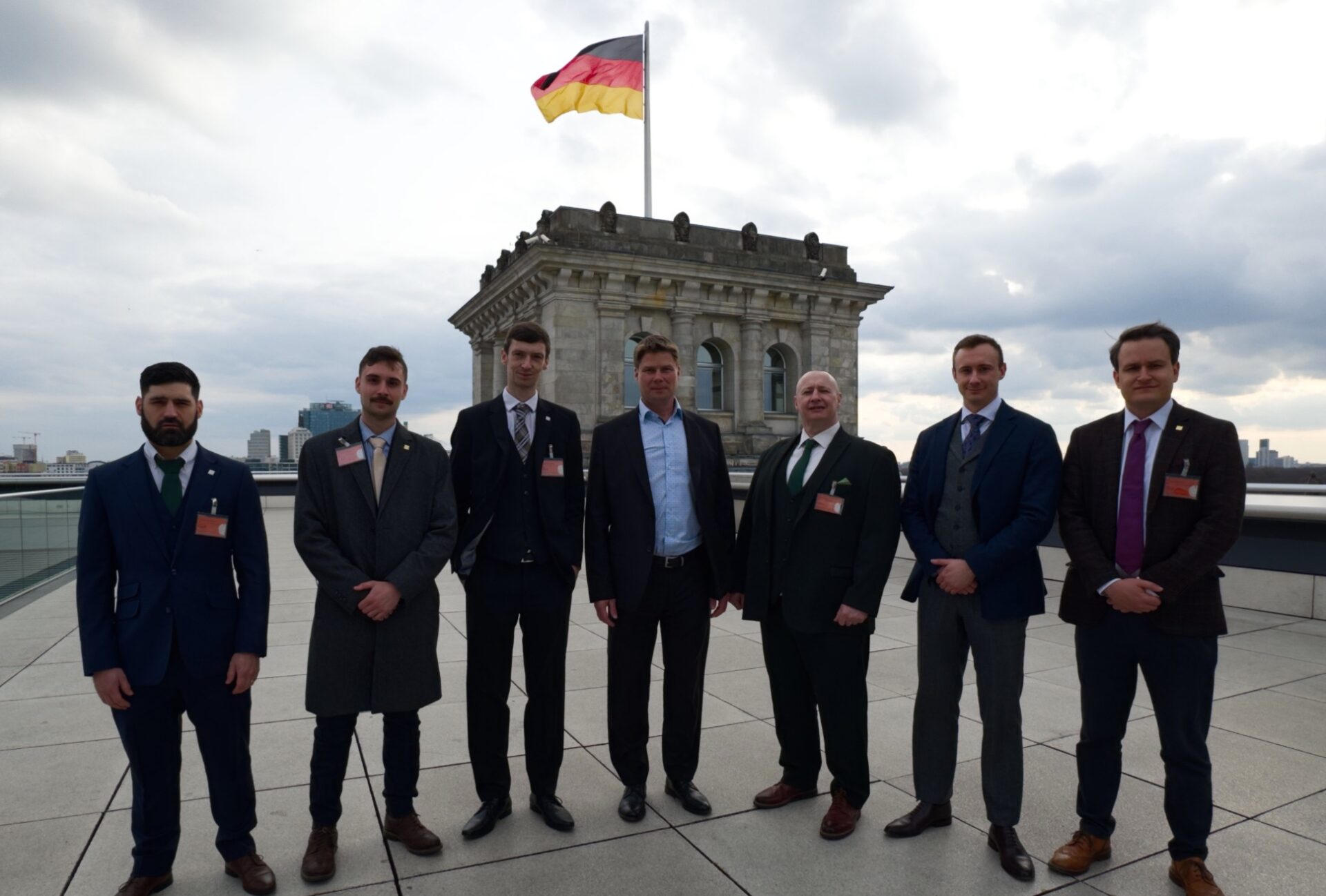
Senior Homeland representatives pictured with AfD politician Steffen Kotré (middle) in Berlin on Thursday. Credit: Homeland Party/X

Senior Homeland representatives pictured with AfD politician Steffen Kotré (middle) in Berlin on Thursday. Credit: Homeland Party/X

March 14 2025 - 3:50pm

An Alternative für Deutschland (AfD) politician has hosted senior members of a British ethnonationalist party at the German parliament. A Homeland Party delegation, including chairman Kenny Smith, yesterday met with the AfD’s Steffen Kotré and received a guided tour of the Bundestag, according to a post shared on Homeland’s social media accounts this afternoon.

Homeland was founded in 2023 and registered as a political party last year. Several of its activists have been outed as former members of neo-Nazi groups, and have denied the Holocaust. The party has adopted a platform of “remigration”, involving the mass repatriation of immigrants, which has also been embraced by the AfD. In January, the German party’s co-leader Alice Weidel endorsed remigration, calling for “repatriations on a large scale”.

Thursday’s meeting between Homeland and AfD representatives was geared towards “building relationships across Europe and the world”, according to the former party’s X account. It added: “Implementing remigration will require good foreign relations and our party is already preparing to ensure it will be a success.”

Homeland interviewed Kotré yesterday, as well as Gunnar Lindemann, an AfD politician in the state parliament of Berlin. Kotré has previously appeared on Russian state television to accuse the Western media of spreading anti-Kremlin disinformation, comments which were labelled “disgusting Putin propaganda” by one of his AfD colleagues. Meanwhile, Lindemann has previously been a member of groups in which antisemitic posts were openly shared, and has been accused of ties to far-Right extremist organizations. He has also pinned blame for the Ukraine war on “warmongering” NATO, America and “above all” the Ukrainian state.

AfD youth representative Manuel Schreiber spoke at a Homeland event in Derbyshire last year, while the British party will next month host a “remigration conference” featuring Lena Kotré, another AfD politician and the wife of Steffen Kotré. Another of the advertised speakers is Renaud Camus, a French writer credited with originating the “Great Replacement” theory, according to which political elites are deliberately replacing native white populations in Europe through mass migration from non-white-majority countries.

Speaking to UnHerd late last year, Homeland chairman Kenny Smith said that remigration “was absolutely necessary”, and that “you could stop all the boats and deport all the illegals tomorrow, but if you only stop there we will still continue to become a minority in our own country.” He also dismissed the idea that his party had neo-Nazi roots, saying: “We ruled half the world — we don’t need to look for inspiration on the continent.”

In a video shared on Homeland’s social media on Wednesday evening alongside Steve Laws — the party’s South East Regional Organizer and arguably most famous face with almost 100,000 X followers — Smith said that they had received “intensive media training from a quality team that has worked very closely with the AfD”. In a separate video, Laws said that the AfD and other Right-wing nationalist parties in Europe “are campaigning on remigration and they’re taking it to national levels, and the majority of people in their countries agree with them. And we want to bring that back to the UK, and we want to present that to our people.”

The AfD came second in Germany’s federal elections last month, returning a record 152 seats as well as doubling its vote share. Homeland remains a minor party in Britain but surpassed 1,000 members this month.

Homeland has been contacted for comment.


Rob Lownie is UnHerd’s Deputy Editor, Newsroom.

RobLownie

China is threatening America in the AI race

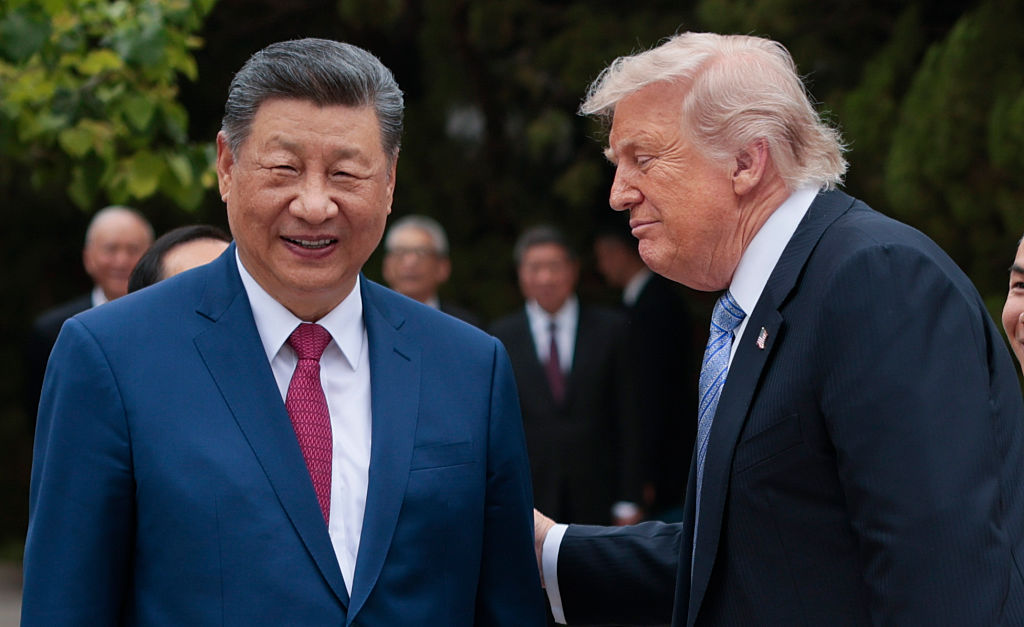
Reports sugget Zhipu AI  has released a new model that can rival leading US systems. Credit: Getty

Reports sugget Zhipu AI has released a new model that can rival leading US systems. Credit: Getty

July 1 2026 - 10:18am

China is trying to catch up with America on artificial intelligence. The Wall Street Journal has reported that Zhipu AI — one of China’s six “AI tiger” LLMs — has released a new model that can rival leading US systems, including Anthropic’s Mythos, in cybersecurity tasks such as pinpointing security bugs. While this marks a milestone in China’s drive to catch up with Western AI capabilities, strong performance on a single benchmark does not mean it has taken the lead. Chinese models still lag behind their Western counterparts in broader capabilities, such as autonomous operation. Skepticism is therefore warranted before resorting to hysterical conclusions, but complacency about the geopolitical implications of China’s AI advances would be an even greater mistake.

On the infrastructure side, Chinese AI is still constrained by access to advanced chips, with American labs way ahead in computing capacity as well as investment. Analysis from earlier this year suggests that Chinese models are likely to be at least a few months behind those in the US. But they are still continuing to make progress, or that the geopolitical importance of AI will be decided only by whose LLM has ventured deeper into the technological frontier. The practical applications of AI, countries’ to capture foreign markets, and the application of AI into the real economy will matter just as much.

Here, China may hold an advantage. As with its dominance across many critical supply chains, Beijing may not need to produce the most advanced AI systems — only those that are affordable and widely deployable. In doing so, it could consolidate global influence by supplying functional, low-cost AI at scale.

Beijing seems to be pursuing exactly that path, developing an AI “open-source” strategy that offers affordable, widely available AI models for companies and individuals to use and modify as they wish. The production of the DeepSeek AI model, which matched the performance of Silicon Valley tools such as ChatGPT at a fraction of the cost for users, created goodwill among Chinese models with developers.

The four most popular models on OpenRouter, an AI hardware platform for developers, are now all Chinese. The goal for China is not only to win the frontier-model race, but to make its systems the default layer of AI adoption across industries and global markets. For most economies, the choice is increasingly between an affordable tool they can deploy now and a more robust one that may be out of reach.

And while the countries adopting Chinese models may be exposed to political pressure and cyber threats from Beijing, safer and more capable alternatives matter little if they are unaffordable. American AI companies are already under pressure to monetize products whose operating costs are rising. If Chinese open-source models become the cheap default for startups, universities, governments and businesses across the developing world, then America’s AI lead will be eroded from below.

Perhaps more concerning for America in the long run is how AI can give Chinese manufacturing even more strength, through the ongoing integration of AI as a general-purpose technology. China’s new Five-Year Plan mentioned AI more than 50 times and includes an “AI+” action plan aimed at spreading AI across the economy.

Beijing has been pioneering automation of its critical infrastructure for years, with promising recent results in increasing warplane production capacity. In that regard, China’s open-model strategy and manufacturing dominance will reinforce each other. Cheap, adaptable models accelerate deployment across the real economy while those deployments generate real-world data and use cases that can feed back into further model improvement.

The United States should not dismiss the importance of its lead in the AI race. That lead worries Beijing, not least because a more automated Chinese economy would also become more vulnerable to AI-generated cyber threats. But nor should Washington assume that China cannot catch up with American capabilities over time.

This AI competition represents part of a broader struggle over tech supply chains and geopolitical influence. Decisions over whether to adopt US or Chinese models could produce a more fragmented global reality, with different regions relying on different cloud providers, chips and security structures. The result will likely be a global economy which is divided into competing spheres, rather than one which produces a single winner.


Miquel Vila is a political and geopolitical risk consultant focusing on industrial strategy, critical infrastructure and global supply chains.

miquelvilam