




X Close

Will Tony Hinchcliffe’s Puerto Rico joke flip Latino voters?

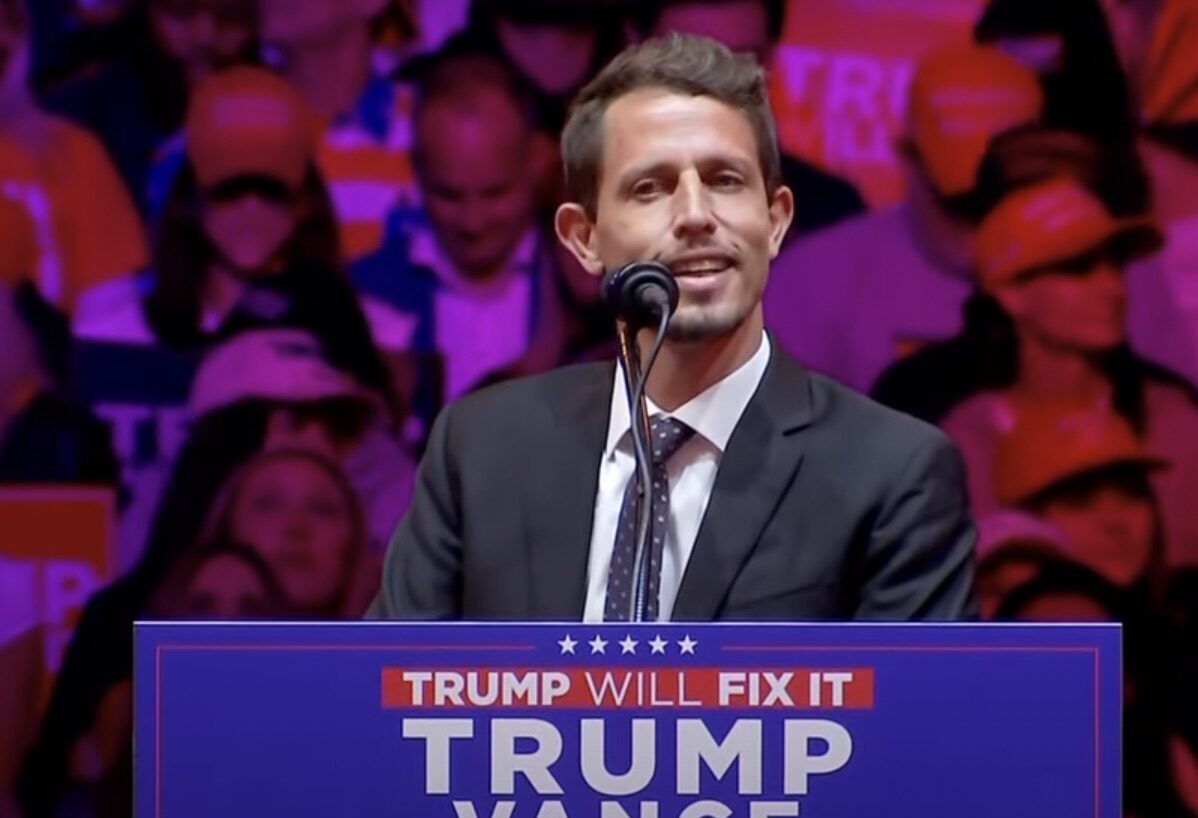
Tony Hinchcliffe speaks in New York on Sunday. Credit: C-Span/YouTube

Tony Hinchcliffe speaks in New York on Sunday. Credit: C-Span/YouTube

October 29 2024 - 1:15pm

In the final week of a presidential election campaign, the Republican candidate’s message is derailed by the remarks of a speaker at a partisan gathering. The speaker makes an inflammatory statement that offends a key voter demographic; in the end, it is enough to cost the Republicans a crucial swing state and hand the election to the Democrats.

This may very well end up as the story of the 2024 election, but it is actually a description of an election that took place 140 years ago: the race of 1884, which saw GOP frontrunner James G. Blaine felled by the infamous remark of Rev. Samuel Burchard, who described the Democrats as the party of “rum, Romanism, and rebellion”. The demographic in question were Irish Catholics who, angered by Burchard’s insult, turned New York State blue by the slimmest of margins. Grover Cleveland consequently became the first Democratic president since the Civil War.

In 2024, Republicans are facing an eerily similar scenario. At a Donald Trump rally at a sold-out Madison Square Garden in New York on Sunday, comedian Tony Hinchcliffe called Puerto Rico a “floating island of garbage in the middle of the ocean”. Puerto Rico is, of course, an unincorporated territory whose inhabitants are American citizens.

The fallout has been swift and far-reaching. In must-win Pennsylvania, where nearly 5% of the population are of Puerto Rican heritage, Spanish-language radio stations and informal social media have amplified Hinchcliffe’s joke among the local Borinquen community. A non-partisan civil society group, the National Puerto Rican Agenda, is set to publish an open letter urging the community not to vote for Trump, while Puerto Rican rapper Bad Bunny promptly endorsed Kamala Harris (his endorsement has previously moved the needle in the election for Puerto Rico’s governor).

Though Trump himself has yet to acknowledge the comments — he may do so at his Tuesday night rally in Latino-majority Allentown — his running mate, Senator J.D. Vance, simply shrugged it off. Privately, however, Republicans are worrying over the potential impact of this “unforced error” which could undermine Trump’s efforts at making inroads with the Latino vote.

The Republican nominee made historic gains with this demographic in 2020, including in North Philadelphia’s Puerto Rican-majority areas. Harris visited the same part of town on Sunday, touring Puerto Rican businesses and outlining her vision for the island. Hinchcliffe also made offensive remarks about Latinos in general and African-Americans.

In the remaining days until the election next Tuesday, is there anything the Trump campaign can do to avoid a repeat of 1884? For the GOP candidate to suffer the fate of unsuccessful James G. Blaine is admittedly unlikely. But, in an act of desperation, he could use his Allentown rally to announce his support for making Puerto Rico the 51st state. This would be a real October surprise.

Such a proposal, which is also up for a non-binding vote on the island, is generally associated with Democrats who believe its elevation to statehood would add to their strength. But if Republicans actually took up the cause and had the territory admitted under a Trump administration, it would all but seal the ongoing movement of Borinquen and Latino voters toward the GOP, fueled by the growing alignment on socially conservative values and working-class identity.

The trouble for Republicans is that this organic trend, which has been years in the making, could be thrown off course by the unfunny jokes of an obscure comedian, ultimately costing the GOP the election. Hinchcliffe, who ironically has some experience mediating between presidents, may go down in history as the modern era’s Samuel Burchard. Of course, history tends to repeat itself — first as tragedy, and then as farce.


Michael Cuenco is Senior Editor at American Affairs.
1TrueCuencoism

China is threatening America in the AI race

Reports sugget Zhipu AI  has released a new model that can rival leading US systems. Credit: Getty

Reports sugget Zhipu AI has released a new model that can rival leading US systems. Credit: Getty

July 1 2026 - 10:18am

China is trying to catch up with America on artificial intelligence. The Wall Street Journal has reported that Zhipu AI — one of China’s six “AI tiger” LLMs — has released a new model that can rival leading US systems, including Anthropic’s Mythos, in cybersecurity tasks such as pinpointing security bugs. While this marks a milestone in China’s drive to catch up with Western AI capabilities, strong performance on a single benchmark does not mean it has taken the lead. Chinese models still lag behind their Western counterparts in broader capabilities, such as autonomous operation. Skepticism is therefore warranted before resorting to hysterical conclusions, but complacency about the geopolitical implications of China’s AI advances would be an even greater mistake.

On the infrastructure side, Chinese AI is still constrained by access to advanced chips, with American labs way ahead in computing capacity as well as investment. Analysis from earlier this year suggests that Chinese models are likely to be at least a few months behind those in the US. But they are still continuing to make progress, or that the geopolitical importance of AI will be decided only by whose LLM has ventured deeper into the technological frontier. The practical applications of AI, countries’ to capture foreign markets, and the application of AI into the real economy will matter just as much.

Here, China may hold an advantage. As with its dominance across many critical supply chains, Beijing may not need to produce the most advanced AI systems — only those that are affordable and widely deployable. In doing so, it could consolidate global influence by supplying functional, low-cost AI at scale.

Beijing seems to be pursuing exactly that path, developing an AI “open-source” strategy that offers affordable, widely available AI models for companies and individuals to use and modify as they wish. The production of the DeepSeek AI model, which matched the performance of Silicon Valley tools such as ChatGPT at a fraction of the cost for users, created goodwill among Chinese models with developers.

The four most popular models on OpenRouter, an AI hardware platform for developers, are now all Chinese. The goal for China is not only to win the frontier-model race, but to make its systems the default layer of AI adoption across industries and global markets. For most economies, the choice is increasingly between an affordable tool they can deploy now and a more robust one that may be out of reach.

And while the countries adopting Chinese models may be exposed to political pressure and cyber threats from Beijing, safer and more capable alternatives matter little if they are unaffordable. American AI companies are already under pressure to monetize products whose operating costs are rising. If Chinese open-source models become the cheap default for startups, universities, governments and businesses across the developing world, then America’s AI lead will be eroded from below.

Perhaps more concerning for America in the long run is how AI can give Chinese manufacturing even more strength, through the ongoing integration of AI as a general-purpose technology. China’s new Five-Year Plan mentioned AI more than 50 times and includes an “AI+” action plan aimed at spreading AI across the economy.

Beijing has been pioneering automation of its critical infrastructure for years, with promising recent results in increasing warplane production capacity. In that regard, China’s open-model strategy and manufacturing dominance will reinforce each other. Cheap, adaptable models accelerate deployment across the real economy while those deployments generate real-world data and use cases that can feed back into further model improvement.

The United States should not dismiss the importance of its lead in the AI race. That lead worries Beijing, not least because a more automated Chinese economy would also become more vulnerable to AI-generated cyber threats. But nor should Washington assume that China cannot catch up with American capabilities over time.

This AI competition represents part of a broader struggle over tech supply chains and geopolitical influence. Decisions over whether to adopt US or Chinese models could produce a more fragmented global reality, with different regions relying on different cloud providers, chips and security structures. The result will likely be a global economy which is divided into competing spheres, rather than one which produces a single winner.


Miquel Vila is a political and geopolitical risk consultant focusing on industrial strategy, critical infrastructure and global supply chains.

miquelvilam