




X Close

Why are Democrats staying quiet on Trump-Zelensky clash?

Where's the outrage? Credit: Getty

Where's the outrage? Credit: Getty

March 3 2025 - 1:00pm

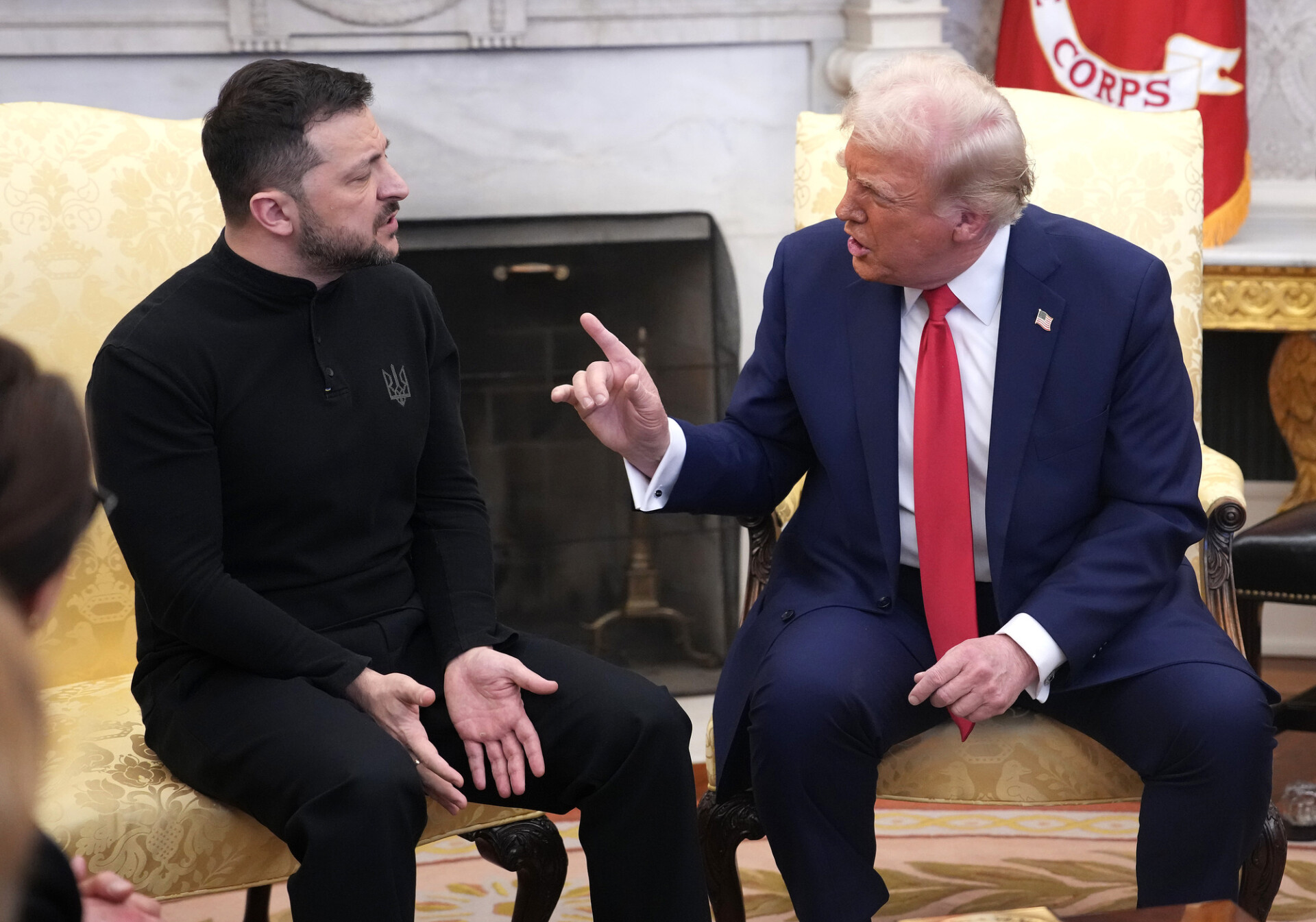
Donald Trump’s heated confrontation with Ukraine’s Volodymyr Zelensky at the White House on Friday has triggered a conspicuous lack of outrage from an increasingly hesitant Democratic Party. This uncharacteristic restraint speaks volumes about a fundamental recalibration taking place within American liberalism, as the appetite for Ukraine support wanes.

Recent polling tells the story plainly enough. A Quinnipiac survey from last week shows that the percentage of Americans who believe the US is doing “too much” to help Ukraine has skyrocketed from 7% to 41% (and to 62% among Republicans). Trust in Zelensky — a formerly revered “secular saint” — has plummeted from 72% to under 48%. The Democrats, long champions of the Ukrainian cause, appear to have recognized a losing battle when they see one.

A handful of strident voices, including Bernie Sanders and Connecticut Senator Chris Murphy, did speak out. “The White House has become an arm of the Kremlin,” Murphy declared on CNN’s State of the Union yesterday, insisting that Trump’s team is “pretending as if Ukraine started this war” while overlooking that the Democrats said the same things during the failed Russiagate investigation. And when Hillary Clinton criticized Defense Secretary Pete Hegseth’s order to the US Cyber Command to stand down from all operations directed at Russia, he replied with a meme of her laughing alongside Russian Foreign Minister Sergey Lavrov. The exchange effectively underscored how these protestations now sound hollow and disconnected from public sentiment.

This strategic retreat isn’t limited to Ukraine policy. Amid record drops in approval for Congressional Democrats’ performance, the party’s leadership has grown similarly quiet on transgender protections in sports, which polling has repeatedly shown to be exceedingly unpopular. It has also begun walking back some messaging on DEI programs and affirmative action in school admissions, issues which are also consistently opposed by majorities. The party appears to be picking its battles more judiciously, recognizing that certain culture war flashpoints have become political quicksand.

So much was evident at a gathering of prominent Democratic moderates last month. The resulting document, a five-page blueprint obtained by Politico, reads like a direct repudiation of the party’s trajectory over the last decade. Among its recommendations are “embrace patriotism, community, and traditional American imagery”; “be pro-capitalism in a smart way”; “ban far-left candidate questionnaires”; and “push back against far-left staffers and groups”. Perhaps most telling is “move away from the dominance of small-dollar donors whose preferences may not align with the broader electorate”. The message couldn’t be clearer: the progressive wing that dominated the party during Trump’s first term has lost its primacy.

While foreign policy was not mentioned in the blueprint, the last few days have shown that Democrats are struggling to find the right line on this too. The Third Way moderates’ prescription to “move away from the dominance of small-dollar donors” and “push back against far-left staffers” may help realign the party domestically, but offers precious little guidance on responding to Trump’s dramatic reorientation of American foreign policy. As Trump pressures Ukraine in the direction of uncomfortable concessions to Russia, Democratic leaders such as Chuck Schumer are nowhere to be found.

This vacuum of opposition speaks to a deeper crisis of confidence within the party: having spent years telling jokes about “pee tapes” and portraying Trump as Putin’s puppet, Democrats now find themselves unable to counter his moves on the world stage. The party’s inability to articulate a compelling alternative vision for America’s evolving role in the world may prove as damaging to its electoral prospects as its previous missteps on domestic issues.


Oliver Bateman is a historian and journalist based in Pittsburgh. He blogs, vlogs, and podcasts at his Substack, Oliver Bateman Does the Work

MoustacheClubUS

China is threatening America in the AI race

Reports sugget Zhipu AI  has released a new model that can rival leading US systems. Credit: Getty

Reports sugget Zhipu AI has released a new model that can rival leading US systems. Credit: Getty

July 1 2026 - 10:18am

China is trying to catch up with America on artificial intelligence. The Wall Street Journal has reported that Zhipu AI — one of China’s six “AI tiger” LLMs — has released a new model that can rival leading US systems, including Anthropic’s Mythos, in cybersecurity tasks such as pinpointing security bugs. While this marks a milestone in China’s drive to catch up with Western AI capabilities, strong performance on a single benchmark does not mean it has taken the lead. Chinese models still lag behind their Western counterparts in broader capabilities, such as autonomous operation. Skepticism is therefore warranted before resorting to hysterical conclusions, but complacency about the geopolitical implications of China’s AI advances would be an even greater mistake.

On the infrastructure side, Chinese AI is still constrained by access to advanced chips, with American labs way ahead in computing capacity as well as investment. Analysis from earlier this year suggests that Chinese models are likely to be at least a few months behind those in the US. But they are still continuing to make progress, or that the geopolitical importance of AI will be decided only by whose LLM has ventured deeper into the technological frontier. The practical applications of AI, countries’ to capture foreign markets, and the application of AI into the real economy will matter just as much.

Here, China may hold an advantage. As with its dominance across many critical supply chains, Beijing may not need to produce the most advanced AI systems — only those that are affordable and widely deployable. In doing so, it could consolidate global influence by supplying functional, low-cost AI at scale.

Beijing seems to be pursuing exactly that path, developing an AI “open-source” strategy that offers affordable, widely available AI models for companies and individuals to use and modify as they wish. The production of the DeepSeek AI model, which matched the performance of Silicon Valley tools such as ChatGPT at a fraction of the cost for users, created goodwill among Chinese models with developers.

The four most popular models on OpenRouter, an AI hardware platform for developers, are now all Chinese. The goal for China is not only to win the frontier-model race, but to make its systems the default layer of AI adoption across industries and global markets. For most economies, the choice is increasingly between an affordable tool they can deploy now and a more robust one that may be out of reach.

And while the countries adopting Chinese models may be exposed to political pressure and cyber threats from Beijing, safer and more capable alternatives matter little if they are unaffordable. American AI companies are already under pressure to monetize products whose operating costs are rising. If Chinese open-source models become the cheap default for startups, universities, governments and businesses across the developing world, then America’s AI lead will be eroded from below.

Perhaps more concerning for America in the long run is how AI can give Chinese manufacturing even more strength, through the ongoing integration of AI as a general-purpose technology. China’s new Five-Year Plan mentioned AI more than 50 times and includes an “AI+” action plan aimed at spreading AI across the economy.

Beijing has been pioneering automation of its critical infrastructure for years, with promising recent results in increasing warplane production capacity. In that regard, China’s open-model strategy and manufacturing dominance will reinforce each other. Cheap, adaptable models accelerate deployment across the real economy while those deployments generate real-world data and use cases that can feed back into further model improvement.

The United States should not dismiss the importance of its lead in the AI race. That lead worries Beijing, not least because a more automated Chinese economy would also become more vulnerable to AI-generated cyber threats. But nor should Washington assume that China cannot catch up with American capabilities over time.

This AI competition represents part of a broader struggle over tech supply chains and geopolitical influence. Decisions over whether to adopt US or Chinese models could produce a more fragmented global reality, with different regions relying on different cloud providers, chips and security structures. The result will likely be a global economy which is divided into competing spheres, rather than one which produces a single winner.


Miquel Vila is a political and geopolitical risk consultant focusing on industrial strategy, critical infrastructure and global supply chains.

miquelvilam