



X Close

Ursula von der Leyen’s confidence vote threatens the EU

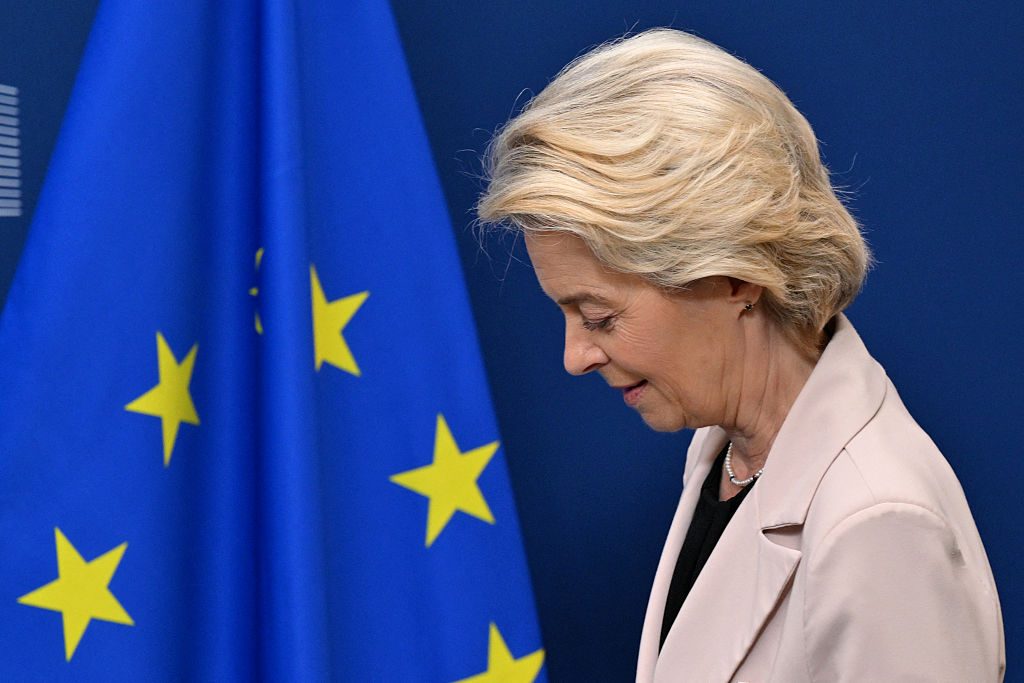
The EU's facade of unity is crumbling. Credit: Getty

The EU's facade of unity is crumbling. Credit: Getty

June 27 2025 - 4:00pm

Pressure is mounting on European Commission President Ursula von der Leyen. On Wednesday, a group of Right-wing MEPs announced that they had secured enough support to table a no-confidence vote against her over concerns about her leadership style, lack of transparency and growing accusations of bypassing democratic norms within the EU’s institutional framework.

The initiative, launched by Romanian far-Right MEP Gheorghe Piperea, stems from the ongoing “Pfizergate” scandal, which escalated in May when the European General Court issued a landmark ruling against the Commission for failing to disclose text messages exchanged between von der Leyen and Pfizer CEO Albert Bourla. These were sent during negotiations in 2021 for the purchase of up to 1.8 billion doses of the Pfizer-BioNTech vaccine at a cost of €35 billion.

Piperea’s motion was supported by 74 MEPs from various cross-party groups — including one from von der Leyen’s own European People’s Party Group — and the vote is expected to take place next month. While the motion has little chance of succeeding due to the high bar of a two-thirds majority, this still represents a serious political hurdle for von der Leyen — and a challenge to the entire Brussels system.

For the first time, the European Parliament will be forced to have a public and official discussion about a scandal that for years has been confined to newspaper reports and courtrooms. “The initiative is fundamentally about upholding transparency and ensuring a fair and genuine democratic process,” Piperea said. He acknowledged that its chances of success are slim, but said it offered a “crucial opportunity for constructive and substantiated criticism” towards the EU Commission President.

This is about more than just Pfizergate. Since her re-election in 2024, von der Leyen has been fiercely criticized from various quarters for her authoritarian approach and systematic sidelining of the Parliament. Last month, for example, the Commission proposed using an emergency clause in the EU treaty to shut MEPs out of approving a €150 billion loan scheme to boost joint procurement of weapons by EU countries, known as SAFE.

Responding to European Parliament President Roberta Metsola, who threatened legal action against the Commission, von der Leyen defended the move, arguing that the emergency clause is “fully justified” as SAFE is “an exceptional and temporary response to an urgent and existential challenge”.

In this sense, Pfizergate symbolizes a broader process of supranationalisation and centralisation of the bloc’s politics, whereby the Commission has progressively increased its influence over areas of competence which have previously been considered the preserve of national governments — from financial budgets and health policy to foreign affairs and defense. Piperea’s motion also mentions this alleged “procedural abuse”. He “calls on the European Commission to resign due to repeated failures to ensure transparency, persistent disregard for democratic oversight and the rule of law within the Union”.

Thus, while the motion is largely driven by Right-wing and conservative factions, it exposes growing dissatisfaction across ideological and party lines. Socialists, liberals and even some Greens — who backed von der Leyen’s re-election — have become increasingly vocal in their criticism of her leadership style, particularly regarding transparency issues and her withdrawal of a greenwashing law without parliamentary consultation. However, these groups explicitly stated they would not support a “far-Right”-led motion.

Ultimately, the no-confidence motion will not topple von der Leyen, but its symbolic force is undeniable. Longstanding concerns over the concentration of power within the Commission can no longer be dismissed as fringe or conspiratorial. By compelling a public debate in the European Parliament, the initiative may begin to tear open the institutional façade of unity and consensus, revealing a growing unease with the EU’s escalating techno-authoritarian regime. Whether or not the motion passes, it signals that the age of unquestioned executive authority in Brussels may be nearing its end — and that a reckoning over the future of EU governance may be fast approaching.


Thomas Fazi is an UnHerd columnist and translator. His latest book is The Covid Consensus, co-authored with Toby Green.

battleforeurope

China is threatening America in the AI race

Reports sugget Zhipu AI  has released a new model that can rival leading US systems. Credit: Getty

Reports sugget Zhipu AI has released a new model that can rival leading US systems. Credit: Getty

July 1 2026 - 10:18am

China is trying to catch up with America on artificial intelligence. The Wall Street Journal has reported that Zhipu AI — one of China’s six “AI tiger” LLMs — has released a new model that can rival leading US systems, including Anthropic’s Mythos, in cybersecurity tasks such as pinpointing security bugs. While this marks a milestone in China’s drive to catch up with Western AI capabilities, strong performance on a single benchmark does not mean it has taken the lead. Chinese models still lag behind their Western counterparts in broader capabilities, such as autonomous operation. Skepticism is therefore warranted before resorting to hysterical conclusions, but complacency about the geopolitical implications of China’s AI advances would be an even greater mistake.

On the infrastructure side, Chinese AI is still constrained by access to advanced chips, with American labs way ahead in computing capacity as well as investment. Analysis from earlier this year suggests that Chinese models are likely to be at least a few months behind those in the US. But they are still continuing to make progress, or that the geopolitical importance of AI will be decided only by whose LLM has ventured deeper into the technological frontier. The practical applications of AI, countries’ to capture foreign markets, and the application of AI into the real economy will matter just as much.

Here, China may hold an advantage. As with its dominance across many critical supply chains, Beijing may not need to produce the most advanced AI systems — only those that are affordable and widely deployable. In doing so, it could consolidate global influence by supplying functional, low-cost AI at scale.

Beijing seems to be pursuing exactly that path, developing an AI “open-source” strategy that offers affordable, widely available AI models for companies and individuals to use and modify as they wish. The production of the DeepSeek AI model, which matched the performance of Silicon Valley tools such as ChatGPT at a fraction of the cost for users, created goodwill among Chinese models with developers.

The four most popular models on OpenRouter, an AI hardware platform for developers, are now all Chinese. The goal for China is not only to win the frontier-model race, but to make its systems the default layer of AI adoption across industries and global markets. For most economies, the choice is increasingly between an affordable tool they can deploy now and a more robust one that may be out of reach.

And while the countries adopting Chinese models may be exposed to political pressure and cyber threats from Beijing, safer and more capable alternatives matter little if they are unaffordable. American AI companies are already under pressure to monetize products whose operating costs are rising. If Chinese open-source models become the cheap default for startups, universities, governments and businesses across the developing world, then America’s AI lead will be eroded from below.

Perhaps more concerning for America in the long run is how AI can give Chinese manufacturing even more strength, through the ongoing integration of AI as a general-purpose technology. China’s new Five-Year Plan mentioned AI more than 50 times and includes an “AI+” action plan aimed at spreading AI across the economy.

Beijing has been pioneering automation of its critical infrastructure for years, with promising recent results in increasing warplane production capacity. In that regard, China’s open-model strategy and manufacturing dominance will reinforce each other. Cheap, adaptable models accelerate deployment across the real economy while those deployments generate real-world data and use cases that can feed back into further model improvement.

The United States should not dismiss the importance of its lead in the AI race. That lead worries Beijing, not least because a more automated Chinese economy would also become more vulnerable to AI-generated cyber threats. But nor should Washington assume that China cannot catch up with American capabilities over time.

This AI competition represents part of a broader struggle over tech supply chains and geopolitical influence. Decisions over whether to adopt US or Chinese models could produce a more fragmented global reality, with different regions relying on different cloud providers, chips and security structures. The result will likely be a global economy which is divided into competing spheres, rather than one which produces a single winner.


Miquel Vila is a political and geopolitical risk consultant focusing on industrial strategy, critical infrastructure and global supply chains.

miquelvilam
