




X Close

Trump’s sanctions threat is directed at Nato, not Russia

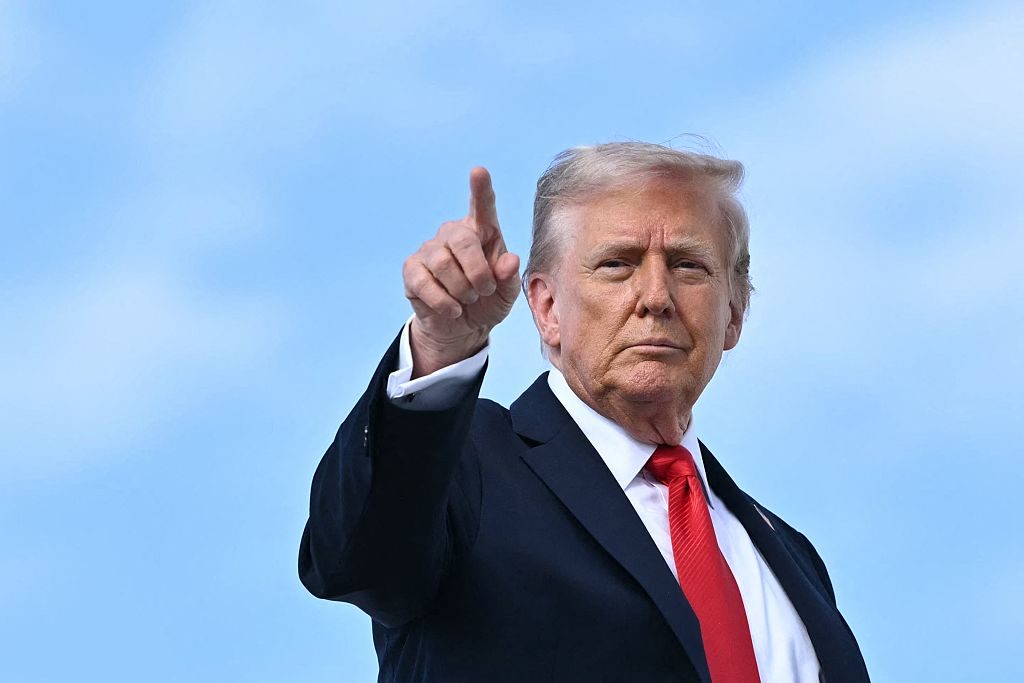
Trump has highlighted fractures in the Western alliance. Credit: Getty

Trump has highlighted fractures in the Western alliance. Credit: Getty

September 14 2025 - 1:00pm

US President Donald Trump has once again announced plans to implement major sanctions on Russia. This time, there is a new condition attached, rather than the past open-ended threats which never materialized. Exhausting both his allies’ patience and his caps lock button, he posted yesterday: “I am ready to do major Sanctions on Russia when all NATO Nations have agreed, and started, to do the same thing, and when all NATO Nations STOP BUYING OIL FROM RUSSIA.”

What is Trump’s strategy here? It might appear that he’s changed his tune, but the statement contains some unmistakably familiar notes. There is the obsession with the US not single-handedly carrying the bulk of responsibility within Nato, as has been demonstrated over defense spending. Ever the dealmaker, Trump’s commercial instincts are also on full display. The EU has pledged to phase out Russian oil by 2028, a timetable that the White House wants accelerated through more purchases from the US. Nuclear power is another flashpoint, with the US urging Europe to switch from Russian to American resources.

Moreover, Trump has lost no appetite for dragging allies into Sino-American tensions. His post added: “I believe that [NATO sanctions on Russia], plus NATO, as a group, placing 50% to 100% tariffs on China, to be fully withdrawn after the war with Russia and Ukraine is ended, will also be of great help in ending this deadly, but ridiculous war.” While the US has been urging European and G7 countries to immediately impose secondary tariffs of between 50% and 100% on Delhi and Beijing for their purchases of Moscow’s oil, Europe has been reluctant due to concerns about the economic impact on its consumers, likely retaliation from China, and damage to its planned trade deal with India.

UK Prime Minister Keir Starmer will this week try to sell the US President on targeted sanctions on those Chinese and Indian companies importing Russian oil, as opposed to tariffs that could “start a trade war”. Yet Trump’s latest bout of public enthusiasm for the idea suggests Starmer will fail in his mission, with the US continuing to use the Ukraine war to make Europe choose between America on the one hand, and China and India on the other.

At first glance, Trump’s latest comments might indicate a push for a coordinated Nato stance or a shift away from his habitual delays on Russia. In reality, they are anything but. Hungary and Slovakia have blamed their continued Russian energy imports on a lack of alternatives, despite studies showing otherwise. Those nations are unlikely to risk their own warm relations with Russian President Vladimir Putin by pursuing other options and, even if they did, it could take time. This provides Trump with the ideal excuse for procrastinating on sanctions against the Kremlin, all while blaming it on others.

It is also notable that Trump’s statement centered on Nato, not Europe. Alliance member Turkey has been the third-largest purchaser of Russian oil since 2023, after China and India. At a time when Russia is aggressively probing Nato defenses, Trump’s words are likely to exacerbate tensions and undermine cohesion within the alliance.

The US President’s latest statement constitutes no real shift in position. Really, he is employing delaying tactics on sanctioning Moscow, seeing Ukraine as only one front in the real battle against China, and eroding Nato unity. Trump isn’t actually singing a different tune. But it will still be music to Putin’s ears.


Bethany Elliott is a writer specialising in Russia and Eastern Europe.

BethanyAElliott

China is threatening America in the AI race

Reports sugget Zhipu AI  has released a new model that can rival leading US systems. Credit: Getty

Reports sugget Zhipu AI has released a new model that can rival leading US systems. Credit: Getty

July 1 2026 - 10:18am

China is trying to catch up with America on artificial intelligence. The Wall Street Journal has reported that Zhipu AI — one of China’s six “AI tiger” LLMs — has released a new model that can rival leading US systems, including Anthropic’s Mythos, in cybersecurity tasks such as pinpointing security bugs. While this marks a milestone in China’s drive to catch up with Western AI capabilities, strong performance on a single benchmark does not mean it has taken the lead. Chinese models still lag behind their Western counterparts in broader capabilities, such as autonomous operation. Skepticism is therefore warranted before resorting to hysterical conclusions, but complacency about the geopolitical implications of China’s AI advances would be an even greater mistake.

On the infrastructure side, Chinese AI is still constrained by access to advanced chips, with American labs way ahead in computing capacity as well as investment. Analysis from earlier this year suggests that Chinese models are likely to be at least a few months behind those in the US. But they are still continuing to make progress, or that the geopolitical importance of AI will be decided only by whose LLM has ventured deeper into the technological frontier. The practical applications of AI, countries’ to capture foreign markets, and the application of AI into the real economy will matter just as much.

Here, China may hold an advantage. As with its dominance across many critical supply chains, Beijing may not need to produce the most advanced AI systems — only those that are affordable and widely deployable. In doing so, it could consolidate global influence by supplying functional, low-cost AI at scale.

Beijing seems to be pursuing exactly that path, developing an AI “open-source” strategy that offers affordable, widely available AI models for companies and individuals to use and modify as they wish. The production of the DeepSeek AI model, which matched the performance of Silicon Valley tools such as ChatGPT at a fraction of the cost for users, created goodwill among Chinese models with developers.

The four most popular models on OpenRouter, an AI hardware platform for developers, are now all Chinese. The goal for China is not only to win the frontier-model race, but to make its systems the default layer of AI adoption across industries and global markets. For most economies, the choice is increasingly between an affordable tool they can deploy now and a more robust one that may be out of reach.

And while the countries adopting Chinese models may be exposed to political pressure and cyber threats from Beijing, safer and more capable alternatives matter little if they are unaffordable. American AI companies are already under pressure to monetize products whose operating costs are rising. If Chinese open-source models become the cheap default for startups, universities, governments and businesses across the developing world, then America’s AI lead will be eroded from below.

Perhaps more concerning for America in the long run is how AI can give Chinese manufacturing even more strength, through the ongoing integration of AI as a general-purpose technology. China’s new Five-Year Plan mentioned AI more than 50 times and includes an “AI+” action plan aimed at spreading AI across the economy.

Beijing has been pioneering automation of its critical infrastructure for years, with promising recent results in increasing warplane production capacity. In that regard, China’s open-model strategy and manufacturing dominance will reinforce each other. Cheap, adaptable models accelerate deployment across the real economy while those deployments generate real-world data and use cases that can feed back into further model improvement.

The United States should not dismiss the importance of its lead in the AI race. That lead worries Beijing, not least because a more automated Chinese economy would also become more vulnerable to AI-generated cyber threats. But nor should Washington assume that China cannot catch up with American capabilities over time.

This AI competition represents part of a broader struggle over tech supply chains and geopolitical influence. Decisions over whether to adopt US or Chinese models could produce a more fragmented global reality, with different regions relying on different cloud providers, chips and security structures. The result will likely be a global economy which is divided into competing spheres, rather than one which produces a single winner.


Miquel Vila is a political and geopolitical risk consultant focusing on industrial strategy, critical infrastructure and global supply chains.

miquelvilam