



X Close

Trump’s order on sanctuary cities is a trap for Democrats

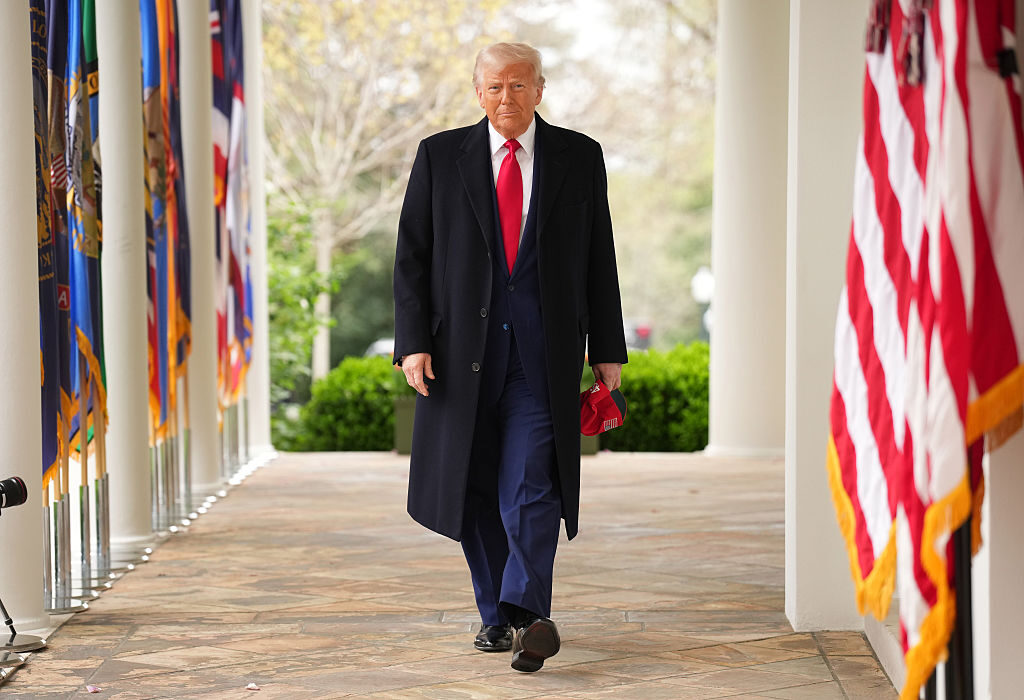
Trump's handling of immigration remains one of his most popular policy areas. Credit: Getty

Trump's handling of immigration remains one of his most popular policy areas. Credit: Getty

April 29 2025 - 7:15pm

In a new executive order published yesterday, President Donald Trump placed a target on sanctuary cities and created yet another trap for his political foes. This new proposal requires the federal government to create a list of “sanctuary” jurisdictions which refuse to cooperate with federal authorities on immigration law. It instructs various federal departments to defund sanctuary jurisdictions as much as they can under current law, and also to establish policies which verify the legal status of those who receive federal benefits in sanctuary jurisdictions.

What’s more, this executive order telegraphs that the Trump administration may escalate its legal battles. It says that state and local officials are engaged in “lawless insurrection” when they refuse to cooperate with federal immigration efforts. It warns that these “nullification efforts” may violate federal laws, including by obstructing justice, unlawfully harboring or hiring illegal aliens, and engaging in a conspiracy against the United States or to impede federal law enforcement. The fingerprints of arch-border hawk Stephen Miller can be seen in this take-no-prisoners approach to immigration enforcement.

Trump’s handling of immigration — especially border security — remains one of his strongest areas when measured by public opinion polls, so this new executive order is a way to help shift the policy conversation onto favored terrain. In raising the salience of sanctuary cities, the EO also casts a spotlight on the internal tensions of the Democratic coalition.

Perhaps MAGA’s main critique of the progressive stance on immigration is that these progressives are more committed to the vision of open borders than the wellbeing of their fellow Americans. The border crisis which sullied the Biden years helped push more working-class voters into the Republican column in 2024, as well as making the American public as a whole more hawkish on illegal immigration than it has been in decades.

In this executive order, the Trump administration has a target tailor-made for populist plaudits: not illegal immigrants themselves, but progressive elites who have tried to create zones of non-enforcement on immigration law. Democratic elected officials resisting federal immigration law are less likely to inspire sympathy than some deported migrants do. The order also calls out states that provide in-state tuition to illegal immigrants. Tellingly, the White House titles that section “Equal Treatment of Americans”, and giving illegal immigrants a lower tuition rate than US citizens crystallizes populist complaints that the progressive project on borders undermines national cohesion.

Trump’s well-honed ability to provoke his opponents has been essential for his political success, and this new gambit on sanctuary cities is a fluttering red cape for progressives. The identity-politics activist base continues to loathe immigration enforcement and remains skeptical about limits on newcomers. In part because of their party’s political vulnerability on the issue, some Democrats would like to moderate on immigration. Earlier this year, a splinter faction of Democrats voted for the Laken Riley Act, requiring illegal immigrants arrested for certain crimes to be detained. At the same time, the progressive grassroots is eager for a full-spectrum clash with Trump, and Democratic officeholders — such as Boston mayor Michelle Wu — have boosted their profiles by defending sanctuary policies.

Within the Democratic upper echelons, the incentives for charging at this red cape are great indeed, but that process-oriented argument about how states and cities should be free to “resist” federal immigration efforts is precisely the battle Trump wants. By offering strident justifications for why illegal immigrants deserve discounted tuition or reduced criminal penalties, progressive elites would drive away working-class voters. In the escalatory spiral of contemporary American politics, immigration has become a central battlefield.


Fred Bauer is a writer from New England.

fredbauerblog

China is threatening America in the AI race

Reports sugget Zhipu AI  has released a new model that can rival leading US systems. Credit: Getty

Reports sugget Zhipu AI has released a new model that can rival leading US systems. Credit: Getty

July 1 2026 - 10:18am

China is trying to catch up with America on artificial intelligence. The Wall Street Journal has reported that Zhipu AI — one of China’s six “AI tiger” LLMs — has released a new model that can rival leading US systems, including Anthropic’s Mythos, in cybersecurity tasks such as pinpointing security bugs. While this marks a milestone in China’s drive to catch up with Western AI capabilities, strong performance on a single benchmark does not mean it has taken the lead. Chinese models still lag behind their Western counterparts in broader capabilities, such as autonomous operation. Skepticism is therefore warranted before resorting to hysterical conclusions, but complacency about the geopolitical implications of China’s AI advances would be an even greater mistake.

On the infrastructure side, Chinese AI is still constrained by access to advanced chips, with American labs way ahead in computing capacity as well as investment. Analysis from earlier this year suggests that Chinese models are likely to be at least a few months behind those in the US. But they are still continuing to make progress, or that the geopolitical importance of AI will be decided only by whose LLM has ventured deeper into the technological frontier. The practical applications of AI, countries’ to capture foreign markets, and the application of AI into the real economy will matter just as much.

Here, China may hold an advantage. As with its dominance across many critical supply chains, Beijing may not need to produce the most advanced AI systems — only those that are affordable and widely deployable. In doing so, it could consolidate global influence by supplying functional, low-cost AI at scale.

Beijing seems to be pursuing exactly that path, developing an AI “open-source” strategy that offers affordable, widely available AI models for companies and individuals to use and modify as they wish. The production of the DeepSeek AI model, which matched the performance of Silicon Valley tools such as ChatGPT at a fraction of the cost for users, created goodwill among Chinese models with developers.

The four most popular models on OpenRouter, an AI hardware platform for developers, are now all Chinese. The goal for China is not only to win the frontier-model race, but to make its systems the default layer of AI adoption across industries and global markets. For most economies, the choice is increasingly between an affordable tool they can deploy now and a more robust one that may be out of reach.

And while the countries adopting Chinese models may be exposed to political pressure and cyber threats from Beijing, safer and more capable alternatives matter little if they are unaffordable. American AI companies are already under pressure to monetize products whose operating costs are rising. If Chinese open-source models become the cheap default for startups, universities, governments and businesses across the developing world, then America’s AI lead will be eroded from below.

Perhaps more concerning for America in the long run is how AI can give Chinese manufacturing even more strength, through the ongoing integration of AI as a general-purpose technology. China’s new Five-Year Plan mentioned AI more than 50 times and includes an “AI+” action plan aimed at spreading AI across the economy.

Beijing has been pioneering automation of its critical infrastructure for years, with promising recent results in increasing warplane production capacity. In that regard, China’s open-model strategy and manufacturing dominance will reinforce each other. Cheap, adaptable models accelerate deployment across the real economy while those deployments generate real-world data and use cases that can feed back into further model improvement.

The United States should not dismiss the importance of its lead in the AI race. That lead worries Beijing, not least because a more automated Chinese economy would also become more vulnerable to AI-generated cyber threats. But nor should Washington assume that China cannot catch up with American capabilities over time.

This AI competition represents part of a broader struggle over tech supply chains and geopolitical influence. Decisions over whether to adopt US or Chinese models could produce a more fragmented global reality, with different regions relying on different cloud providers, chips and security structures. The result will likely be a global economy which is divided into competing spheres, rather than one which produces a single winner.


Miquel Vila is a political and geopolitical risk consultant focusing on industrial strategy, critical infrastructure and global supply chains.

miquelvilam
