



X Close

Trump’s Lance Schroyer pick shows nobody wants to run ICE

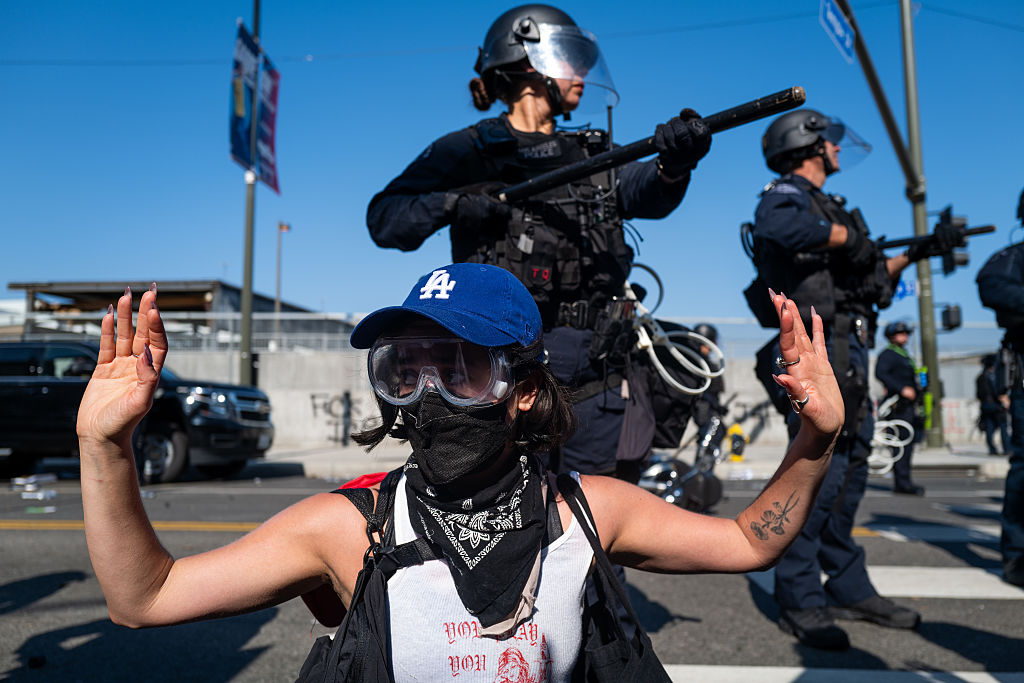
ICE raids have prompted a series of protests across America in the last year. Credit: Getty

ICE raids have prompted a series of protests across America in the last year. Credit: Getty

June 29 2026 - 6:15pm

Who on earth is Lance Schroyer? It’s a question on the lips of many political observers in the United States following President Donald Trump’s announcement that Schroyer will be his nominee as director of Immigration and Customs Enforcement.

The agency — which has frequently been in the national spotlight as it has led the crackdown on illegal immigration that was a centerpiece of Trump’s 2024 campaign — has been without a permanent, Senate-confirmed leader since 2017, when Barack Obama’s head of ICE, Sarah Saldaña, left office. Trump never got anyone confirmed to the job in his first term, nor did Joe Biden. Instead, a parade of 13 acting directors has led the agency over the past nine years.

If that seems like a long time for an important agency to have its top job sit vacant, that’s because it is. Understandably, the job went unfilled during Biden’s term: the policy of that administration was essentially one of open borders, and few Democrats would want the job of standing in the way of that. Biden wanted ICE to process illegal immigrants’ asylum claims — real or invented — and to speed them on their way, with no bold leadership required.

Trump, however, clearly has a different agenda, and ICE became the most prominent part of his administration for a time last winter as its officers surged into several American cities to capture and deport illegal migrants there while battling the crowds of protesters — peaceful and not-so-peaceful — who gathered to oppose them. This was an administrative agency in need of a firm hand, but it had none. “Border Czar” Tom Homan, one of the 13 former acting directors, finally had to take charge of the effort.

So why was there no one nominated to lead ICE until now? It is, perhaps, a symptom of a larger problem across the administration: many people who would be leading candidates for the job do not want to work there. The President is increasingly unpopular and facing a midterm rebuke in November. Candidates with better national reputations may not want to board a sinking ship.

ICE is an especially hot assignment, since the near-riots in Minnesota that led to the deaths of protesters Renée Good and Alex Pretti. But even beyond ICE, there is a steady diminution of the caliber of candidates Trump has been able to put forward for vacancies.

This is not a criticism of Schroyer, only a recognition that he is a fairly obscure figure for such an important job. He may yet be good at it. According to his Wikipedia page — which was created two days ago — Schroyer has a career in law enforcement spanning more than 30 years. That sets him apart from most people in the country, but Trump could also have found a cop with that much experience in nearly any city or county in the nation.

Schroyer’s confirmation hearings will answer many of the questions about him, and the Senate may even confirm him. But the larger question for the Trump administration is this: does anyone want to work at ICE?


Kyle Sammin is the managing editor of Broad + Liberty. Follow him on Twitter at @KyleSammin.


China is threatening America in the AI race

Reports sugget Zhipu AI  has released a new model that can rival leading US systems. Credit: Getty

Reports sugget Zhipu AI has released a new model that can rival leading US systems. Credit: Getty

July 1 2026 - 10:18am

China is trying to catch up with America on artificial intelligence. The Wall Street Journal has reported that Zhipu AI — one of China’s six “AI tiger” LLMs — has released a new model that can rival leading US systems, including Anthropic’s Mythos, in cybersecurity tasks such as pinpointing security bugs. While this marks a milestone in China’s drive to catch up with Western AI capabilities, strong performance on a single benchmark does not mean it has taken the lead. Chinese models still lag behind their Western counterparts in broader capabilities, such as autonomous operation. Skepticism is therefore warranted before resorting to hysterical conclusions, but complacency about the geopolitical implications of China’s AI advances would be an even greater mistake.

On the infrastructure side, Chinese AI is still constrained by access to advanced chips, with American labs way ahead in computing capacity as well as investment. Analysis from earlier this year suggests that Chinese models are likely to be at least a few months behind those in the US. But they are still continuing to make progress, or that the geopolitical importance of AI will be decided only by whose LLM has ventured deeper into the technological frontier. The practical applications of AI, countries’ to capture foreign markets, and the application of AI into the real economy will matter just as much.

Here, China may hold an advantage. As with its dominance across many critical supply chains, Beijing may not need to produce the most advanced AI systems — only those that are affordable and widely deployable. In doing so, it could consolidate global influence by supplying functional, low-cost AI at scale.

Beijing seems to be pursuing exactly that path, developing an AI “open-source” strategy that offers affordable, widely available AI models for companies and individuals to use and modify as they wish. The production of the DeepSeek AI model, which matched the performance of Silicon Valley tools such as ChatGPT at a fraction of the cost for users, created goodwill among Chinese models with developers.

The four most popular models on OpenRouter, an AI hardware platform for developers, are now all Chinese. The goal for China is not only to win the frontier-model race, but to make its systems the default layer of AI adoption across industries and global markets. For most economies, the choice is increasingly between an affordable tool they can deploy now and a more robust one that may be out of reach.

And while the countries adopting Chinese models may be exposed to political pressure and cyber threats from Beijing, safer and more capable alternatives matter little if they are unaffordable. American AI companies are already under pressure to monetize products whose operating costs are rising. If Chinese open-source models become the cheap default for startups, universities, governments and businesses across the developing world, then America’s AI lead will be eroded from below.

Perhaps more concerning for America in the long run is how AI can give Chinese manufacturing even more strength, through the ongoing integration of AI as a general-purpose technology. China’s new Five-Year Plan mentioned AI more than 50 times and includes an “AI+” action plan aimed at spreading AI across the economy.

Beijing has been pioneering automation of its critical infrastructure for years, with promising recent results in increasing warplane production capacity. In that regard, China’s open-model strategy and manufacturing dominance will reinforce each other. Cheap, adaptable models accelerate deployment across the real economy while those deployments generate real-world data and use cases that can feed back into further model improvement.

The United States should not dismiss the importance of its lead in the AI race. That lead worries Beijing, not least because a more automated Chinese economy would also become more vulnerable to AI-generated cyber threats. But nor should Washington assume that China cannot catch up with American capabilities over time.

This AI competition represents part of a broader struggle over tech supply chains and geopolitical influence. Decisions over whether to adopt US or Chinese models could produce a more fragmented global reality, with different regions relying on different cloud providers, chips and security structures. The result will likely be a global economy which is divided into competing spheres, rather than one which produces a single winner.


Miquel Vila is a political and geopolitical risk consultant focusing on industrial strategy, critical infrastructure and global supply chains.

miquelvilam
