




X Close

Trump’s gender executive order is a return to common sense

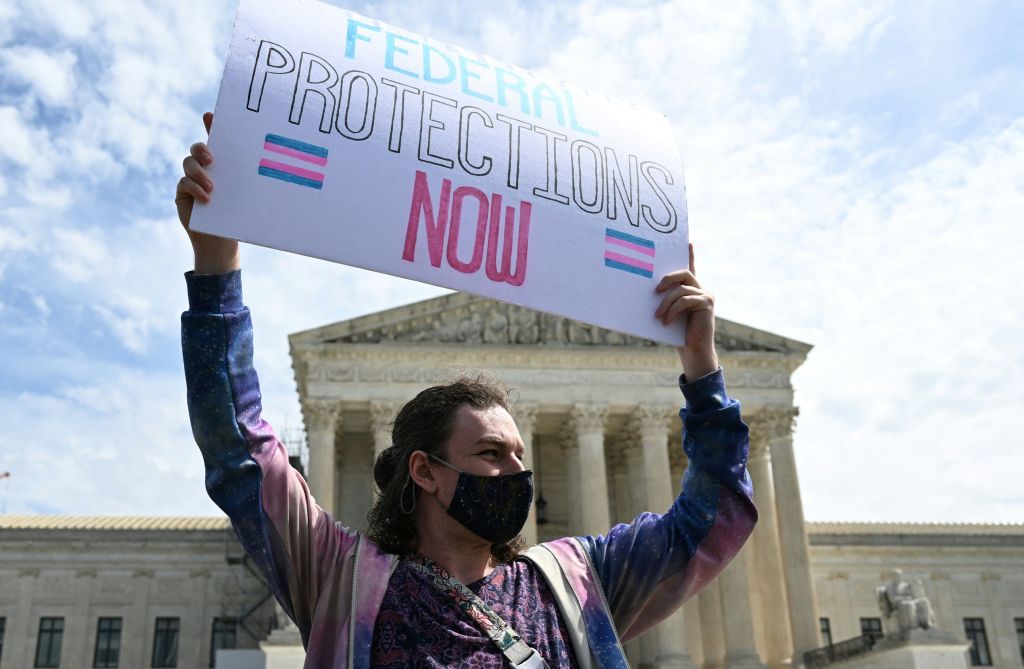
Protests from the trans lobby won't change the direction of travel. Credit: Getty

Protests from the trans lobby won't change the direction of travel. Credit: Getty

January 29 2025 - 3:30pm

Yesterday, President Donald Trump released yet another executive order, this one entitled “Protecting Children from Chemical and Surgical Mutilation.”

It notes that “countless children” regret their sex-trait alterations — women who can’t breastfeed after cosmetic mastectomies; a lifetime of medical bills; “a losing war with their own bodies,” and, in some cases, sterilization. Thus, the United States “will not fund, sponsor, promote, assist, or support the so-called ‘transition’ of a child from one sex to another.”

“Child,” in this case, means anyone under 19 years old, although “minor” might have been the more appropriate term. “Chemical and surgical mutilation” refers to cross-sex hormones, surgeries, and puberty blockers — not for precocious puberty, in which the body matures too early, but “to delay the onset or progression of normally timed puberty in an individual who does not identify as his or her sex.” That is: just for trans-identified youth.

To many of us who’ve studied this issue, Trump’s directives seem reasonable. First, it forbids funding to hospitals or medical schools which provide these procedures, preventing them from being covered by the government-funded insurance programs Medicaid and Medicare and the military insurance program Tricare. It notes that ending these practices may involve getting rid of section 1557 of the Patient Protection and Affordable Care Act, which prohibited discrimination based on gender identity, but what power the administration has to override it, we don’t yet know.

The institutionalization of “gender identity” as a fact, rather than a feeling, laid the groundwork for biological males in women’s sports, locker rooms, bathrooms, and prisons. Allowing men to be treated legally as women turned out to be profoundly destabilizing, especially when any objection to it was dismissed by the Left as bigoted or hateful. These were heavy-handed policies protected in censorship, spearheaded by advocacy groups like World Professional Association for Transgender Health (WPATH).

That is why the order specifically directs the unseating of the WPATH, which created the “standards of care” for patients’ “lasting personal comfort with their gendered selves”. The order refers to this as “Ending Reliance on Junk Science,” and demands that the Secretary of Health and Human Services (HHS), “publish a review of the existing literature on best practices” to treat young people with gender dysphoria. That includes “rapid-onset gender dysphoria,” a term that WPATH and others on the Left have worked hard to discredit, but which clearly exists. HHS should “use all available methods to increase the quality of data to guide practices,” it reads.

The executive order also directs the FDA to investigate those providing misinformation “about long-term side effects of chemical and surgical mutilation,” and demands the extension of statutes of limitations for those who’ve been hurt by gender-affirming care to sue, and the protection of whistleblowers. Extending the statute of limitations is a good thing, especially when it seems that it can take over a decade before those who’ve medically transitioned realize they’ve been harmed. Providers of these interventions should — must — be honest about their long-term implications.

Elsewhere, the order calls for ending “child-abusive practices by so-called sanctuary States.” These are the blue-state laws that indemnify practitioners who provide gender-affirming care to minors from states where it’s banned, but which may also suggest that children who run away and become wards of the state can access those interventions without parental or consent. Thus, Trump suggests applying the Parental Kidnapping Prevention Act to override them.

This lack of oversight is one of the key issues at the heart of the trans movement. We’ve long needed evidence-based guidelines instead of activist-based guidelines, but as documents unsealed in lawsuits revealed, WPATH suppressed systematic evidence reviews because they didn’t support gender-affirming care for adolescents.

Indeed, to this day, we don’t necessarily know what the data tells us about best practices going forward. There is no good data or robust follow-up studies. The order refers to “countless children” who regret their transition, but we don’t know how many there are. Trump insists on “a single, combined report,” which will detail “progress in implementing this order and a timeline for future action.” That report isn’t asking for this missing data, just a progress report on shutting it all down.

It wasn’t long ago that many Americans, especially Democrats, supported gender-affirming care and “trans rights”. But as they’ve come to understand what these amorphous phrases meant, they’ve shifted their stances. The majority of Americans no longer believe that boys should play on girls’ sports teams, or that minors should receive sex changes. Will those moderates be able to see that this executive order is in line with their thinking, or will they be overwhelmed by the barrage of directives that they can’t tell which are reasonable and which aren’t? We don’t know, but, for now at least, this executive order is a welcome corrective.


Lisa Selin Davis is the author of Tomboy. She writes at Broadview on Substack.

LisaSelinDavis

China is threatening America in the AI race

Reports sugget Zhipu AI  has released a new model that can rival leading US systems. Credit: Getty

Reports sugget Zhipu AI has released a new model that can rival leading US systems. Credit: Getty

July 1 2026 - 10:18am

China is trying to catch up with America on artificial intelligence. The Wall Street Journal has reported that Zhipu AI — one of China’s six “AI tiger” LLMs — has released a new model that can rival leading US systems, including Anthropic’s Mythos, in cybersecurity tasks such as pinpointing security bugs. While this marks a milestone in China’s drive to catch up with Western AI capabilities, strong performance on a single benchmark does not mean it has taken the lead. Chinese models still lag behind their Western counterparts in broader capabilities, such as autonomous operation. Skepticism is therefore warranted before resorting to hysterical conclusions, but complacency about the geopolitical implications of China’s AI advances would be an even greater mistake.

On the infrastructure side, Chinese AI is still constrained by access to advanced chips, with American labs way ahead in computing capacity as well as investment. Analysis from earlier this year suggests that Chinese models are likely to be at least a few months behind those in the US. But they are still continuing to make progress, or that the geopolitical importance of AI will be decided only by whose LLM has ventured deeper into the technological frontier. The practical applications of AI, countries’ to capture foreign markets, and the application of AI into the real economy will matter just as much.

Here, China may hold an advantage. As with its dominance across many critical supply chains, Beijing may not need to produce the most advanced AI systems — only those that are affordable and widely deployable. In doing so, it could consolidate global influence by supplying functional, low-cost AI at scale.

Beijing seems to be pursuing exactly that path, developing an AI “open-source” strategy that offers affordable, widely available AI models for companies and individuals to use and modify as they wish. The production of the DeepSeek AI model, which matched the performance of Silicon Valley tools such as ChatGPT at a fraction of the cost for users, created goodwill among Chinese models with developers.

The four most popular models on OpenRouter, an AI hardware platform for developers, are now all Chinese. The goal for China is not only to win the frontier-model race, but to make its systems the default layer of AI adoption across industries and global markets. For most economies, the choice is increasingly between an affordable tool they can deploy now and a more robust one that may be out of reach.

And while the countries adopting Chinese models may be exposed to political pressure and cyber threats from Beijing, safer and more capable alternatives matter little if they are unaffordable. American AI companies are already under pressure to monetize products whose operating costs are rising. If Chinese open-source models become the cheap default for startups, universities, governments and businesses across the developing world, then America’s AI lead will be eroded from below.

Perhaps more concerning for America in the long run is how AI can give Chinese manufacturing even more strength, through the ongoing integration of AI as a general-purpose technology. China’s new Five-Year Plan mentioned AI more than 50 times and includes an “AI+” action plan aimed at spreading AI across the economy.

Beijing has been pioneering automation of its critical infrastructure for years, with promising recent results in increasing warplane production capacity. In that regard, China’s open-model strategy and manufacturing dominance will reinforce each other. Cheap, adaptable models accelerate deployment across the real economy while those deployments generate real-world data and use cases that can feed back into further model improvement.

The United States should not dismiss the importance of its lead in the AI race. That lead worries Beijing, not least because a more automated Chinese economy would also become more vulnerable to AI-generated cyber threats. But nor should Washington assume that China cannot catch up with American capabilities over time.

This AI competition represents part of a broader struggle over tech supply chains and geopolitical influence. Decisions over whether to adopt US or Chinese models could produce a more fragmented global reality, with different regions relying on different cloud providers, chips and security structures. The result will likely be a global economy which is divided into competing spheres, rather than one which produces a single winner.


Miquel Vila is a political and geopolitical risk consultant focusing on industrial strategy, critical infrastructure and global supply chains.

miquelvilam