




X Close

Trump’s crypto reserve could create a market bubble

All aboard the Bitcoin train. Credit: Getty

All aboard the Bitcoin train. Credit: Getty

March 3 2025 - 7:30pm

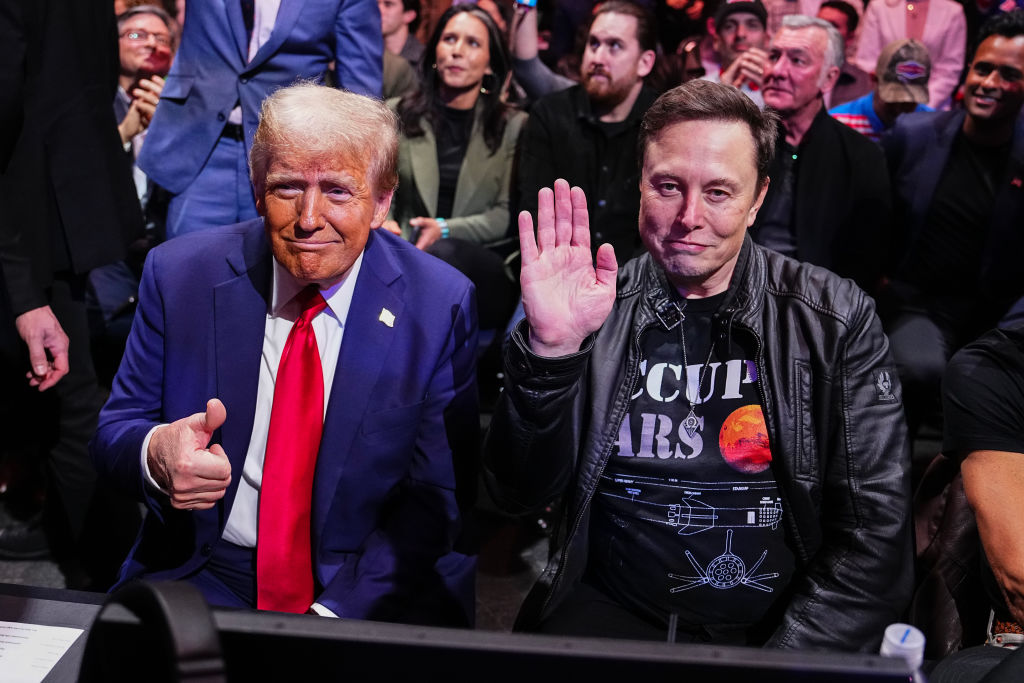
Elon Musk and Donald Trump are still trailing their auditing trip to Fort Knox, to figure out what’s gold bullion, and what’s gold spray-painted polystyrene blocks. But the question circulating on Sunday was more esoteric than whether there is still any gold in the US Treasury: namely, what is the digital equivalent of Fort Knox? Is there a wallet yet made that could safely hold $100 billion?

Yesterday, the US President announced a “new strategic reserve” of cryptocurrency. This would, he claimed in a post on Truth Social, make the US “the Crypto Capital of the World”. Immediately afterwards, the prices of the five coins he named in the initial reserve — Bitcoin, Ethereum, XRP, Solana and Cardano — spiked by about 60%, illustrating just how volatile crypto is.

The plan is that the US Government will hold these in much the way that the Treasury holds gold, or foreign bonds as a hedge. What sets crypto apart, however, is that it is highly correlated with precisely the kinds of market downturns that one would normally hedge against. One might wonder why the US Government should be getting into the game at all — only this is a regime which likes shiny new things, while crypto entrepreneurs like to finance Trump’s election campaigns.

One Republican-backed Senate bill wants to direct the US Treasury to buy one million Bitcoin. Were the cryptocurrency to shoot up in value across the next decade as much it has done in the last one, that stock would be worth over a trillion dollars. As a matter of neo-cold war geopolitics, the argument goes, it would be better that America has the biggest stake in crypto, rather than the Chinese or the Russians. But, much like sending a dog into space, while impressive, the exact strategic payoff here is harder to see.

In many ways, it’s the opposite of a hedge, traditionally an insurance against loss. Instead, Trump’s crypto strategy is an insurance against enemy profit, which takes government into the realm of mere gambling. The point of governments holding gold or bonds is historically that they might be sold off in order to defend the national currency; selling off Bitcoin to shore up the dollar is a far more indirect act.

Another proposal is to use the stock of cryptocurrencies already confiscated by the FBI and other agencies from criminals. This would at least take the sting out of throwing taxpayers’ money at the reserve. Musk is also set to launch X Money — another key step on his road to the “everything app” he wants X to be. X Money will inevitably feature crypto trading, as Revolut and Cash App already do.

Of course, top of Trump’s reasons for the strategic reserve is simply “the legitimation of crypto”, growing the industry by giving it the halo of government backing. Yet legitimation without utility is an obvious negative, and the energy now clustering around crypto represents a market misallocation. Real dollars are being spent buying up imaginary assets: dollars that could be used to found real companies. Even as he rips down the fake economy of, say, USAID with one hand, Trump erects a whole new Potemkin city with the other. It’s going to be a confusing four years.


Gavin Haynes is a journalist and former editor-at-large at Vice.

@gavhaynes

China is threatening America in the AI race

Reports sugget Zhipu AI  has released a new model that can rival leading US systems. Credit: Getty

Reports sugget Zhipu AI has released a new model that can rival leading US systems. Credit: Getty

July 1 2026 - 10:18am

China is trying to catch up with America on artificial intelligence. The Wall Street Journal has reported that Zhipu AI — one of China’s six “AI tiger” LLMs — has released a new model that can rival leading US systems, including Anthropic’s Mythos, in cybersecurity tasks such as pinpointing security bugs. While this marks a milestone in China’s drive to catch up with Western AI capabilities, strong performance on a single benchmark does not mean it has taken the lead. Chinese models still lag behind their Western counterparts in broader capabilities, such as autonomous operation. Skepticism is therefore warranted before resorting to hysterical conclusions, but complacency about the geopolitical implications of China’s AI advances would be an even greater mistake.

On the infrastructure side, Chinese AI is still constrained by access to advanced chips, with American labs way ahead in computing capacity as well as investment. Analysis from earlier this year suggests that Chinese models are likely to be at least a few months behind those in the US. But they are still continuing to make progress, or that the geopolitical importance of AI will be decided only by whose LLM has ventured deeper into the technological frontier. The practical applications of AI, countries’ to capture foreign markets, and the application of AI into the real economy will matter just as much.

Here, China may hold an advantage. As with its dominance across many critical supply chains, Beijing may not need to produce the most advanced AI systems — only those that are affordable and widely deployable. In doing so, it could consolidate global influence by supplying functional, low-cost AI at scale.

Beijing seems to be pursuing exactly that path, developing an AI “open-source” strategy that offers affordable, widely available AI models for companies and individuals to use and modify as they wish. The production of the DeepSeek AI model, which matched the performance of Silicon Valley tools such as ChatGPT at a fraction of the cost for users, created goodwill among Chinese models with developers.

The four most popular models on OpenRouter, an AI hardware platform for developers, are now all Chinese. The goal for China is not only to win the frontier-model race, but to make its systems the default layer of AI adoption across industries and global markets. For most economies, the choice is increasingly between an affordable tool they can deploy now and a more robust one that may be out of reach.

And while the countries adopting Chinese models may be exposed to political pressure and cyber threats from Beijing, safer and more capable alternatives matter little if they are unaffordable. American AI companies are already under pressure to monetize products whose operating costs are rising. If Chinese open-source models become the cheap default for startups, universities, governments and businesses across the developing world, then America’s AI lead will be eroded from below.

Perhaps more concerning for America in the long run is how AI can give Chinese manufacturing even more strength, through the ongoing integration of AI as a general-purpose technology. China’s new Five-Year Plan mentioned AI more than 50 times and includes an “AI+” action plan aimed at spreading AI across the economy.

Beijing has been pioneering automation of its critical infrastructure for years, with promising recent results in increasing warplane production capacity. In that regard, China’s open-model strategy and manufacturing dominance will reinforce each other. Cheap, adaptable models accelerate deployment across the real economy while those deployments generate real-world data and use cases that can feed back into further model improvement.

The United States should not dismiss the importance of its lead in the AI race. That lead worries Beijing, not least because a more automated Chinese economy would also become more vulnerable to AI-generated cyber threats. But nor should Washington assume that China cannot catch up with American capabilities over time.

This AI competition represents part of a broader struggle over tech supply chains and geopolitical influence. Decisions over whether to adopt US or Chinese models could produce a more fragmented global reality, with different regions relying on different cloud providers, chips and security structures. The result will likely be a global economy which is divided into competing spheres, rather than one which produces a single winner.


Miquel Vila is a political and geopolitical risk consultant focusing on industrial strategy, critical infrastructure and global supply chains.

miquelvilam