




X Close

Trump isn’t ‘chickening out’ on tariffs

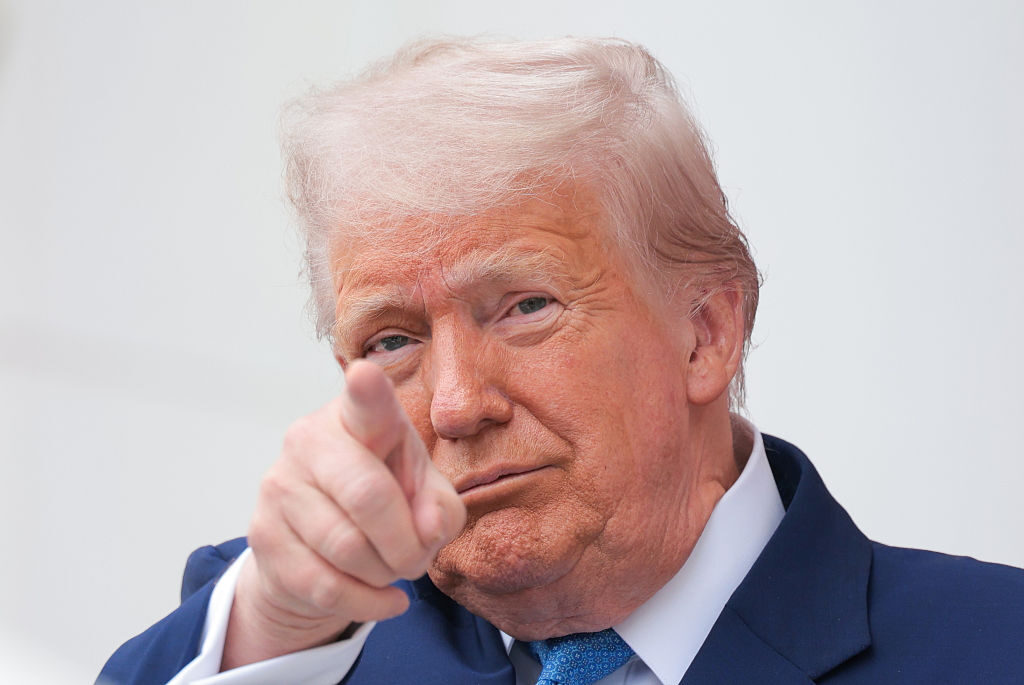
In TACO we trust. Credit: Getty

In TACO we trust. Credit: Getty

May 30 2025 - 2:00pm

“You call that chickening out?” Donald Trump asked a reporter on Wednesday. The question was rhetorical.

The US President had been pressed for a response to Wall Street’s emerging belief in the “TACO trade” — a theory first outlined by Financial Times columnist Robert Armstrong. The acronym stands for “Trump Always Chickens Out”, and is intended to explain why markets rally when the President cuts trade deals. On 2 May, Armstrong explained that the “recent rally has a lot to do with markets realizing that the US administration does not have a very high tolerance for market and economic pressure, and will be quick to back off when tariffs cause pain”.

The label stuck. By Tuesday, after Trump delayed a 50% tariff on the European Union, a New York Times headline read: “Stocks Rally on the ‘TACO Trade’”. Asked about the coinage, Trump unloaded on the reporter with a two-minute response. “It’s called negotiation — you set a number,” he replied, concluding: “Don’t ever say what you said. That’s a nasty question.” Since then, a US court has ruled that the President “exceeded his authority” when he implemented global tariffs. That ruling has itself now been temporarily halted on appeal.

But TACO traders and Trump can both be correct. It’s a question of semantics. The President can’t set tariff rates high enough to frighten another country into negotiating without, at some point, being willing to land on a lower number. The exaggerated high number is meant to make the lower, actual target seem like a compromise. This undermines the pejorative description of Trump “chickening out”, unless one believes he’s caving without accomplishing his negotiation goals for fear of “market and economic pressure”, as Armstrong put it.

Is Trump chickening out or successfully playing hardball? The answer really depends on what his goal is and whether it’s being met. When he declared a national emergency on “Liberation Day”, that declaration was predicated on “underlying conditions, including a lack of reciprocity in our bilateral trade relationships, disparate tariff rates and non-tariff barriers, and US trading partners’ economic policies that suppress domestic wages and consumption”. On this basis, it’s too early to tell — but Republicans are putting their hopes in the “One Big, Beautiful Bill” to couple Trump’s sticks with some carrots in their efforts to spur onshoring.

It’s also hard to say that a man who implemented and maintained a 10% unilateral tariff on all nations is chickening out. That rate does not appear to be going anywhere for the foreseeable future. “Trump’s Threatened Tariffs Are So Large, 10% Feels Like a Relief,” read a NYT headline earlier this month.

What’s more, the White House can point to a handful of examples which show Trump’s tariff negotiations successfully persuading manufacturers to invest in heavier domestic operations. The evening after Liberation Day, Reuters reported that General Motors was increasing its truck production in Indiana as a result of Trump’s tariffs.

There’s no doubt the policy will create some good jobs in the short term. But over the long run, the sheer volatility of a president imposing or lifting sweeping tariffs at will could prompt many businesses to shift investment elsewhere, ultimately doing more harm than good. That unpredictability makes it hard to forecast what will happen once the current pause ends. Even then, experts will face a complex task disentangling the economic gains from the losses.

In the end, calling Trump’s moves “chickening out” may miss the point. If the goal is to use bold threats to extract better trade terms without triggering full-scale economic fallout, then backing off at the right moment isn’t weakness — it’s strategy. Critics may scoff at the theatrics, but markets and foreign negotiators alike are paying attention. For all the noise, Trump may be doing exactly what he set out to do: keeping America’s leverage high and its options open.


Emily Jashinsky is UnHerd‘s Washington correspondent.

emilyjashinsky

China is threatening America in the AI race

Reports sugget Zhipu AI  has released a new model that can rival leading US systems. Credit: Getty

Reports sugget Zhipu AI has released a new model that can rival leading US systems. Credit: Getty

July 1 2026 - 10:18am

China is trying to catch up with America on artificial intelligence. The Wall Street Journal has reported that Zhipu AI — one of China’s six “AI tiger” LLMs — has released a new model that can rival leading US systems, including Anthropic’s Mythos, in cybersecurity tasks such as pinpointing security bugs. While this marks a milestone in China’s drive to catch up with Western AI capabilities, strong performance on a single benchmark does not mean it has taken the lead. Chinese models still lag behind their Western counterparts in broader capabilities, such as autonomous operation. Skepticism is therefore warranted before resorting to hysterical conclusions, but complacency about the geopolitical implications of China’s AI advances would be an even greater mistake.

On the infrastructure side, Chinese AI is still constrained by access to advanced chips, with American labs way ahead in computing capacity as well as investment. Analysis from earlier this year suggests that Chinese models are likely to be at least a few months behind those in the US. But they are still continuing to make progress, or that the geopolitical importance of AI will be decided only by whose LLM has ventured deeper into the technological frontier. The practical applications of AI, countries’ to capture foreign markets, and the application of AI into the real economy will matter just as much.

Here, China may hold an advantage. As with its dominance across many critical supply chains, Beijing may not need to produce the most advanced AI systems — only those that are affordable and widely deployable. In doing so, it could consolidate global influence by supplying functional, low-cost AI at scale.

Beijing seems to be pursuing exactly that path, developing an AI “open-source” strategy that offers affordable, widely available AI models for companies and individuals to use and modify as they wish. The production of the DeepSeek AI model, which matched the performance of Silicon Valley tools such as ChatGPT at a fraction of the cost for users, created goodwill among Chinese models with developers.

The four most popular models on OpenRouter, an AI hardware platform for developers, are now all Chinese. The goal for China is not only to win the frontier-model race, but to make its systems the default layer of AI adoption across industries and global markets. For most economies, the choice is increasingly between an affordable tool they can deploy now and a more robust one that may be out of reach.

And while the countries adopting Chinese models may be exposed to political pressure and cyber threats from Beijing, safer and more capable alternatives matter little if they are unaffordable. American AI companies are already under pressure to monetize products whose operating costs are rising. If Chinese open-source models become the cheap default for startups, universities, governments and businesses across the developing world, then America’s AI lead will be eroded from below.

Perhaps more concerning for America in the long run is how AI can give Chinese manufacturing even more strength, through the ongoing integration of AI as a general-purpose technology. China’s new Five-Year Plan mentioned AI more than 50 times and includes an “AI+” action plan aimed at spreading AI across the economy.

Beijing has been pioneering automation of its critical infrastructure for years, with promising recent results in increasing warplane production capacity. In that regard, China’s open-model strategy and manufacturing dominance will reinforce each other. Cheap, adaptable models accelerate deployment across the real economy while those deployments generate real-world data and use cases that can feed back into further model improvement.

The United States should not dismiss the importance of its lead in the AI race. That lead worries Beijing, not least because a more automated Chinese economy would also become more vulnerable to AI-generated cyber threats. But nor should Washington assume that China cannot catch up with American capabilities over time.

This AI competition represents part of a broader struggle over tech supply chains and geopolitical influence. Decisions over whether to adopt US or Chinese models could produce a more fragmented global reality, with different regions relying on different cloud providers, chips and security structures. The result will likely be a global economy which is divided into competing spheres, rather than one which produces a single winner.


Miquel Vila is a political and geopolitical risk consultant focusing on industrial strategy, critical infrastructure and global supply chains.

miquelvilam