




X Close

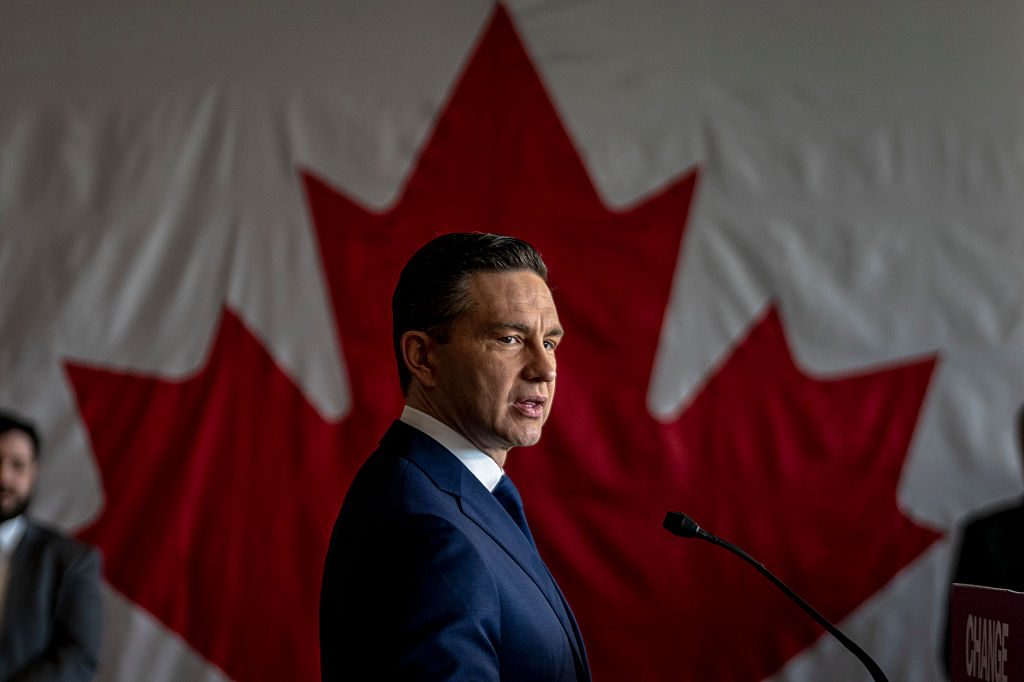
Pierre Poilievre’s return won’t save the Canadian Tories

Stuck in an ideological doom loop. Credit: Getty

Stuck in an ideological doom loop. Credit: Getty

August 21 2025 - 9:30pm

Pierre Poilievre is back in Canada’s parliament. After winning a by-election on Monday, the Tory will resume his post as Leader of the Opposition against Mark’s Carney Liberals. He will face one more test at a January 2026 party leadership review but is expected to win it just as handily.

Following a shock ouster from his longtime Ottawa-area riding (which he held for 20 years) at the 28 April general election, Poilievre settled on a new constituency on the other side of the country, picked to ensure minimal resistance. Battle River-Crowfoot is a sprawling rural Alberta seat that is probably the safest for a Conservative in all of Canada, having returned the last Tory candidate with 83% of the vote. Poilievre won by a similar margin. But even as it’s considered a non-story by most Canadians, the implications of Poilievre’s victory are worth considering.

From 2022 onward, Poilievre led Canada’s Conservatives with an extraordinary polling advantage, earning praise from figures such as Elon Musk, as well as from journalists struck by his appeal to young voters. But Trudeau’s handover to Mark Carney, against the backdrop of Trump’s turbulent second term, exposed the fragility of Poilievre’s lead, grounded less in his own appeal than in Trudeau’s unpopularity. The erosion of his youth support made that clear.

Poilievre has shown little flexibility. He has consistently avoided strong criticism of Trump — something his chief Tory rival, Ontario Premier Doug Ford, has been only too happy to do. At the same time, Poilievre has tried to replicate the purely oppositional approach that served him well under Trudeau. In doing so, he swapped the carbon tax, which Carney himself repealed, for an obscure EV mandate that most Canadians have never heard of, making it the centerpiece of a sloganeering campaign. It is unlikely to resonate, especially as the ongoing trade war with Washington — about which he has seemingly little to say — continues to dominate the agenda.

But perhaps most striking is Poilievre’s inability to question his priors. He remains firmly rooted in the market-fundamentalist milieu of the 1990s, a worldview shaped in his youth. Unlike the New Right elsewhere, this approach refuses to entertain serious industrial policy, even as the post-globalized era makes a compelling case for it. Instead, he remains fixated on tax cuts and deregulation, treating them as panaceas. The possibility that Canada’s decades-old productivity crisis may arise from a timid, risk-averse investment culture in the private sector rather than just Ottawa regulation is something Poilievre cannot admit, as it falls outside his ideological safe space.

The most significant impact of an extended Poilievre era on the Canadian Right may be its chilling effect on the next generation of Conservative leaders, represented by the likes of MP Jamil Jivani, JD Vance’s Yale classmate, who is far more aligned with post-neoliberal currents (and conspicuously excluded from Poilievre’s shadow cabinet).

As populist intellectual Oren Cass remarked after a visit to Canada earlier this year, “the Conservative Party there is far behind the Republican Party in its realignment … on the basics of political economy, [Poilievre] hasn’t moved far.” Going forward, Poilievre’s Tories are likely to cling to their old Trudeau-era playbook, passively waiting for the reigning Liberal government to bleed popularity while galvanizing their own base with appeals to anti-elite sentiment, avoiding internal divisions over Trump, and focusing frustrations on one or two myopically chosen policy targets.

Indeed, while he may have proved his resiliency within the Tory base, he is adamant that his party should remain wedded to last century’s orthodoxies, limping along as a Thatcherite holdover as the rest of the world moves on to fresher and more vital models of governance.


Michael Cuenco is Senior Editor at American Affairs.
1TrueCuencoism

China is threatening America in the AI race

Reports sugget Zhipu AI  has released a new model that can rival leading US systems. Credit: Getty

Reports sugget Zhipu AI has released a new model that can rival leading US systems. Credit: Getty

July 1 2026 - 10:18am

China is trying to catch up with America on artificial intelligence. The Wall Street Journal has reported that Zhipu AI — one of China’s six “AI tiger” LLMs — has released a new model that can rival leading US systems, including Anthropic’s Mythos, in cybersecurity tasks such as pinpointing security bugs. While this marks a milestone in China’s drive to catch up with Western AI capabilities, strong performance on a single benchmark does not mean it has taken the lead. Chinese models still lag behind their Western counterparts in broader capabilities, such as autonomous operation. Skepticism is therefore warranted before resorting to hysterical conclusions, but complacency about the geopolitical implications of China’s AI advances would be an even greater mistake.

On the infrastructure side, Chinese AI is still constrained by access to advanced chips, with American labs way ahead in computing capacity as well as investment. Analysis from earlier this year suggests that Chinese models are likely to be at least a few months behind those in the US. But they are still continuing to make progress, or that the geopolitical importance of AI will be decided only by whose LLM has ventured deeper into the technological frontier. The practical applications of AI, countries’ to capture foreign markets, and the application of AI into the real economy will matter just as much.

Here, China may hold an advantage. As with its dominance across many critical supply chains, Beijing may not need to produce the most advanced AI systems — only those that are affordable and widely deployable. In doing so, it could consolidate global influence by supplying functional, low-cost AI at scale.

Beijing seems to be pursuing exactly that path, developing an AI “open-source” strategy that offers affordable, widely available AI models for companies and individuals to use and modify as they wish. The production of the DeepSeek AI model, which matched the performance of Silicon Valley tools such as ChatGPT at a fraction of the cost for users, created goodwill among Chinese models with developers.

The four most popular models on OpenRouter, an AI hardware platform for developers, are now all Chinese. The goal for China is not only to win the frontier-model race, but to make its systems the default layer of AI adoption across industries and global markets. For most economies, the choice is increasingly between an affordable tool they can deploy now and a more robust one that may be out of reach.

And while the countries adopting Chinese models may be exposed to political pressure and cyber threats from Beijing, safer and more capable alternatives matter little if they are unaffordable. American AI companies are already under pressure to monetize products whose operating costs are rising. If Chinese open-source models become the cheap default for startups, universities, governments and businesses across the developing world, then America’s AI lead will be eroded from below.

Perhaps more concerning for America in the long run is how AI can give Chinese manufacturing even more strength, through the ongoing integration of AI as a general-purpose technology. China’s new Five-Year Plan mentioned AI more than 50 times and includes an “AI+” action plan aimed at spreading AI across the economy.

Beijing has been pioneering automation of its critical infrastructure for years, with promising recent results in increasing warplane production capacity. In that regard, China’s open-model strategy and manufacturing dominance will reinforce each other. Cheap, adaptable models accelerate deployment across the real economy while those deployments generate real-world data and use cases that can feed back into further model improvement.

The United States should not dismiss the importance of its lead in the AI race. That lead worries Beijing, not least because a more automated Chinese economy would also become more vulnerable to AI-generated cyber threats. But nor should Washington assume that China cannot catch up with American capabilities over time.

This AI competition represents part of a broader struggle over tech supply chains and geopolitical influence. Decisions over whether to adopt US or Chinese models could produce a more fragmented global reality, with different regions relying on different cloud providers, chips and security structures. The result will likely be a global economy which is divided into competing spheres, rather than one which produces a single winner.


Miquel Vila is a political and geopolitical risk consultant focusing on industrial strategy, critical infrastructure and global supply chains.

miquelvilam