




X Close

The hidden tension behind King Charles’s Canada visit

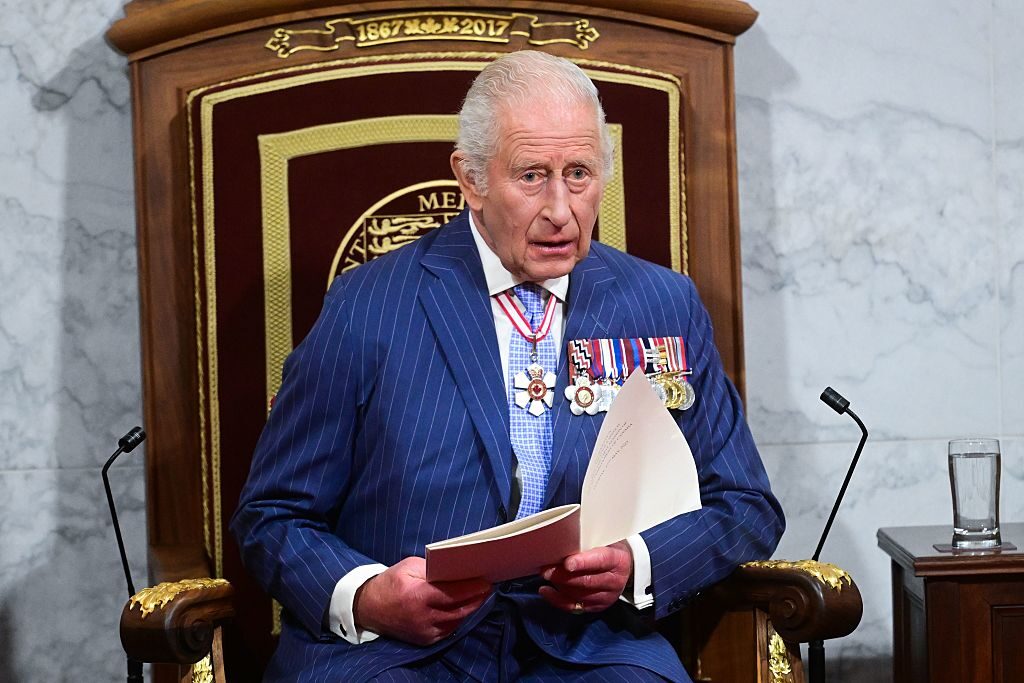
His Majesty addresses the Senate of Canada on Tuesday. Credit: Getty

His Majesty addresses the Senate of Canada on Tuesday. Credit: Getty

May 28 2025 - 7:00am

King Charles III today delivered the Throne Speech opening Canada’s parliament, something which has not been done by a monarch since 1977. Though his visit is brief, the royal presence in Ottawa is rich with symbolic significance: Prime Minister Mark Carney has made clear that the King is there to give expression to Canadian sovereignty, sending a message to President Donald Trump, who has mused about making the Commonwealth nation into the 51st US state.

Against this threat, Charles’s address — which was written for him by the Canadian government — stressed “national values”, “democracy, pluralism, the rule of law, self-determination”, concluding that “the true north is indeed strong and free.” Even before his journey, the King signalled his support for Canada through gestures of his own: wearing Canadian decorations, sporting the national colors, and planting a maple tree. And judging by the throngs and poll numbers, there is enough popular enthusiasm in evidence to show that the Crown is still appreciated by many Canadians.

Yet there are controversies both within Canada and across the Commonwealth that challenge this narrative. For a start, some may ask how a monarch who lives across the Atlantic can faithfully represent the Canadian state. Left-wing Quebec separatists and, more implicitly, Right-wing Alberta “Republicans” reject the institution as offensively anachronistic and mock the country’s attachment to what the former group refers to derisively as “la monarchie brittanique”.

Indeed, there appears to be a glaring contradiction in celebrating Charles as a Canadian figurehead. After all, the King, acting under the advice of the UK Government, also extended an invitation to Trump for a second state visit to Britain, in which Charles will host and toast the very same president who is menacing his Canadian realm. Earlier this month, Carney saw fit to criticize British Prime Minister Keir Starmer for a supposed lack of sensitivity, amounting to open conflict between two of the Crown’s first ministers. How is the monarchy supposed to function under these strained circumstances?

The answer is that there is not one monarchy but two — or, to be more precise, 15. This is because, contra les indépendantistes, the Canadian Crown is an entirely separate institution from the British one, the result of constitutional evolution across the Commonwealth in which each realm progressively gained more autonomy to the point of eventually becoming sovereign, while still sharing a monarch. Canada played a central role in this push, since it was a 1926 Canadian constitutional crisis that helped to bring about the 1931 Statute of Westminster which formalized the principle of equality between realms. (During the Second World War, Ottawa declared war on Germany one week later than London did, to emphasize Canadian independence.)

Thus, there is no contradiction in Charles doing one thing on Carney’s advice and another on Starmer’s; for His Majesty to obey both would be in accord with the logic of constitutional monarchy, which has lately proven far sounder and more resilient than many other political systems, including that of the perennially unstable republic to Canada’s south. In case of any confusion, the words of Canada’s greatest viceroy, John Buchan, should clarify: “a Canadian’s first loyalty is not to the British Commonwealth of Nations, but to Canada and Canada’s King.”


Michael Cuenco is Senior Editor at American Affairs.
1TrueCuencoism

China is threatening America in the AI race

Reports sugget Zhipu AI  has released a new model that can rival leading US systems. Credit: Getty

Reports sugget Zhipu AI has released a new model that can rival leading US systems. Credit: Getty

July 1 2026 - 10:18am

China is trying to catch up with America on artificial intelligence. The Wall Street Journal has reported that Zhipu AI — one of China’s six “AI tiger” LLMs — has released a new model that can rival leading US systems, including Anthropic’s Mythos, in cybersecurity tasks such as pinpointing security bugs. While this marks a milestone in China’s drive to catch up with Western AI capabilities, strong performance on a single benchmark does not mean it has taken the lead. Chinese models still lag behind their Western counterparts in broader capabilities, such as autonomous operation. Skepticism is therefore warranted before resorting to hysterical conclusions, but complacency about the geopolitical implications of China’s AI advances would be an even greater mistake.

On the infrastructure side, Chinese AI is still constrained by access to advanced chips, with American labs way ahead in computing capacity as well as investment. Analysis from earlier this year suggests that Chinese models are likely to be at least a few months behind those in the US. But they are still continuing to make progress, or that the geopolitical importance of AI will be decided only by whose LLM has ventured deeper into the technological frontier. The practical applications of AI, countries’ to capture foreign markets, and the application of AI into the real economy will matter just as much.

Here, China may hold an advantage. As with its dominance across many critical supply chains, Beijing may not need to produce the most advanced AI systems — only those that are affordable and widely deployable. In doing so, it could consolidate global influence by supplying functional, low-cost AI at scale.

Beijing seems to be pursuing exactly that path, developing an AI “open-source” strategy that offers affordable, widely available AI models for companies and individuals to use and modify as they wish. The production of the DeepSeek AI model, which matched the performance of Silicon Valley tools such as ChatGPT at a fraction of the cost for users, created goodwill among Chinese models with developers.

The four most popular models on OpenRouter, an AI hardware platform for developers, are now all Chinese. The goal for China is not only to win the frontier-model race, but to make its systems the default layer of AI adoption across industries and global markets. For most economies, the choice is increasingly between an affordable tool they can deploy now and a more robust one that may be out of reach.

And while the countries adopting Chinese models may be exposed to political pressure and cyber threats from Beijing, safer and more capable alternatives matter little if they are unaffordable. American AI companies are already under pressure to monetize products whose operating costs are rising. If Chinese open-source models become the cheap default for startups, universities, governments and businesses across the developing world, then America’s AI lead will be eroded from below.

Perhaps more concerning for America in the long run is how AI can give Chinese manufacturing even more strength, through the ongoing integration of AI as a general-purpose technology. China’s new Five-Year Plan mentioned AI more than 50 times and includes an “AI+” action plan aimed at spreading AI across the economy.

Beijing has been pioneering automation of its critical infrastructure for years, with promising recent results in increasing warplane production capacity. In that regard, China’s open-model strategy and manufacturing dominance will reinforce each other. Cheap, adaptable models accelerate deployment across the real economy while those deployments generate real-world data and use cases that can feed back into further model improvement.

The United States should not dismiss the importance of its lead in the AI race. That lead worries Beijing, not least because a more automated Chinese economy would also become more vulnerable to AI-generated cyber threats. But nor should Washington assume that China cannot catch up with American capabilities over time.

This AI competition represents part of a broader struggle over tech supply chains and geopolitical influence. Decisions over whether to adopt US or Chinese models could produce a more fragmented global reality, with different regions relying on different cloud providers, chips and security structures. The result will likely be a global economy which is divided into competing spheres, rather than one which produces a single winner.


Miquel Vila is a political and geopolitical risk consultant focusing on industrial strategy, critical infrastructure and global supply chains.

miquelvilam