




X Close

The decline of dairy farmers is a rural tragedy

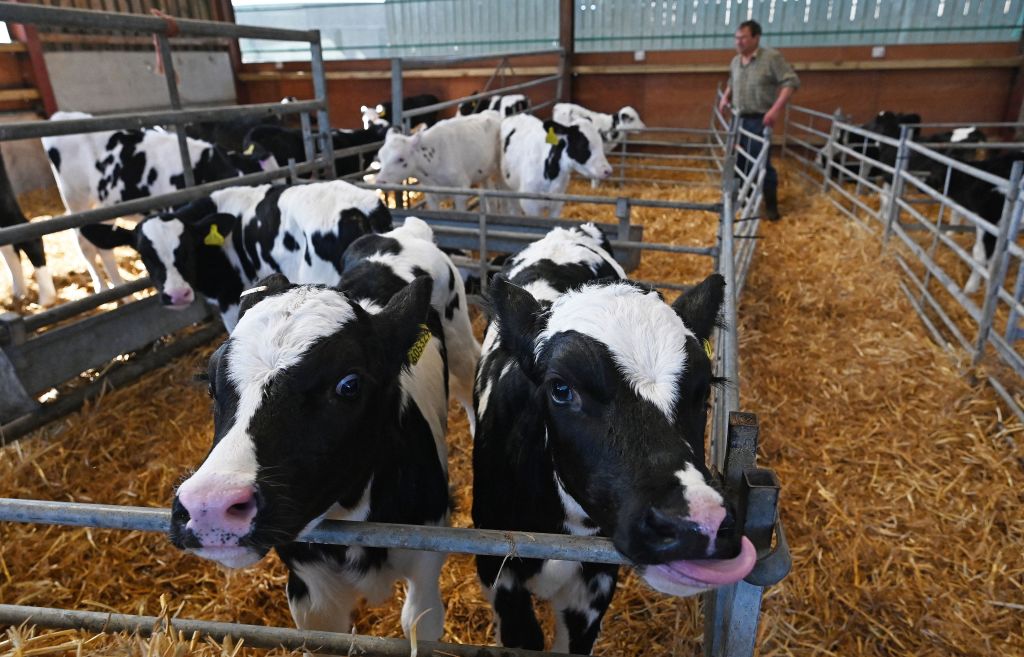
Shelves may remain stocked, but at what price to the cow? Credit: Getty

Shelves may remain stocked, but at what price to the cow? Credit: Getty

June 17 2026 - 2:31pm

There are now fewer than 7,000 dairy farmers in Britain for the first time, down from 8,720 in October 2019.

However, the decline in dairy farmers does not equate to a decline in dairying: a different set of AHDB figures show milk production is at record levels, up 5% year-on-year. More milk is being produced by fewer farmers and fewer cows.

Milk production is a far more complex business than most shoppers realize. When thinking about the dairy industry, we tend to picture the herds glimpsed from a car window: cows milked by a farmer, the milk collected by a processor, bottled, and sent to the supermarket.

In reality, dairy sits at the center of a vast and intricate supply chain. The milk in your fridge is only one part of the story. It also feeds the production of cheese, yogurt and butter, supplies a hospitality sector that depends on everything from cappuccinos to soft-serve ice cream, and underpins a global trade in milk powder worth billions of pounds.

I was Head of Farming Sectors at Defra during the early months of Covid-19, briefly designated a “category 1 crisis responder” as we scrambled to redirect UK milk supply. I even had a letter from the Secretary of State asking that I be permitted to work under lockdown rules — somewhat redundant given my “commute” was from kitchen to laptop.

Once there, I was dealing with what to do with the large share of UK milk destined for cafés, bars and restaurants that shut overnight. Hospitality milk is packaged and distributed differently to supermarket supply, and there was neither the capacity to rapidly re-route it nor any environmentally acceptable way to simply dispose of it.

The point being: dairy is complicated. So, what sits behind the headline figures — milk production up, farmer numbers down?

Milk profit margins are tiny. Research in 2022 found that a £2.50 block of supermarket cheddar was yielding the farmer about 0.05p. That was before milk prices fell off a cliff. Prices have dropped about 15p/liter since last October, with AHDB now saying that the all-milk price is about 35p a liter. Reuters spoke to farmers in March who were receiving about 30p/liter and citing production costs of 40p.

The basic story is therefore a straightforward one. Domestic demand is constant, supply has increased, and so down goes the price and the margins. The only ones left able to compete are the big players.

This is a story of consolidation, not decline. The rise of the “mega dairy” is well-documented and widely debated. Roughly defined as units housing 700 cattle or more, these systems often rely on year-round indoor housing rather than grazing. As the number of dairy farmers has fallen, the number of mega dairies is estimated to have roughly doubled over the past decade.

That shift means a growing share of the national herd is now in large-scale units — what Sustainable Food Trust’s Patrick Holden has described as “battery cage cows”.

Not everyone agrees that this is a deterioration in welfare. Industry bodies argue that scale is not the opposite of good standards, and that larger units can invest more in technology, monitoring and animal health. But the underlying structural change is clear: fewer farmers, larger herds.

At the same time, dairy faces pressures that go beyond economics. Demand remains broadly stable, but some consumers are turning to alternatives over concerns about welfare and environmental impact. And while the number of serious water pollution incidents linked to dairy farming remains relatively small in absolute terms, it has risen each year since 2020. A recent Bureau of Investigative Journalism investigation found that “nearly one in five of the largest [dairy] units had been linked to pollution in recent years.”

More regulation might help curb pollution, but it could also accelerate the exit of smaller family farms, since larger operations are better placed to absorb compliance costs. That is the difficult environment in which farmers are operating: squeezed by higher energy and input costs, weaker farmgate prices, and uncertainty around inheritance tax. Against that backdrop, consolidation continues to advance. Shelves may remain stocked, but the question remains: at what cost to the countryside, and at what cost to the cow?

Liam Stokes is a writer and environmentalist.

LNJStokes

China is threatening America in the AI race

Reports sugget Zhipu AI  has released a new model that can rival leading US systems. Credit: Getty

Reports sugget Zhipu AI has released a new model that can rival leading US systems. Credit: Getty

July 1 2026 - 10:18am

China is trying to catch up with America on artificial intelligence. The Wall Street Journal has reported that Zhipu AI — one of China’s six “AI tiger” LLMs — has released a new model that can rival leading US systems, including Anthropic’s Mythos, in cybersecurity tasks such as pinpointing security bugs. While this marks a milestone in China’s drive to catch up with Western AI capabilities, strong performance on a single benchmark does not mean it has taken the lead. Chinese models still lag behind their Western counterparts in broader capabilities, such as autonomous operation. Skepticism is therefore warranted before resorting to hysterical conclusions, but complacency about the geopolitical implications of China’s AI advances would be an even greater mistake.

On the infrastructure side, Chinese AI is still constrained by access to advanced chips, with American labs way ahead in computing capacity as well as investment. Analysis from earlier this year suggests that Chinese models are likely to be at least a few months behind those in the US. But they are still continuing to make progress, or that the geopolitical importance of AI will be decided only by whose LLM has ventured deeper into the technological frontier. The practical applications of AI, countries’ to capture foreign markets, and the application of AI into the real economy will matter just as much.

Here, China may hold an advantage. As with its dominance across many critical supply chains, Beijing may not need to produce the most advanced AI systems — only those that are affordable and widely deployable. In doing so, it could consolidate global influence by supplying functional, low-cost AI at scale.

Beijing seems to be pursuing exactly that path, developing an AI “open-source” strategy that offers affordable, widely available AI models for companies and individuals to use and modify as they wish. The production of the DeepSeek AI model, which matched the performance of Silicon Valley tools such as ChatGPT at a fraction of the cost for users, created goodwill among Chinese models with developers.

The four most popular models on OpenRouter, an AI hardware platform for developers, are now all Chinese. The goal for China is not only to win the frontier-model race, but to make its systems the default layer of AI adoption across industries and global markets. For most economies, the choice is increasingly between an affordable tool they can deploy now and a more robust one that may be out of reach.

And while the countries adopting Chinese models may be exposed to political pressure and cyber threats from Beijing, safer and more capable alternatives matter little if they are unaffordable. American AI companies are already under pressure to monetize products whose operating costs are rising. If Chinese open-source models become the cheap default for startups, universities, governments and businesses across the developing world, then America’s AI lead will be eroded from below.

Perhaps more concerning for America in the long run is how AI can give Chinese manufacturing even more strength, through the ongoing integration of AI as a general-purpose technology. China’s new Five-Year Plan mentioned AI more than 50 times and includes an “AI+” action plan aimed at spreading AI across the economy.

Beijing has been pioneering automation of its critical infrastructure for years, with promising recent results in increasing warplane production capacity. In that regard, China’s open-model strategy and manufacturing dominance will reinforce each other. Cheap, adaptable models accelerate deployment across the real economy while those deployments generate real-world data and use cases that can feed back into further model improvement.

The United States should not dismiss the importance of its lead in the AI race. That lead worries Beijing, not least because a more automated Chinese economy would also become more vulnerable to AI-generated cyber threats. But nor should Washington assume that China cannot catch up with American capabilities over time.

This AI competition represents part of a broader struggle over tech supply chains and geopolitical influence. Decisions over whether to adopt US or Chinese models could produce a more fragmented global reality, with different regions relying on different cloud providers, chips and security structures. The result will likely be a global economy which is divided into competing spheres, rather than one which produces a single winner.


Miquel Vila is a political and geopolitical risk consultant focusing on industrial strategy, critical infrastructure and global supply chains.

miquelvilam