




X Close

Scott Bessent’s warning is clear: Europe must defend itself

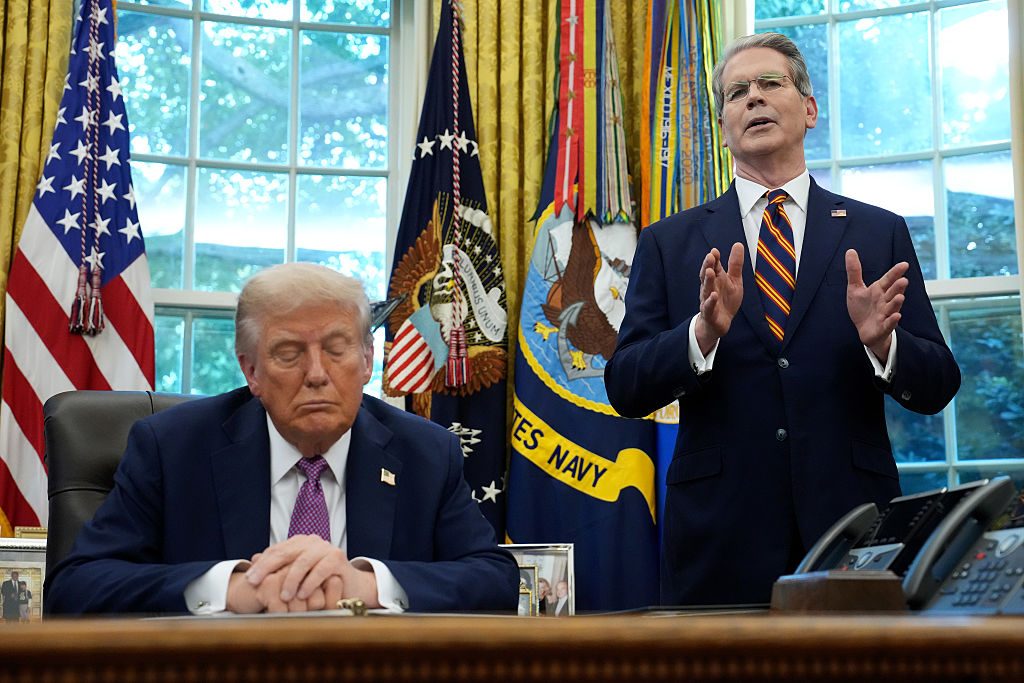
The Treasury Secretary made some revealing remarks this week. Credit: Getty

The Treasury Secretary made some revealing remarks this week. Credit: Getty

September 28 2025 - 5:00pm

US Treasury Secretary Scott Bessent insisted earlier this week that a Russian incursion into Nato territory would not trigger US intervention, and that America’s role would be confined to selling arms to Europe.

Speaking to Fox Business, Bessent described the Trump administration’s foreign policy doctrine with a clarity we have not heard from the President himself. “Now Putin has started making incursions into the Nato borders,” he said. “The one thing I can tell you is the US is not going to get involved with troops or any of that. We will sell the Europeans weapons.”

In other words: the US did not perform a policy U-turn this week, as some of the more naive European political observers were hoping for. Quite the contrary. The US is signaling to Russia — and Nato — that it will not respond to the current wave of Russian provocations in Europe. Vladimir Putin is testing Nato’s resolve. And he is getting the result he was hoping for from the White House.

You can often tell a country’s official policy by looking at revealed, not stated, preferences. It is Bessent’s message — not Donald Trump’s wide-ranging, meandering speech at the UN — that is US policy. The Trump administration, then, would not trigger Article 5 in the event of a Russian attack on a Nato ally.

The incidents Bessent was referring to were related to Russian hybrid attacks deep inside Nato territory. There were drones over Poland, Russian jets in Estonian airspace, and, although not confirmed as Russian but still suspicious enough, drones over Copenhagen airport. A less reported incident that happened last week was an interaction between Russian fighter jets and German navy frigate on the Baltic Sea, as relayed by German Defense Minister, Boris Pistorius in an address to MPs. German forces did not respond, he said. “We are thus showing a clear response to Russian behavior, but without alarmism,” Pistorius said. “In other words, we are not falling for Putin’s provocations; we are not falling into this trap of escalation.”

While that may sound like a well-calibrated message, this is not how Putin will interpret it. While the Russian leader does not have the capacity to fight two simultaneous land wars, he has the resources to continue his land war in Ukraine, and engage in a hybrid war in western Europe, exposing the political weaknesses of Nato leaders. It is likely Moscow will increase the provocations.

This new situation requires European countries to rethink their defense strategies. Should we ever get into the calamity of a war with Russia, it will not consist of the kind of trench warfare imprinted on the continent’s psyche from the First World War. It will be drone warfare, as we are increasingly seeing in Ukraine. Europe’s out-of-date air-defense systems are not equipped to handle this, which means the continent must rely once again on the retreating US security umbrella.

Bessent’s comments this week ought to be a wake-up call, or Moscow’s increasingly unanswered provocations will eventually call Europe’s bluff.


Wolfgang Munchau is the Director of Eurointelligence and an UnHerd columnist.

EuroBriefing

China is threatening America in the AI race

Reports sugget Zhipu AI  has released a new model that can rival leading US systems. Credit: Getty

Reports sugget Zhipu AI has released a new model that can rival leading US systems. Credit: Getty

July 1 2026 - 10:18am

China is trying to catch up with America on artificial intelligence. The Wall Street Journal has reported that Zhipu AI — one of China’s six “AI tiger” LLMs — has released a new model that can rival leading US systems, including Anthropic’s Mythos, in cybersecurity tasks such as pinpointing security bugs. While this marks a milestone in China’s drive to catch up with Western AI capabilities, strong performance on a single benchmark does not mean it has taken the lead. Chinese models still lag behind their Western counterparts in broader capabilities, such as autonomous operation. Skepticism is therefore warranted before resorting to hysterical conclusions, but complacency about the geopolitical implications of China’s AI advances would be an even greater mistake.

On the infrastructure side, Chinese AI is still constrained by access to advanced chips, with American labs way ahead in computing capacity as well as investment. Analysis from earlier this year suggests that Chinese models are likely to be at least a few months behind those in the US. But they are still continuing to make progress, or that the geopolitical importance of AI will be decided only by whose LLM has ventured deeper into the technological frontier. The practical applications of AI, countries’ to capture foreign markets, and the application of AI into the real economy will matter just as much.

Here, China may hold an advantage. As with its dominance across many critical supply chains, Beijing may not need to produce the most advanced AI systems — only those that are affordable and widely deployable. In doing so, it could consolidate global influence by supplying functional, low-cost AI at scale.

Beijing seems to be pursuing exactly that path, developing an AI “open-source” strategy that offers affordable, widely available AI models for companies and individuals to use and modify as they wish. The production of the DeepSeek AI model, which matched the performance of Silicon Valley tools such as ChatGPT at a fraction of the cost for users, created goodwill among Chinese models with developers.

The four most popular models on OpenRouter, an AI hardware platform for developers, are now all Chinese. The goal for China is not only to win the frontier-model race, but to make its systems the default layer of AI adoption across industries and global markets. For most economies, the choice is increasingly between an affordable tool they can deploy now and a more robust one that may be out of reach.

And while the countries adopting Chinese models may be exposed to political pressure and cyber threats from Beijing, safer and more capable alternatives matter little if they are unaffordable. American AI companies are already under pressure to monetize products whose operating costs are rising. If Chinese open-source models become the cheap default for startups, universities, governments and businesses across the developing world, then America’s AI lead will be eroded from below.

Perhaps more concerning for America in the long run is how AI can give Chinese manufacturing even more strength, through the ongoing integration of AI as a general-purpose technology. China’s new Five-Year Plan mentioned AI more than 50 times and includes an “AI+” action plan aimed at spreading AI across the economy.

Beijing has been pioneering automation of its critical infrastructure for years, with promising recent results in increasing warplane production capacity. In that regard, China’s open-model strategy and manufacturing dominance will reinforce each other. Cheap, adaptable models accelerate deployment across the real economy while those deployments generate real-world data and use cases that can feed back into further model improvement.

The United States should not dismiss the importance of its lead in the AI race. That lead worries Beijing, not least because a more automated Chinese economy would also become more vulnerable to AI-generated cyber threats. But nor should Washington assume that China cannot catch up with American capabilities over time.

This AI competition represents part of a broader struggle over tech supply chains and geopolitical influence. Decisions over whether to adopt US or Chinese models could produce a more fragmented global reality, with different regions relying on different cloud providers, chips and security structures. The result will likely be a global economy which is divided into competing spheres, rather than one which produces a single winner.


Miquel Vila is a political and geopolitical risk consultant focusing on industrial strategy, critical infrastructure and global supply chains.

miquelvilam