




X Close

Richard Tice holidays with Russian oligarch on Riviera

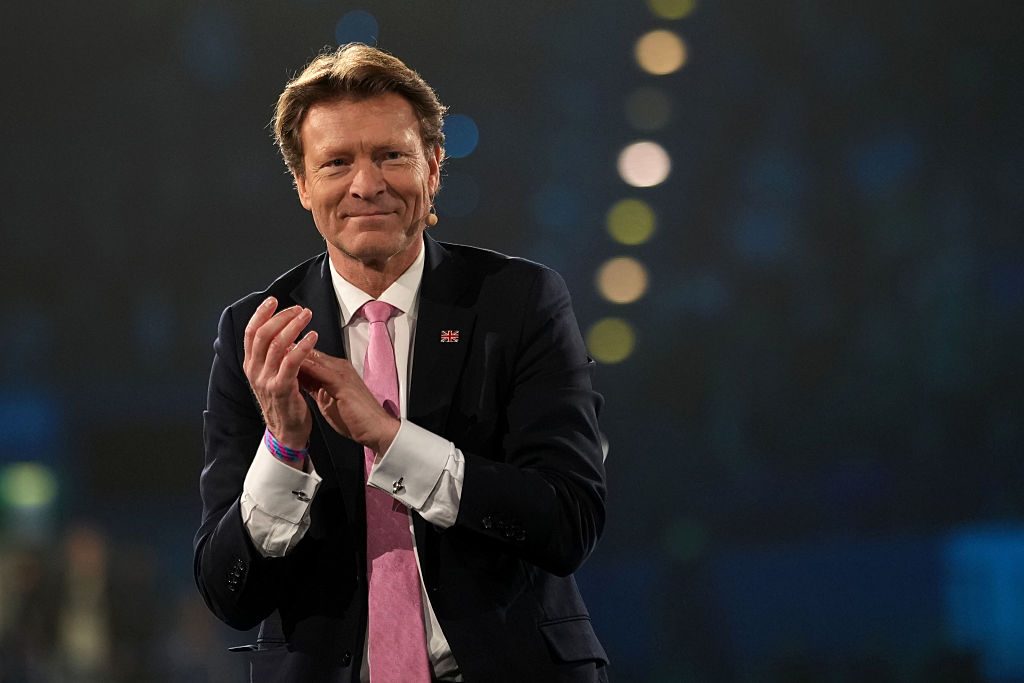
Tice told UnHerd that his meal at Grand-Hotel du Cap-Ferrat was 'very good'. Credit: Getty

Tice told UnHerd that his meal at Grand-Hotel du Cap-Ferrat was 'very good'. Credit: Getty

August 20 2025 - 1:10pm

The Russian oligarch Vladimir Chernukhin and his wife, Lubov, have long been known for their generous support for the Conservative Party. Since 2012 Lubov has given the party at least £2.1 million, as well as an individual gift to former home secretary Priti Patel of a further £70,000 to fund her bid for the party leadership last year.

But these are uncertain times, and now, UnHerd can reveal, the Chernukhins are cultivating new political friends. Over two days in the first week of August, at their turreted villa with a stunning view of the Mediterranean at Cap d’Antibes, they hosted Reform UK Deputy Leader Richard Tice along with his partner, the journalist Isabel Oakeshott.

They had dinner à quatre at the Michelin-starred restaurant at the Grand-Hotel du Cap-Ferrat; Tice told me the meal was “very good”. The villa, he added cagily, was “very nice […] all those villas have a history and a heritage, so that’s the nature of it, but I’m not going to give any details.”

The trip, he admitted, wasn’t all sunbathing: it was “about power, not parties”. When I asked what that meant, he disclosed that Lubov is “quite interested in energy projects, as in gas-fired power stations. Obviously we at Reform are very focused on sensibly priced energy, the fact we’ve got a shortage of it in the UK, and what we’re going to do about it.” She is, Tice added, “looking very closely” at investing in gas plants, “as you would expect from a smart entrepreneur who understands the common sense facts of economic life”.

For her part, Tice said, Lubov was seeking reassurance that a Reform UK government would create “an attractive regulatory environment in which to operate. There’ll be a general election in less than four years and we’ve got a cracking chance of winning it.” He added: “I’m talking to oil and gas people, saying get your oil and gas applications ready. We want lots of home-grown energy and we want it cheap.”

Vladimir Chernukhin served as Russia’s deputy finance minister from 2000 until 2002, then as chairman of a state-owned bank. But after his mentor, the then-Prime Minister Mikhail Kasyanov, fell out with Vladimir Putin, in late 2004 Chernukhin fled the country for Britain — taking with him a fortune that already amounted to almost £400 million.

He continued to own a large stake in Navio Holdings, a lucrative Russian textile business, along with Oleg Deripaska, another oligarch with a keen interest in British politicians. When it emerged that both Blair-era cabinet minister (now Ambassador to Washington) Lord Mandelson and then-Shadow Chancellor George Osborne had been guests on his luxury yacht, both suffered serious political embarrassment. Eventually the Chernukhin–Deripaska partnership soured, triggering a High Court battle in London, which ended with Deripaska being ordered to pay him some £74 million.

In 2021, the leaked Pandora Papers revealed that the Chernukhins, whose residences also include a £10 million home in Oxfordshire and a £30 million townhouse overlooking Regent’s Park, controlled a web of 32 offshore companies registered in the British Virgin Islands (BVI) to help them maintain their opulent lives. These firms were used to fund their superyacht cruises several times a year and a private jet — as well as the villa at Cap d’Antibes, which is said to have once belonged to an English aristocrat. In 2016, French tax authorities tried to extract information about its ownership and status from the Panamanian law firm that managed the Chernukhins’ BVI interests. This triggered consternation, as recorded in the Pandora leak.

The couple are now UK citizens, though Vladimir is said to retain non-domicile status in order, legally, to avoid tax. But it is his wife who has always been more interested in politics. Aside from her cash donations to the Tories, in 2014 Lubov paid £160,000 to play tennis with Boris Johnson, then London Mayor, and PM David Cameron. Six years later, she forked out another £45,000 at the Black and White party fundraising ball to play Johnson again, and in 2019 dined with then-PM Theresa May and six members of her Cabinet for £135,000.

When asked whether he thinks that staying chez Chernukhin might cause controversy, given the publicity over their offshore companies and court cases, Tice said: “I don’t know about these other matters. Generally, successful people have always had legal rows. I’m having legal rows with [Labour donor and green energy tycoon] Dale Vince. Does that make me a bad person? No.”

Does Tice hope that Lubov Chernukhin may give money to Reform? For now, it seems not. “She is a Conservative,” he replied.


David Rose is UnHerd‘s Investigations Editor.

DavidRoseUK

China is threatening America in the AI race

Reports sugget Zhipu AI  has released a new model that can rival leading US systems. Credit: Getty

Reports sugget Zhipu AI has released a new model that can rival leading US systems. Credit: Getty

July 1 2026 - 10:18am

China is trying to catch up with America on artificial intelligence. The Wall Street Journal has reported that Zhipu AI — one of China’s six “AI tiger” LLMs — has released a new model that can rival leading US systems, including Anthropic’s Mythos, in cybersecurity tasks such as pinpointing security bugs. While this marks a milestone in China’s drive to catch up with Western AI capabilities, strong performance on a single benchmark does not mean it has taken the lead. Chinese models still lag behind their Western counterparts in broader capabilities, such as autonomous operation. Skepticism is therefore warranted before resorting to hysterical conclusions, but complacency about the geopolitical implications of China’s AI advances would be an even greater mistake.

On the infrastructure side, Chinese AI is still constrained by access to advanced chips, with American labs way ahead in computing capacity as well as investment. Analysis from earlier this year suggests that Chinese models are likely to be at least a few months behind those in the US. But they are still continuing to make progress, or that the geopolitical importance of AI will be decided only by whose LLM has ventured deeper into the technological frontier. The practical applications of AI, countries’ to capture foreign markets, and the application of AI into the real economy will matter just as much.

Here, China may hold an advantage. As with its dominance across many critical supply chains, Beijing may not need to produce the most advanced AI systems — only those that are affordable and widely deployable. In doing so, it could consolidate global influence by supplying functional, low-cost AI at scale.

Beijing seems to be pursuing exactly that path, developing an AI “open-source” strategy that offers affordable, widely available AI models for companies and individuals to use and modify as they wish. The production of the DeepSeek AI model, which matched the performance of Silicon Valley tools such as ChatGPT at a fraction of the cost for users, created goodwill among Chinese models with developers.

The four most popular models on OpenRouter, an AI hardware platform for developers, are now all Chinese. The goal for China is not only to win the frontier-model race, but to make its systems the default layer of AI adoption across industries and global markets. For most economies, the choice is increasingly between an affordable tool they can deploy now and a more robust one that may be out of reach.

And while the countries adopting Chinese models may be exposed to political pressure and cyber threats from Beijing, safer and more capable alternatives matter little if they are unaffordable. American AI companies are already under pressure to monetize products whose operating costs are rising. If Chinese open-source models become the cheap default for startups, universities, governments and businesses across the developing world, then America’s AI lead will be eroded from below.

Perhaps more concerning for America in the long run is how AI can give Chinese manufacturing even more strength, through the ongoing integration of AI as a general-purpose technology. China’s new Five-Year Plan mentioned AI more than 50 times and includes an “AI+” action plan aimed at spreading AI across the economy.

Beijing has been pioneering automation of its critical infrastructure for years, with promising recent results in increasing warplane production capacity. In that regard, China’s open-model strategy and manufacturing dominance will reinforce each other. Cheap, adaptable models accelerate deployment across the real economy while those deployments generate real-world data and use cases that can feed back into further model improvement.

The United States should not dismiss the importance of its lead in the AI race. That lead worries Beijing, not least because a more automated Chinese economy would also become more vulnerable to AI-generated cyber threats. But nor should Washington assume that China cannot catch up with American capabilities over time.

This AI competition represents part of a broader struggle over tech supply chains and geopolitical influence. Decisions over whether to adopt US or Chinese models could produce a more fragmented global reality, with different regions relying on different cloud providers, chips and security structures. The result will likely be a global economy which is divided into competing spheres, rather than one which produces a single winner.


Miquel Vila is a political and geopolitical risk consultant focusing on industrial strategy, critical infrastructure and global supply chains.

miquelvilam