




X Close

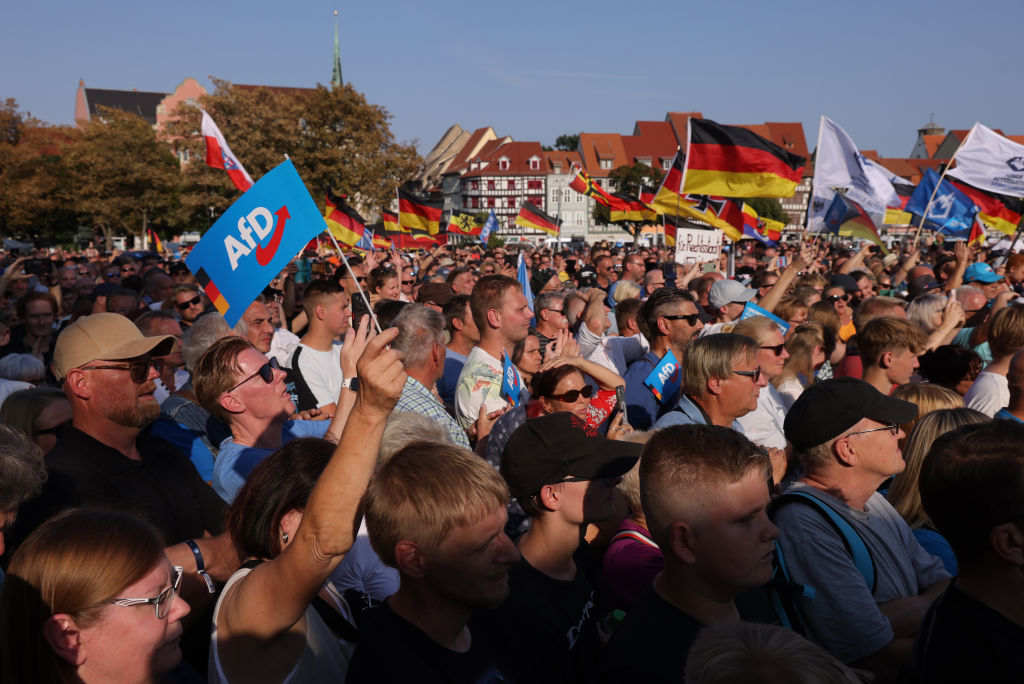
‘Remigration’ is the selling point for AfD voters

AfD supporters in eastern Germany last year. Credit: Getty

AfD supporters in eastern Germany last year. Credit: Getty

February 17 2025 - 7:00am

Dresden, Germany

It is early evening on a clear day in Dresden, and a neo-Nazi is telling me the Jews had it coming. “They are never going to tell you in history class what the Jews did to Germany in the Weimar Republic,” Konstantin, a clean-shaven and bespectacled 23-year-old, says calmly. I idly wonder if he can tell I’m Jewish.

Konstantin is among hundreds of neo-Nazis from across Europe participating in a march officially commemorating 80 years since the 1945 bombing of Dresden, when up to 25,000 people were killed by Allied air raids on the city. Unofficially, the demonstration relativizes Nazi crimes against humanity by presenting the German people as just as much of a victim of World War II as any other.

The march is politically irrelevant: overt neo-Nazism is a losing proposition in modern Germany. But hard-Right politics is having a moment. Barring a freak polling accident, Alternative for Germany (AfD) will finish second in next week’s federal election, capitalizing on government failures to deal with mass immigration.

Ten miles away, in the picturesque town of Pirna, AfD MP Steffen Janich is holding an election rally. He is not politically marginal. Germany’s political center of gravity is shifting towards places like this small town in Saxony, which in 2023 was the first in Germany to elect an AfD mayor.

In the shadow of the medieval town hall, under a brightly painted sundial, Janich tells the audience of middle-aged locals that Germany should stop funding the war in Ukraine, that the Left’s plan for a €15 minimum wage would bankrupt the country, and that the AfD has a plan for mass deportations. By far the longest section, though, is about the inefficiency of wind turbines. “It is madness! We should use every source of energy available to us!” Janich says. The audience applauds wildly, a reminder that the issues which play well in the media are sometimes not those which have most salience on the ground.

I’m approached after the rally by 56-year-old Dirk Mende, who grew up in communist East Germany and trained as a car mechanic. Life was better back then, he says: CEOs made three times more than workers, not 3,000 times more. Now, life is hard. He’s mentally and physically disabled; his pension isn’t enough to live off, so he receives extra money from the government to help pay his rent.

Dirk usually votes for Left-wing parties, including the successor to the East German ruling party, but he’s come to the AfD rally out of curiosity. “I disagree with almost nothing,” he says, adding that most migrants don’t respect German culture and laws.

Disillusionment with how the mainstream parties have dealt with migration comes up in almost every conversation about the AfD. The party has made much of its plan for “remigration”, a term which originated with the white nationalist Identitarian movement and originally referred to mass deportations of non-ethnic Europeans. Early last year, news of an AfD conference planning for remigration so disgusted French far-right leader Marine Le Pen that she publicly condemned the German party.

Janich, however, insists there is nothing racist about remigration. He says it means deporting failed asylum seekers and refugees whose home countries are safe to return to. “Skin color and religion don’t matter to me at all,” he says. He points to a spate of apparent terror attacks committed by migrants. Just two days earlier, an Afghan bodybuilder whose application for asylum had been refused drove into a trade union demonstration in Munich, killing two people and injuring 37 more.

The sense that Germany has reached breaking point over unprecedented levels of immigration is shared across the political spectrum. Last month, Christian Democratic Union leader and favorite to be next chancellor Friedrich Merz sought the AfD’s votes to pass a motion in parliament, a first in postwar history. After the Munich attack, Social Democratic Interior Minister Nancy Faeser highlighted the fact that Germany is the only country which deports people to Afghanistan “despite Taliban rule”. The “firewall” preventing mainstream cooperation with the AfD is holding — for now — but the party has succeeded in shifting the national conversation on immigration to the Right.

At the AfD’s conference this year, delegates chanted “Alice für Deutschland” in support of party leader Alice Weidel, a play on the banned Nazi-era slogan “Alles für Deutschland”. Prominent party figures have previously called for a “180-degree change” in Germany’s approach to historical remembrance. Officially, the AfD distances itself from people like Konstantin. But in practice, the party’s rhetoric and policies give them a political home. He will vote AfD next week.


Ido Vock is a reporter and editor based in Berlin, specialising in Europe’s politics and economy. He was previously a senior journalist at the BBC and Europe correspondent at the New Statesman.

idvck

China is threatening America in the AI race

Reports sugget Zhipu AI  has released a new model that can rival leading US systems. Credit: Getty

Reports sugget Zhipu AI has released a new model that can rival leading US systems. Credit: Getty

July 1 2026 - 10:18am

China is trying to catch up with America on artificial intelligence. The Wall Street Journal has reported that Zhipu AI — one of China’s six “AI tiger” LLMs — has released a new model that can rival leading US systems, including Anthropic’s Mythos, in cybersecurity tasks such as pinpointing security bugs. While this marks a milestone in China’s drive to catch up with Western AI capabilities, strong performance on a single benchmark does not mean it has taken the lead. Chinese models still lag behind their Western counterparts in broader capabilities, such as autonomous operation. Skepticism is therefore warranted before resorting to hysterical conclusions, but complacency about the geopolitical implications of China’s AI advances would be an even greater mistake.

On the infrastructure side, Chinese AI is still constrained by access to advanced chips, with American labs way ahead in computing capacity as well as investment. Analysis from earlier this year suggests that Chinese models are likely to be at least a few months behind those in the US. But they are still continuing to make progress, or that the geopolitical importance of AI will be decided only by whose LLM has ventured deeper into the technological frontier. The practical applications of AI, countries’ to capture foreign markets, and the application of AI into the real economy will matter just as much.

Here, China may hold an advantage. As with its dominance across many critical supply chains, Beijing may not need to produce the most advanced AI systems — only those that are affordable and widely deployable. In doing so, it could consolidate global influence by supplying functional, low-cost AI at scale.

Beijing seems to be pursuing exactly that path, developing an AI “open-source” strategy that offers affordable, widely available AI models for companies and individuals to use and modify as they wish. The production of the DeepSeek AI model, which matched the performance of Silicon Valley tools such as ChatGPT at a fraction of the cost for users, created goodwill among Chinese models with developers.

The four most popular models on OpenRouter, an AI hardware platform for developers, are now all Chinese. The goal for China is not only to win the frontier-model race, but to make its systems the default layer of AI adoption across industries and global markets. For most economies, the choice is increasingly between an affordable tool they can deploy now and a more robust one that may be out of reach.

And while the countries adopting Chinese models may be exposed to political pressure and cyber threats from Beijing, safer and more capable alternatives matter little if they are unaffordable. American AI companies are already under pressure to monetize products whose operating costs are rising. If Chinese open-source models become the cheap default for startups, universities, governments and businesses across the developing world, then America’s AI lead will be eroded from below.

Perhaps more concerning for America in the long run is how AI can give Chinese manufacturing even more strength, through the ongoing integration of AI as a general-purpose technology. China’s new Five-Year Plan mentioned AI more than 50 times and includes an “AI+” action plan aimed at spreading AI across the economy.

Beijing has been pioneering automation of its critical infrastructure for years, with promising recent results in increasing warplane production capacity. In that regard, China’s open-model strategy and manufacturing dominance will reinforce each other. Cheap, adaptable models accelerate deployment across the real economy while those deployments generate real-world data and use cases that can feed back into further model improvement.

The United States should not dismiss the importance of its lead in the AI race. That lead worries Beijing, not least because a more automated Chinese economy would also become more vulnerable to AI-generated cyber threats. But nor should Washington assume that China cannot catch up with American capabilities over time.

This AI competition represents part of a broader struggle over tech supply chains and geopolitical influence. Decisions over whether to adopt US or Chinese models could produce a more fragmented global reality, with different regions relying on different cloud providers, chips and security structures. The result will likely be a global economy which is divided into competing spheres, rather than one which produces a single winner.


Miquel Vila is a political and geopolitical risk consultant focusing on industrial strategy, critical infrastructure and global supply chains.

miquelvilam