




X Close

Reform UK looks to Trump as it prepares for power

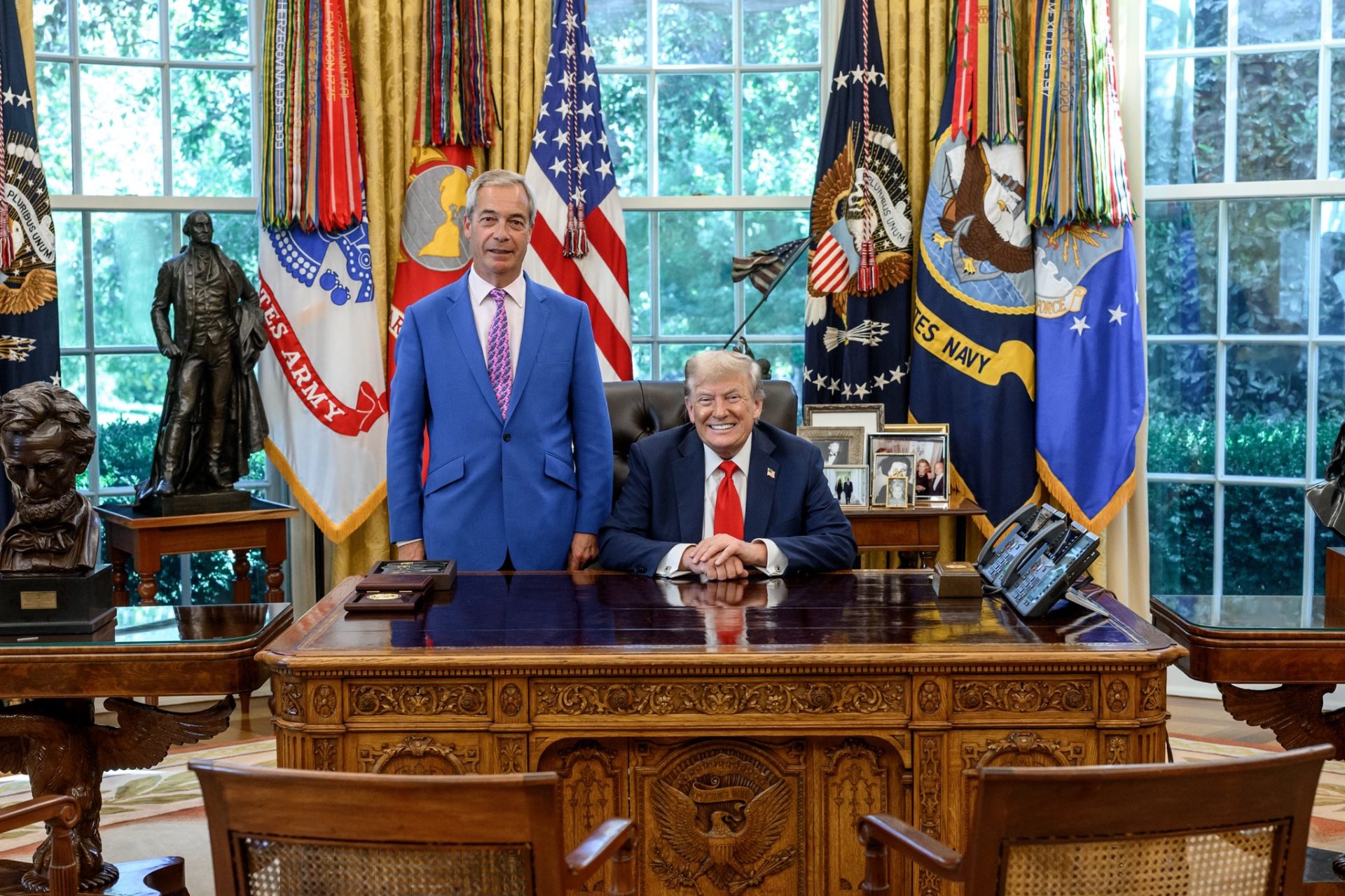
The MAGA mafia. Credit: X/Nigel Farage

The MAGA mafia. Credit: X/Nigel Farage

September 6 2025 - 8:00am

In Birmingham this weekend, Reform UK is already getting ready to govern. At its party conference on Friday afternoon, leader Nigel Farage announced that he would be launching a new “Department of Preparing for Government”. But, in the wake of Deputy Prime Minister Angela Rayner’s resignation shortly before, questions remain as to how ready Reform can be in the event of another general election as soon as 2027. With only four MPs at present, the party faces an obvious problem: who would fill its Cabinet seats in two years’ time?

To combat this problem, Reform is taking its cue from the Trump administration. Just as the US President eschewed career politicians in favor of TV presenters and former WWE execs, Zia Yusuf wants to do something similar. The party’s former chair, who will now become head of party policy, told the Telegraph this week that a Reform government would make many of its key appointments outside the party’s pool of MPs. These would be high-achievers from public life and the private sphere — “galactic-level” talent, per Yusuf’s modest assessment — parachuted into the Lords to form a particularly Faragist meritocracy. The party leader backed this up in his Friday speech, arguing that he wanted to build a “ministry of all the talents from all walks of life”.

While Reform’s policy is devised in-house, assistance is being provided by a new think tank, the Center for a Better Britain (abbreviated to CFABB to avoid any confusion with Celebrity Big Brother or children’s TV channels). CFABB’s offices are located in Millbank Tower in central London, just a few floors down from Reform’s own HQ, and the organization is proud to play up some of its Trumpian influences.

Earlier this week, I spoke to CFABB’s chief executive, Jonathan Brown, Reform’s former COO. He told me that for decades the British Right “has been good at winning elections and bad at running institutions”. His think tank is dedicating itself not only to devising ideas but to spotting capable people who can be trained up to become parliamentary candidates and special advisers. Brown, who formerly worked in the Foreign Office, has suggested that Reform should aim to streamline the UK’s bloated Civil Service, while cautioning that the Right has a bad habit of reflexively attacking rank-and-file mandarins.

Are there parallels between CFABB’s purpose and Project 2025, the 920-page mandate for a second Trump term drawn up by the conservative Heritage Foundation? Brown — while insisting that “we’re not MAGA” — acknowledges a debt, telling me that a Reform government has to be “prepared to hit the ground running”. He adds: “It has to be like Trump 2.0, not Trump 1.0.” To aid this goal, CFABB has launched a fundraising operation in the US as well as at home in order to drum up over £25 million by the next general election.

The current US administration has also influenced Goldman Sachs alumnus Yusuf, who has held up Trump’s action on the Mexican border as a model for Operation Restoring Justice, Reform’s deportations plan. The DOGE scheme he currently heads up is a direct cadge from MAGA’s own efficiency operation, while Reform’s Mayor for Great Lincolnshire, Andrea Jenkyns, has highlighted the presence of US-style “sanctuary cities” for asylum seekers in Britain.

Farage, meanwhile, has been in America this week to claim that Keir Starmer’s Britain is an authoritarian, speech-suppressing hellscape on par with North Korea. While the liberal press has roundly mocked him for this comparison, the context of the arrest of Graham Linehan for comments on social media has energized those who share Farage’s apocalyptic view of the state of free expression in modern Britain.

Reform received a boost on Thursday night following the defection of former Tory Cabinet minister Nadine Dorries, who offered a parting shot about her old party now being “dead”. She follows the likes of Jenkyns, Jake Berry and Lee Anderson in making the switch from blue to teal. But this parade of Conservative cast-offs may come to be at odds with Farage’s pledge to form a government out of people untainted by a prior career in politics. Are these “galactic-level” talents, or opportunists who see which way the wind is blowing?

The Reform leadership will need to ensure that it can integrate these turncoats with its appointments from outside Westminster life. Otherwise, the reality of a Farage government may fall short of what he’s promised.


Rob Lownie is UnHerd’s Deputy Editor, Newsroom.

RobLownie

China is threatening America in the AI race

Reports sugget Zhipu AI  has released a new model that can rival leading US systems. Credit: Getty

Reports sugget Zhipu AI has released a new model that can rival leading US systems. Credit: Getty

July 1 2026 - 10:18am

China is trying to catch up with America on artificial intelligence. The Wall Street Journal has reported that Zhipu AI — one of China’s six “AI tiger” LLMs — has released a new model that can rival leading US systems, including Anthropic’s Mythos, in cybersecurity tasks such as pinpointing security bugs. While this marks a milestone in China’s drive to catch up with Western AI capabilities, strong performance on a single benchmark does not mean it has taken the lead. Chinese models still lag behind their Western counterparts in broader capabilities, such as autonomous operation. Skepticism is therefore warranted before resorting to hysterical conclusions, but complacency about the geopolitical implications of China’s AI advances would be an even greater mistake.

On the infrastructure side, Chinese AI is still constrained by access to advanced chips, with American labs way ahead in computing capacity as well as investment. Analysis from earlier this year suggests that Chinese models are likely to be at least a few months behind those in the US. But they are still continuing to make progress, or that the geopolitical importance of AI will be decided only by whose LLM has ventured deeper into the technological frontier. The practical applications of AI, countries’ to capture foreign markets, and the application of AI into the real economy will matter just as much.

Here, China may hold an advantage. As with its dominance across many critical supply chains, Beijing may not need to produce the most advanced AI systems — only those that are affordable and widely deployable. In doing so, it could consolidate global influence by supplying functional, low-cost AI at scale.

Beijing seems to be pursuing exactly that path, developing an AI “open-source” strategy that offers affordable, widely available AI models for companies and individuals to use and modify as they wish. The production of the DeepSeek AI model, which matched the performance of Silicon Valley tools such as ChatGPT at a fraction of the cost for users, created goodwill among Chinese models with developers.

The four most popular models on OpenRouter, an AI hardware platform for developers, are now all Chinese. The goal for China is not only to win the frontier-model race, but to make its systems the default layer of AI adoption across industries and global markets. For most economies, the choice is increasingly between an affordable tool they can deploy now and a more robust one that may be out of reach.

And while the countries adopting Chinese models may be exposed to political pressure and cyber threats from Beijing, safer and more capable alternatives matter little if they are unaffordable. American AI companies are already under pressure to monetize products whose operating costs are rising. If Chinese open-source models become the cheap default for startups, universities, governments and businesses across the developing world, then America’s AI lead will be eroded from below.

Perhaps more concerning for America in the long run is how AI can give Chinese manufacturing even more strength, through the ongoing integration of AI as a general-purpose technology. China’s new Five-Year Plan mentioned AI more than 50 times and includes an “AI+” action plan aimed at spreading AI across the economy.

Beijing has been pioneering automation of its critical infrastructure for years, with promising recent results in increasing warplane production capacity. In that regard, China’s open-model strategy and manufacturing dominance will reinforce each other. Cheap, adaptable models accelerate deployment across the real economy while those deployments generate real-world data and use cases that can feed back into further model improvement.

The United States should not dismiss the importance of its lead in the AI race. That lead worries Beijing, not least because a more automated Chinese economy would also become more vulnerable to AI-generated cyber threats. But nor should Washington assume that China cannot catch up with American capabilities over time.

This AI competition represents part of a broader struggle over tech supply chains and geopolitical influence. Decisions over whether to adopt US or Chinese models could produce a more fragmented global reality, with different regions relying on different cloud providers, chips and security structures. The result will likely be a global economy which is divided into competing spheres, rather than one which produces a single winner.


Miquel Vila is a political and geopolitical risk consultant focusing on industrial strategy, critical infrastructure and global supply chains.

miquelvilam