




X Close

Moscow strikes signal Ukraine’s aggressive new strategy

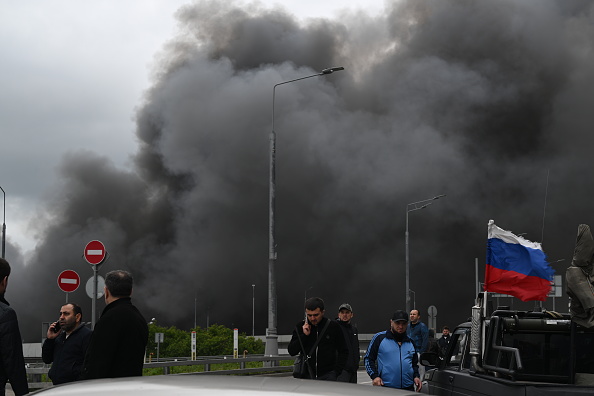
The aftermath of yesterday’s attack on a Moscow oil refinery. Credit: Getty

The aftermath of yesterday’s attack on a Moscow oil refinery. Credit: Getty

June 19 2026 - 10:08am

“If Ukraine burns, your Moscow will burn,” crowed Ukrainian President Volodymyr Zelensky yesterday. And burn she did. Smoke billowed over the Russian capital after Kyiv launched its largest drone attack since the start of the war. Dramatic images showed the roof of a crucial oil refinery blown apart, wrecking infrastructure that supplies up to 40% of the city’s gasoline.

The assault appeared to be swift retribution for this week’s deadly Russian strikes that set a Kyiv cathedral ablaze. Yet, while that may have been the immediate catalyst, it was also a reflection of longer-term confidence on Ukraine’s part, both in the strength of its weaponry and in its diplomatic position. The Bars hybrid drone-cruise missiles used were believed to have a range of between 600 km and 800 km. Yesterday’s strikes on Moscow suggest their capabilities extend beyond that.

Meanwhile, at this week’s G7 summit, Donald Trump signed onto a statement that upped Ukraine’s air defense capabilities and committed to strengthening sanctions on Russia. He met Zelensky for the first time in over four months and — according to French President Emmanuel Macron — acknowledged that the Kremlin is not truly interested in peace.

Zelensky can feel secure in the knowledge that, for now, his friends are behind him. But what about the enemy in front of him? Russian President Vladimir Putin will be embarrassed by the attack, not least since it occurred while he was hosting an Association of Southeast Asian Nations (ASEAN) summit in Kazan, and because it sparked widespread disruption as well as online panic. Amid a lack of sirens and warnings, Muscovites have posted that they intend to depart the city or “just didn’t think the war would affect us like this”.

Ukraine’s strategy hinges in part on bringing the war home to ordinary Russians, eroding public support for the conflict by shattering the sense of distance that has long insulated Moscow from most consequences. As strikes hit the capital, Ukrainian Foreign Minister Andrii Sybiha urged denizens to direct their complaints towards the Kremlin: “Now that you know what’s going on, ask Putin when he is planning to end it.”

The strategy rests on a dubious assumption, namely that public frustration can translate into political pressure. There is little evidence that even Russia’s most powerful business figures possess any leverage to alter the Kremlin’s course, let alone ordinary citizens constrained by pervasive restrictions on freedom of speech. Kyiv also assumes that shock and fear will fuel demands to end the war, rather than harden public attitudes and strengthen calls for retaliation against those responsible for bringing the conflict to Moscow’s door and endangering civilian lives.

On the one hand, the attack has undermined Russians’ confidence in the government’s capabilities. One milblogger, known as “Fighterbomber”, criticized the authorities, writing that “the enemy has correctly calculated the forces and assets needed to hit the target. But you haven’t.” Rather than demanding a Russian withdrawal from Ukraine, however, he stressed that “no one in the country gives a damn how [Ukrainians] are suffering” and hoped for “wonder weapons” to appear. Other military bloggers rallied against Russia’s “weakness”, demanding the use of nuclear weapons and proposing that the Office of the Ukrainian President be “razed”.

The Kremlin can, of course, arrest milbloggers who step too far out of line — and has already done so. But their criticism points to a broader reality. Muscovites are just as likely to rally around the flag as hope for an end to the war, and are more likely to blame attacks on the Ukrainians who launched them than the Russians who started the war.

Putin is unlikely to let this cycle of escalation end here. An Oreshnik strike or the targeting of a symbolic Ukrainian landmark could be his next move. Within Russia, such a response would likely be welcomed by segments of the public as justified retaliation. Exposing weakness can often harden resolve rather than diminish it. The problem with revealing someone as weak is that they become determined to prove you wrong. As Zelensky watches Moscow burn, he must remember that fire spreads.


Bethany Elliott is a writer specialising in Russia and Eastern Europe.

BethanyAElliott

China is threatening America in the AI race

Reports sugget Zhipu AI  has released a new model that can rival leading US systems. Credit: Getty

Reports sugget Zhipu AI has released a new model that can rival leading US systems. Credit: Getty

July 1 2026 - 10:18am

China is trying to catch up with America on artificial intelligence. The Wall Street Journal has reported that Zhipu AI — one of China’s six “AI tiger” LLMs — has released a new model that can rival leading US systems, including Anthropic’s Mythos, in cybersecurity tasks such as pinpointing security bugs. While this marks a milestone in China’s drive to catch up with Western AI capabilities, strong performance on a single benchmark does not mean it has taken the lead. Chinese models still lag behind their Western counterparts in broader capabilities, such as autonomous operation. Skepticism is therefore warranted before resorting to hysterical conclusions, but complacency about the geopolitical implications of China’s AI advances would be an even greater mistake.

On the infrastructure side, Chinese AI is still constrained by access to advanced chips, with American labs way ahead in computing capacity as well as investment. Analysis from earlier this year suggests that Chinese models are likely to be at least a few months behind those in the US. But they are still continuing to make progress, or that the geopolitical importance of AI will be decided only by whose LLM has ventured deeper into the technological frontier. The practical applications of AI, countries’ to capture foreign markets, and the application of AI into the real economy will matter just as much.

Here, China may hold an advantage. As with its dominance across many critical supply chains, Beijing may not need to produce the most advanced AI systems — only those that are affordable and widely deployable. In doing so, it could consolidate global influence by supplying functional, low-cost AI at scale.

Beijing seems to be pursuing exactly that path, developing an AI “open-source” strategy that offers affordable, widely available AI models for companies and individuals to use and modify as they wish. The production of the DeepSeek AI model, which matched the performance of Silicon Valley tools such as ChatGPT at a fraction of the cost for users, created goodwill among Chinese models with developers.

The four most popular models on OpenRouter, an AI hardware platform for developers, are now all Chinese. The goal for China is not only to win the frontier-model race, but to make its systems the default layer of AI adoption across industries and global markets. For most economies, the choice is increasingly between an affordable tool they can deploy now and a more robust one that may be out of reach.

And while the countries adopting Chinese models may be exposed to political pressure and cyber threats from Beijing, safer and more capable alternatives matter little if they are unaffordable. American AI companies are already under pressure to monetize products whose operating costs are rising. If Chinese open-source models become the cheap default for startups, universities, governments and businesses across the developing world, then America’s AI lead will be eroded from below.

Perhaps more concerning for America in the long run is how AI can give Chinese manufacturing even more strength, through the ongoing integration of AI as a general-purpose technology. China’s new Five-Year Plan mentioned AI more than 50 times and includes an “AI+” action plan aimed at spreading AI across the economy.

Beijing has been pioneering automation of its critical infrastructure for years, with promising recent results in increasing warplane production capacity. In that regard, China’s open-model strategy and manufacturing dominance will reinforce each other. Cheap, adaptable models accelerate deployment across the real economy while those deployments generate real-world data and use cases that can feed back into further model improvement.

The United States should not dismiss the importance of its lead in the AI race. That lead worries Beijing, not least because a more automated Chinese economy would also become more vulnerable to AI-generated cyber threats. But nor should Washington assume that China cannot catch up with American capabilities over time.

This AI competition represents part of a broader struggle over tech supply chains and geopolitical influence. Decisions over whether to adopt US or Chinese models could produce a more fragmented global reality, with different regions relying on different cloud providers, chips and security structures. The result will likely be a global economy which is divided into competing spheres, rather than one which produces a single winner.


Miquel Vila is a political and geopolitical risk consultant focusing on industrial strategy, critical infrastructure and global supply chains.

miquelvilam