




X Close

Left-wing civil war threatens LA’s future

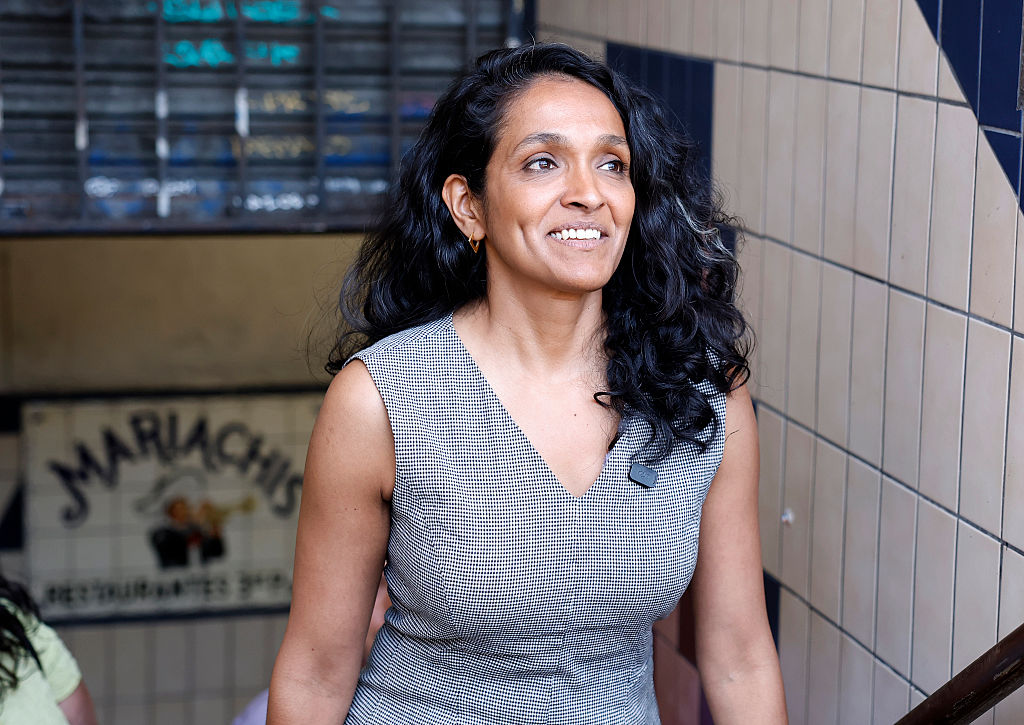
Raman edged out Spencer Pratt to pave the way for a runoff with Karen Bass. Credit: Getty

Raman edged out Spencer Pratt to pave the way for a runoff with Karen Bass. Credit: Getty

June 11 2026 - 6:01pm

Nithya Raman’s come-from-behind victory represents a challenge from the Left to an LA establishment that also regards itself as progressive.

Such conflicts are becoming more common as coastal cities evolve into de facto one-party systems, split between establishment Democrats and a newer, generally younger cohort of socialists. Even moderate Democrats — and Republicans, including Spencer Pratt, whose much-hyped effort ultimately failed — are increasingly outliers in their own cities.

Raman, a council member representing a diverse district with a large middle-class electorate, could benefit from the shortcomings of her fellow progressives. Angelenos across political lines are increasingly frustrated with the condition of the city; public services are strained while concerns persist over crime and homelessness.

As one campaign adviser to Raman tells me, Mayor Karen Bass is not widely popular, with nearly two-thirds of Angelenos voting for other candidates. This allows Raman to position herself as a “change candidate” against Bass, who is more closely associated with the city’s status quo power structures, particularly municipal unions.

Raman’s most significant challenge is likely to come from those same unions, which dominate fundraising and ground operations in city politics. She also carries the baggage of her earlier progressive positions on policing, Israel, and particularly homelessness, which opponents may seek to use against her.

According to Tim Campbell, a longtime Angeleno and former government auditor, Raman’s record on homelessness is “worse than Bass — if that is possible”. She has opposed encampment clearing and has been accused of being linked to dodgy NGOs. “She’s incompetent and arrogant, which is a fatal combination,” he concludes.

To be sure, the progressive label may thrill Raman’s core supporters in LA’s version of New York’s “commie corridor” — progressive communities such as Echo Park, Silver Lake, parts of Hollywood, and less affluent areas of the Westside form her natural base. But it may not be the hipster Left that ultimately decides the race; instead, it could be Pratt voters — around 25% of the electorate — who prove pivotal.

Winning over voters who did not participate or who previously supported Pratt will be central to Raman’s prospects. However, the Pratt constituency, already suspicious of what it sees as machine influence over electoral processes, is unlikely to respond positively to her characterization of Pratt as a fascist. The prospect of an LA version of New York’s Zohran Mamdani may also sit uneasily with parts of the electorate, including segments of the city’s large Jewish community.

Raman, a close adviser suggests, can emphasize her efforts to rein in what she sees as excessive public-sector pay increases, as well as large allocations to projects such as the city’s Convention Center, which critics have long described as inefficient or wasteful. In this framing, her lack of backing from the unions and from the three other DSA members — widely seen as aligned with Bass and their union backers — on the council gives her room to present herself as a steward of a strained municipal budget. “The most important issue is the budget,” one of her top aides tells me. “If the focus is on competence, Karen becomes the defender of a failed status quo.”

Given the internecine nature of the race, much may come down to the ground game. Raman has built a strong grassroots organization and brings an energy that reflects her age and political style. Bass, while far from doddering, is 72 and appears to belong to an earlier political era.

All of this suggests that, even without the media-savvy Pratt in the race, Angelenos can expect plenty of fireworks in this Left versus Left contest. With relatively little disagreement on issues such as Trump and ICE, the candidates are likely to compete instead on personal attributes, which are always fertile ground for a hard-fought and often acrimonious campaign season.

“It’s going to be one of the ugliest campaigns ever,” says Dave Gershwin, a longtime city council aide and now a Democratic political consultant. “It’s Karen’s race to lose but Raman is not to be underestimated.”


Joel Kotkin is a Presidential Fellow in Urban Futures at Chapman University and a Senior Research Fellow at the Civitas Institute, the University of Texas at Austin.

joelkotkin

China is threatening America in the AI race

Reports sugget Zhipu AI  has released a new model that can rival leading US systems. Credit: Getty

Reports sugget Zhipu AI has released a new model that can rival leading US systems. Credit: Getty

July 1 2026 - 10:18am

China is trying to catch up with America on artificial intelligence. The Wall Street Journal has reported that Zhipu AI — one of China’s six “AI tiger” LLMs — has released a new model that can rival leading US systems, including Anthropic’s Mythos, in cybersecurity tasks such as pinpointing security bugs. While this marks a milestone in China’s drive to catch up with Western AI capabilities, strong performance on a single benchmark does not mean it has taken the lead. Chinese models still lag behind their Western counterparts in broader capabilities, such as autonomous operation. Skepticism is therefore warranted before resorting to hysterical conclusions, but complacency about the geopolitical implications of China’s AI advances would be an even greater mistake.

On the infrastructure side, Chinese AI is still constrained by access to advanced chips, with American labs way ahead in computing capacity as well as investment. Analysis from earlier this year suggests that Chinese models are likely to be at least a few months behind those in the US. But they are still continuing to make progress, or that the geopolitical importance of AI will be decided only by whose LLM has ventured deeper into the technological frontier. The practical applications of AI, countries’ to capture foreign markets, and the application of AI into the real economy will matter just as much.

Here, China may hold an advantage. As with its dominance across many critical supply chains, Beijing may not need to produce the most advanced AI systems — only those that are affordable and widely deployable. In doing so, it could consolidate global influence by supplying functional, low-cost AI at scale.

Beijing seems to be pursuing exactly that path, developing an AI “open-source” strategy that offers affordable, widely available AI models for companies and individuals to use and modify as they wish. The production of the DeepSeek AI model, which matched the performance of Silicon Valley tools such as ChatGPT at a fraction of the cost for users, created goodwill among Chinese models with developers.

The four most popular models on OpenRouter, an AI hardware platform for developers, are now all Chinese. The goal for China is not only to win the frontier-model race, but to make its systems the default layer of AI adoption across industries and global markets. For most economies, the choice is increasingly between an affordable tool they can deploy now and a more robust one that may be out of reach.

And while the countries adopting Chinese models may be exposed to political pressure and cyber threats from Beijing, safer and more capable alternatives matter little if they are unaffordable. American AI companies are already under pressure to monetize products whose operating costs are rising. If Chinese open-source models become the cheap default for startups, universities, governments and businesses across the developing world, then America’s AI lead will be eroded from below.

Perhaps more concerning for America in the long run is how AI can give Chinese manufacturing even more strength, through the ongoing integration of AI as a general-purpose technology. China’s new Five-Year Plan mentioned AI more than 50 times and includes an “AI+” action plan aimed at spreading AI across the economy.

Beijing has been pioneering automation of its critical infrastructure for years, with promising recent results in increasing warplane production capacity. In that regard, China’s open-model strategy and manufacturing dominance will reinforce each other. Cheap, adaptable models accelerate deployment across the real economy while those deployments generate real-world data and use cases that can feed back into further model improvement.

The United States should not dismiss the importance of its lead in the AI race. That lead worries Beijing, not least because a more automated Chinese economy would also become more vulnerable to AI-generated cyber threats. But nor should Washington assume that China cannot catch up with American capabilities over time.

This AI competition represents part of a broader struggle over tech supply chains and geopolitical influence. Decisions over whether to adopt US or Chinese models could produce a more fragmented global reality, with different regions relying on different cloud providers, chips and security structures. The result will likely be a global economy which is divided into competing spheres, rather than one which produces a single winner.


Miquel Vila is a political and geopolitical risk consultant focusing on industrial strategy, critical infrastructure and global supply chains.

miquelvilam