




X Close

Klaus Schwab was always too powerless to be a bogeyman

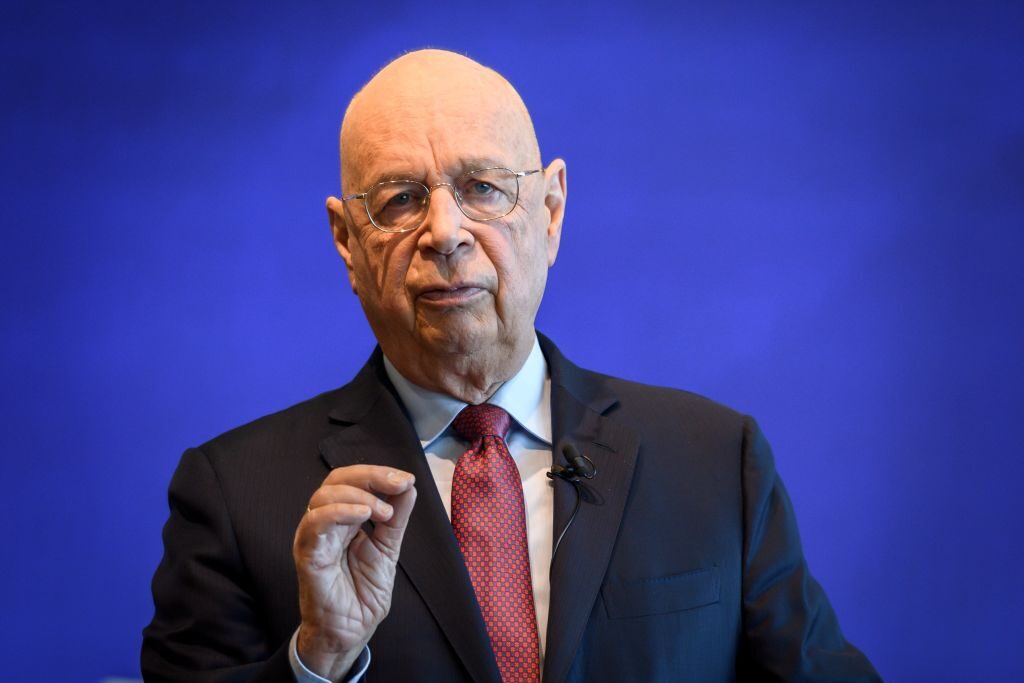
An inconsequential 'puppet-master'. Credit: Getty

An inconsequential 'puppet-master'. Credit: Getty

April 22 2025 - 10:45am

Yesterday, Klaus Schwab announced his decision to step down as Chairman of the World Economic Forum (WEF). In a message posted on its website, the WEF explained that 87-year-old Schwab would be resigning with immediate effect, to be replaced in the interim by Vice Chairman Peter Brabeck-Letmathe. No particular reason was given for the sudden change in leadership.

We should have expected no less from Schwab, the mechanical engineer and economics professor who has steered the WEF since its foundation in 1971 as a talking shop for global policymakers. The Forum is hosted every year in Davos, Switzerland, and has become a lightning rod for a certain kind of populist, anti-globalist anger. For many, the metonym of Davos now stands for a high-handed, technocratic style of policy and “Davos man” for its glossy, plutocratic proponents.

This anger reached its zenith during the Covid-19 pandemic, when bafflement and outrage drove some to identify the omnipresent WEF as puppet-master of liberticidal public health policies. And both the organization and its CEO — with his penchant for sinister book titles like The Great Reset and his tendency to be photographed in Emperor Palpatine’s robes (a Lithuanian university’s graduation outfit, it turns out) — were well-placed to play the role.

The gist of these theories is that Schwab and the WEF somehow “dictated” the global response to Covid, or even “pre-planned” [sic] the pandemic itself. The evidence given for these — from, among others, US Health Secretary Robert F. Kennedy Jr — includes Event 201, a three-and-a-half-hour tabletop exercise co-hosted in October 2019 by the WEF and the Bill and Melinda Gates Foundation, simulating the outbreak of a novel coronavirus.

While there are some eerie similarities between the scenario described by Event 201 and the subsequent pandemic, the exercise does not actually demonstrate what the anti-WEFers claim. In fact, it may even demonstrate the complete opposite. For a start, pandemic exercises are a well-established — and largely useless — practice in the global health security community, and coronaviruses were known to pose an epidemic threat (for example, SARS-1). Neither Event 201’s occurrence nor its focus are therefore especially suspicious.

More damning, however, are its recommendations. Written in the airy corporate-speak so typical of the Davos set, they make no reference to the havoc-wreaking pandemic measures later imputed to Schwab and the WEF. On the contrary, they can even be read as recommending the opposite of what was done: “Countries, international organizations, and global transportation companies should work together to maintain travel and trade during severe pandemics.” In this way, far from illustrating Schwab and the WEF’s omnipotence, Event 201 showcases their irrelevance to what actually happened.

This is not to say that WEF had no role in shaping the Covid-19 debacle, but instead that it played exactly the role that you would expect an elite forum to play: that of a networking opportunity for influential people. In his 2021 pandemic memoir, ex-SAGE member Jeremy Farrar described how January 2020’s Davos meeting catalyzed Moderna’s mRNA vaccine development program and helped instill a sense of urgency in public health leaders. While not entirely trivial, it hardly constitutes puppet-mastery. Far more consequential were domestic decisions made by our states and our willingness — eagerness, even — to comply with them. Perversely, in focusing their anger on a fantasy-version of Schwab, critics of the lockdown-till-vaccine policy absolve its real perpetrators: governments and their citizens.

Really, Schwab was the pandemic’s most inconsequential man; and his departure should allow us to dispense with these convenient fictions. WEF did not lock us down: our state did and far too many of us accepted. WEF did not abandon our grandparents to die alone, or let our friends, and families go crazy under house arrest. Our state did, just as our parliamentarians chipped away at our civil liberties. In Covid’s wake, it is time for us to reckon with the harm that these people did, not Klaus Schwab.


Max Lacour is a postgraduate student. He tweets at @MaxFromMax


China is threatening America in the AI race

Reports sugget Zhipu AI  has released a new model that can rival leading US systems. Credit: Getty

Reports sugget Zhipu AI has released a new model that can rival leading US systems. Credit: Getty

July 1 2026 - 10:18am

China is trying to catch up with America on artificial intelligence. The Wall Street Journal has reported that Zhipu AI — one of China’s six “AI tiger” LLMs — has released a new model that can rival leading US systems, including Anthropic’s Mythos, in cybersecurity tasks such as pinpointing security bugs. While this marks a milestone in China’s drive to catch up with Western AI capabilities, strong performance on a single benchmark does not mean it has taken the lead. Chinese models still lag behind their Western counterparts in broader capabilities, such as autonomous operation. Skepticism is therefore warranted before resorting to hysterical conclusions, but complacency about the geopolitical implications of China’s AI advances would be an even greater mistake.

On the infrastructure side, Chinese AI is still constrained by access to advanced chips, with American labs way ahead in computing capacity as well as investment. Analysis from earlier this year suggests that Chinese models are likely to be at least a few months behind those in the US. But they are still continuing to make progress, or that the geopolitical importance of AI will be decided only by whose LLM has ventured deeper into the technological frontier. The practical applications of AI, countries’ to capture foreign markets, and the application of AI into the real economy will matter just as much.

Here, China may hold an advantage. As with its dominance across many critical supply chains, Beijing may not need to produce the most advanced AI systems — only those that are affordable and widely deployable. In doing so, it could consolidate global influence by supplying functional, low-cost AI at scale.

Beijing seems to be pursuing exactly that path, developing an AI “open-source” strategy that offers affordable, widely available AI models for companies and individuals to use and modify as they wish. The production of the DeepSeek AI model, which matched the performance of Silicon Valley tools such as ChatGPT at a fraction of the cost for users, created goodwill among Chinese models with developers.

The four most popular models on OpenRouter, an AI hardware platform for developers, are now all Chinese. The goal for China is not only to win the frontier-model race, but to make its systems the default layer of AI adoption across industries and global markets. For most economies, the choice is increasingly between an affordable tool they can deploy now and a more robust one that may be out of reach.

And while the countries adopting Chinese models may be exposed to political pressure and cyber threats from Beijing, safer and more capable alternatives matter little if they are unaffordable. American AI companies are already under pressure to monetize products whose operating costs are rising. If Chinese open-source models become the cheap default for startups, universities, governments and businesses across the developing world, then America’s AI lead will be eroded from below.

Perhaps more concerning for America in the long run is how AI can give Chinese manufacturing even more strength, through the ongoing integration of AI as a general-purpose technology. China’s new Five-Year Plan mentioned AI more than 50 times and includes an “AI+” action plan aimed at spreading AI across the economy.

Beijing has been pioneering automation of its critical infrastructure for years, with promising recent results in increasing warplane production capacity. In that regard, China’s open-model strategy and manufacturing dominance will reinforce each other. Cheap, adaptable models accelerate deployment across the real economy while those deployments generate real-world data and use cases that can feed back into further model improvement.

The United States should not dismiss the importance of its lead in the AI race. That lead worries Beijing, not least because a more automated Chinese economy would also become more vulnerable to AI-generated cyber threats. But nor should Washington assume that China cannot catch up with American capabilities over time.

This AI competition represents part of a broader struggle over tech supply chains and geopolitical influence. Decisions over whether to adopt US or Chinese models could produce a more fragmented global reality, with different regions relying on different cloud providers, chips and security structures. The result will likely be a global economy which is divided into competing spheres, rather than one which produces a single winner.


Miquel Vila is a political and geopolitical risk consultant focusing on industrial strategy, critical infrastructure and global supply chains.

miquelvilam