



X Close

Kemi Badenoch is turning realism into a culture war

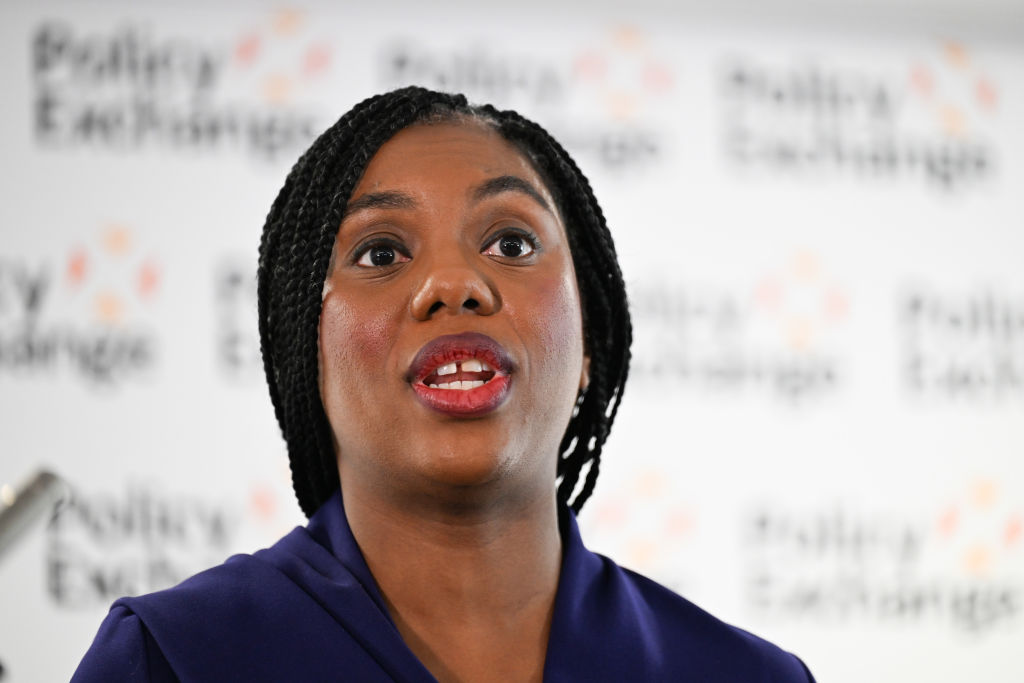
Kemi Badenoch pitched 'conservative realism' this week. Credit: Getty

Kemi Badenoch pitched 'conservative realism' this week. Credit: Getty

February 28 2025 - 1:00pm

One of the most dramatic effects of Donald Trump’s second administration is that it has thrust the doctrine of realism to the forefront of public debate. A storied theoretical tradition rooted in the academic discipline of International Relations, realism has recently won greater public prominence through the efforts of pugnacious exponents such as Chicago professor John Mearsheimer, known for his sharp criticisms of US foreign policy over Israel and Ukraine.

Yet since Trump returned to the White House this year, realism has been used less to attack Western foreign policy than to promote it. It has now been officially endorsed by both Labor and the Conservatives in the UK. Foreign Secretary David Lammy set out his doctrine of “progressive realism” last summer, while Tory leader Kemi Badenoch this week promulgated her own theory of “conservative realism”.

On the face of it, Badenoch’s version of realism sounds better than Lammy’s. She explicitly differentiates herself from those she calls neoconservatives and cosmopolitan internationalists. Unlike the Foreign Secretary’s veneration of international law, she voices her frank skepticism. She criticizes the current government’s deal with Mauritius to relinquish British sovereignty over the Chagos Islands in the Indian Ocean, and moots the possibility of raising national spending on defense above the 2.5% targeted by Labor. She also explicitly talks in terms of pursuing the national interest, something that Lammy abjures, predictably damning it by association with colonialism.

With British voters now having the choice of conservative realism or progressive realism, one is left wondering: why is realism itself not sufficient? In her speech on Tuesday, Badenoch argued that “progressive realism” is a contradiction in terms, but what is the reality from which she needs to shield herself by caveating realism with the word “conservative”?

Realism has been historically defined by its focus on the ruthless pursuit of the national interest. The difficulty for Badenoch is that pursuing the national interest today is not a conservative task but a radical one, going far beyond adding a few more slivers of GDP to defense. Pursuing the national interest today requires remaking the British state itself. This is something from which Badenoch shies away, as she predictably qualifies the prospect of Brexiting from the European Convention on Human Rights and the International Criminal Court, talking in terms of “disengagement” rather than departure.

The truth is that whether the chosen buffer for realism is progressive or conservative, both Lammy and Badenoch are shielding themselves from reality, while at the same time trying to domesticate realism and make it safe for a decaying Westminster elite. The logical endpoint of all this will be another hapless British politician calling in due course for a “real realism”. To claim a conservative realism as opposed to a progressive realism is only to announce that you are incapable of rising to the challenges of realism.

Talking in terms of “conservative” or “progressive” realism indicates a political elite that is thinking in terms of global culture wars rather than representing and defending the nation. Like the linen rolls clinging to a decomposed mummy, such labels are ideological strands that are intended to entwine us forever in online discourse in service of crumbling political parties. The point of the national interest is precisely that it transcends the tedious ideological polarization of the Westminster state and the ancien regime of globalism. Serving the interests of a new British nation will require a new generation of political representatives. The current crop simply won’t do.


Philip Cunliffe is Associate Professor of International Relations at the Department of Risk and Disaster Reduction, University College London. He is the author of seven books, including, most recently: The National Interest: Politics after Globalization.

thephilippics

China is threatening America in the AI race

Reports sugget Zhipu AI  has released a new model that can rival leading US systems. Credit: Getty

Reports sugget Zhipu AI has released a new model that can rival leading US systems. Credit: Getty

July 1 2026 - 10:18am

China is trying to catch up with America on artificial intelligence. The Wall Street Journal has reported that Zhipu AI — one of China’s six “AI tiger” LLMs — has released a new model that can rival leading US systems, including Anthropic’s Mythos, in cybersecurity tasks such as pinpointing security bugs. While this marks a milestone in China’s drive to catch up with Western AI capabilities, strong performance on a single benchmark does not mean it has taken the lead. Chinese models still lag behind their Western counterparts in broader capabilities, such as autonomous operation. Skepticism is therefore warranted before resorting to hysterical conclusions, but complacency about the geopolitical implications of China’s AI advances would be an even greater mistake.

On the infrastructure side, Chinese AI is still constrained by access to advanced chips, with American labs way ahead in computing capacity as well as investment. Analysis from earlier this year suggests that Chinese models are likely to be at least a few months behind those in the US. But they are still continuing to make progress, or that the geopolitical importance of AI will be decided only by whose LLM has ventured deeper into the technological frontier. The practical applications of AI, countries’ to capture foreign markets, and the application of AI into the real economy will matter just as much.

Here, China may hold an advantage. As with its dominance across many critical supply chains, Beijing may not need to produce the most advanced AI systems — only those that are affordable and widely deployable. In doing so, it could consolidate global influence by supplying functional, low-cost AI at scale.

Beijing seems to be pursuing exactly that path, developing an AI “open-source” strategy that offers affordable, widely available AI models for companies and individuals to use and modify as they wish. The production of the DeepSeek AI model, which matched the performance of Silicon Valley tools such as ChatGPT at a fraction of the cost for users, created goodwill among Chinese models with developers.

The four most popular models on OpenRouter, an AI hardware platform for developers, are now all Chinese. The goal for China is not only to win the frontier-model race, but to make its systems the default layer of AI adoption across industries and global markets. For most economies, the choice is increasingly between an affordable tool they can deploy now and a more robust one that may be out of reach.

And while the countries adopting Chinese models may be exposed to political pressure and cyber threats from Beijing, safer and more capable alternatives matter little if they are unaffordable. American AI companies are already under pressure to monetize products whose operating costs are rising. If Chinese open-source models become the cheap default for startups, universities, governments and businesses across the developing world, then America’s AI lead will be eroded from below.

Perhaps more concerning for America in the long run is how AI can give Chinese manufacturing even more strength, through the ongoing integration of AI as a general-purpose technology. China’s new Five-Year Plan mentioned AI more than 50 times and includes an “AI+” action plan aimed at spreading AI across the economy.

Beijing has been pioneering automation of its critical infrastructure for years, with promising recent results in increasing warplane production capacity. In that regard, China’s open-model strategy and manufacturing dominance will reinforce each other. Cheap, adaptable models accelerate deployment across the real economy while those deployments generate real-world data and use cases that can feed back into further model improvement.

The United States should not dismiss the importance of its lead in the AI race. That lead worries Beijing, not least because a more automated Chinese economy would also become more vulnerable to AI-generated cyber threats. But nor should Washington assume that China cannot catch up with American capabilities over time.

This AI competition represents part of a broader struggle over tech supply chains and geopolitical influence. Decisions over whether to adopt US or Chinese models could produce a more fragmented global reality, with different regions relying on different cloud providers, chips and security structures. The result will likely be a global economy which is divided into competing spheres, rather than one which produces a single winner.


Miquel Vila is a political and geopolitical risk consultant focusing on industrial strategy, critical infrastructure and global supply chains.

miquelvilam
