



X Close

Jasmine Crockett is not the Democrats’ answer to Trump

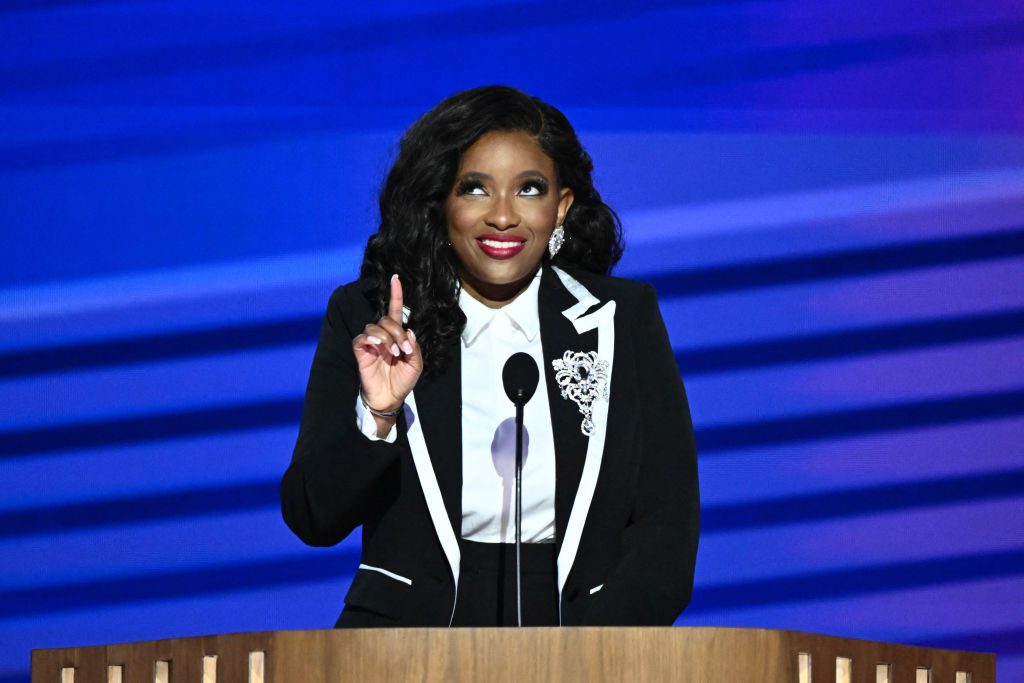
Crockett has no long-term appeal. Credit: Getty

Crockett has no long-term appeal. Credit: Getty

July 29 2025 - 5:30pm

The Atlantic has just crowned Texas Rep. Jasmine Crockett as “a Democrat for the Trump Era”. Democrats seem to agree. Earlier this month, the Houston Chronicle declared Crockett a “fundraising juggernaut,” noting that the second-term congresswoman ranks fifth among all House Democrats when it comes to raking in campaign cash.

The contention of Crockett’s Atlantic profile is that she’s particularly suited for the Trump era because no other Democrat has come quite so close to matching the President’s raw hostility towards his enemies. “Crockett is testing out the coarser, insult-comedy-style attacks that the GOP has embraced under Trump, the general idea being that when the Republicans go low, the Democrats should meet them there,” the story posits.

Crockett calls Republicans “motherfuckers” and Trump “Putin’s hoe” (the President has responded by calling her “low IQ”). She described her state’s wheelchair-bound Republican Governor, Greg Abbott, as “Governor Hot Wheels”. Like Trump, Crockett’s iPhone lock screen is also a picture of herself, according to The Atlantic.

Of course, Crockett’s most famous feud is with GOP Rep. Marjorie Taylor Greene, whom she accused last year of having a “bleach-blonde, bad-built, butch body”. She then trademarked the phrase and started selling merchandise featuring it to fundraise for Democrats. (Back in 2016, Trump made headlines when his campaign sold “Hillary for Prison” gear.)

Progressive strategist Max Burns is quoted in the profile saying, “What establishment Democrats see as undignified, disillusioned Democrats see as a small victory.” This dynamic mirrors Trump’s appeal to his base — and Greene’s to hers. It explains why Republicans in 2016 failed to derail Trump despite attacks on his character and crude rhetoric. It also helps explain why Greene raises 73% of her campaign funds from small-dollar donors — a higher percentage than anyone in Congress, including Alexandria Ocasio-Cortez and Bernie Sanders; Crockett herself was at 45% in 2024.

And this is where Crockett’s appeal becomes less certain in the long term. Rep. Maxine Dexter told The Atlantic that Crockett has expressed no interest in tussling with party leadership like Ocasio-Cortez, “explaining that she had never wanted to ‘burn it down’ and prefers to be seen as working on behalf of the party”. This doesn’t just put her at odds with AOC, but also with MTG.

Crockett has taken the first step to recovery by admitting the party has a problem. “The base is thirsty. The base right now is not very happy with us,” she told The Atlantic, pitching herself as the answer. But, as Marco Rubio’s failed 2016 presidential campaign showed, it’s not enough to just talk tough. You have to walk the walk too.

When Joe Biden was flailing towards the end of his campaign, Crockett stood firmly by him, even defending him after his debate disaster against Trump. Among Democrats, she falls roughly in the middle of her caucus on GovTrack’s Ideology-Leadership matrix, indicating she’s on the Left but not far Left. Indeed, she remains relatively in line with party bosses when it comes to votes.

This is an interesting recipe for Democrats: attacking the establishment in style, but supporting it in substance. The first part of that equation is at least a start. As Founding Father James Wilson said, the House of Representatives “ought to be the most exact transcript of the whole society”. American society now is perhaps coarser and more precarious than ever before, so it’s no great scandal that desperate voters are interested in electing representatives who match their frustration.

To maintain her credibility with a “thirsty” base, Crockett might actually need to “burn it down” sooner rather than later. This is what Trump forced on the GOP. It’s coming for the Democrats, too.


Emily Jashinsky is UnHerd‘s Washington correspondent.

emilyjashinsky

China is threatening America in the AI race

Reports sugget Zhipu AI  has released a new model that can rival leading US systems. Credit: Getty

Reports sugget Zhipu AI has released a new model that can rival leading US systems. Credit: Getty

July 1 2026 - 10:18am

China is trying to catch up with America on artificial intelligence. The Wall Street Journal has reported that Zhipu AI — one of China’s six “AI tiger” LLMs — has released a new model that can rival leading US systems, including Anthropic’s Mythos, in cybersecurity tasks such as pinpointing security bugs. While this marks a milestone in China’s drive to catch up with Western AI capabilities, strong performance on a single benchmark does not mean it has taken the lead. Chinese models still lag behind their Western counterparts in broader capabilities, such as autonomous operation. Skepticism is therefore warranted before resorting to hysterical conclusions, but complacency about the geopolitical implications of China’s AI advances would be an even greater mistake.

On the infrastructure side, Chinese AI is still constrained by access to advanced chips, with American labs way ahead in computing capacity as well as investment. Analysis from earlier this year suggests that Chinese models are likely to be at least a few months behind those in the US. But they are still continuing to make progress, or that the geopolitical importance of AI will be decided only by whose LLM has ventured deeper into the technological frontier. The practical applications of AI, countries’ to capture foreign markets, and the application of AI into the real economy will matter just as much.

Here, China may hold an advantage. As with its dominance across many critical supply chains, Beijing may not need to produce the most advanced AI systems — only those that are affordable and widely deployable. In doing so, it could consolidate global influence by supplying functional, low-cost AI at scale.

Beijing seems to be pursuing exactly that path, developing an AI “open-source” strategy that offers affordable, widely available AI models for companies and individuals to use and modify as they wish. The production of the DeepSeek AI model, which matched the performance of Silicon Valley tools such as ChatGPT at a fraction of the cost for users, created goodwill among Chinese models with developers.

The four most popular models on OpenRouter, an AI hardware platform for developers, are now all Chinese. The goal for China is not only to win the frontier-model race, but to make its systems the default layer of AI adoption across industries and global markets. For most economies, the choice is increasingly between an affordable tool they can deploy now and a more robust one that may be out of reach.

And while the countries adopting Chinese models may be exposed to political pressure and cyber threats from Beijing, safer and more capable alternatives matter little if they are unaffordable. American AI companies are already under pressure to monetize products whose operating costs are rising. If Chinese open-source models become the cheap default for startups, universities, governments and businesses across the developing world, then America’s AI lead will be eroded from below.

Perhaps more concerning for America in the long run is how AI can give Chinese manufacturing even more strength, through the ongoing integration of AI as a general-purpose technology. China’s new Five-Year Plan mentioned AI more than 50 times and includes an “AI+” action plan aimed at spreading AI across the economy.

Beijing has been pioneering automation of its critical infrastructure for years, with promising recent results in increasing warplane production capacity. In that regard, China’s open-model strategy and manufacturing dominance will reinforce each other. Cheap, adaptable models accelerate deployment across the real economy while those deployments generate real-world data and use cases that can feed back into further model improvement.

The United States should not dismiss the importance of its lead in the AI race. That lead worries Beijing, not least because a more automated Chinese economy would also become more vulnerable to AI-generated cyber threats. But nor should Washington assume that China cannot catch up with American capabilities over time.

This AI competition represents part of a broader struggle over tech supply chains and geopolitical influence. Decisions over whether to adopt US or Chinese models could produce a more fragmented global reality, with different regions relying on different cloud providers, chips and security structures. The result will likely be a global economy which is divided into competing spheres, rather than one which produces a single winner.


Miquel Vila is a political and geopolitical risk consultant focusing on industrial strategy, critical infrastructure and global supply chains.

miquelvilam
