



X Close

Infighting will damage GOP more than Houthi leaks

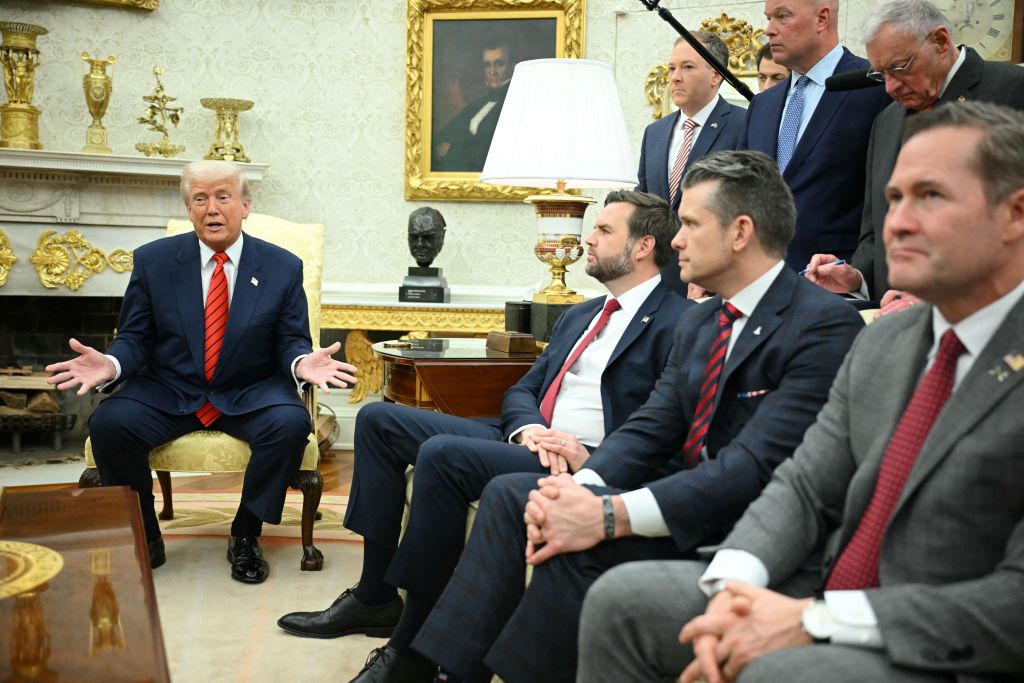
Cabinet of chaos. Credit: Getty

Cabinet of chaos. Credit: Getty

March 25 2025 - 3:10pm

“It’s not the crime but the cover-up” is one of the glib refrains of the Beltway. In the aftermath of Atlantic editor Jeffrey Goldberg’s bombshell story about being added to a high-level national security Signal group chat, a cousin of that truism has come into view: it’s not the leaks but the fallout from the leaks that may divide the new Trump administration.

Other than the fact that they were shared with Goldberg, the contents of that Signal group chat are hardly surprising. Trump’s team of brokenists is a broad coalition, and the President’s national security team includes both Jacksonian hawks and restrainers who are more skeptical about projecting American power abroad.

Those divides were in full view in the group chat. Vice President JD Vance bluntly told the other members: “I think we are making a mistake” in striking the Houthis so soon. While he said he was willing to go along with the consensus of the national security team, he also warned that the strikes could have destabilizing repercussions. Instead, he said that “there is a strong argument for delaying this a month, doing the messaging work on why this matters, seeing where the economy is, etc.”

Defense chief Pete Hegseth responded by claiming that delaying strikes on the Houthis could pose its own strategic risks, and he and National Security Advisor Mike Waltz argued that no American ally in the region had the technological wherewithal to accomplish those strikes — it was solely up to the United States. Vance ended up saying he would back strikes if Hegseth endorsed them.

None of this is shocking. In public, Vance has emphasized restraint-oriented themes, so it’s not an earth-shattering revelation when he offers the same argument in private. Likewise, Waltz and, to some extent, Hegseth are often identified with the hawkish wing of the Republican Party. It’s normal for policy principals at the highest level to have disagreements and debates before uniting behind a plan of action.

What might be more politically perilous for the administration is the infighting which has broken out among Republicans in the aftermath of Goldberg’s story. Tensions between hawks and restrainers, which had been simmering after the Houthi strikes, erupted after the leaks. In a series of media attacks, Waltz’s political foes have called for the axe to fall on him because he allegedly added Goldberg to the group chat, but his hawkish allies have pushed back hard.

Breitbart reporter Matthew Boyle — one of the most seasoned veterans of populist new media — took to X to warn about the risks of defenestrating a national security advisor: “Remember it was when Mike Flynn went down in Trump’s first term that things began to go off the rails. National Security Adviser a critical position. And the establishment media has been coming after Mike Waltz for some time now writing lots of hit pieces on him.” Trump’s national security team is still being staffed, and an NSA vacancy now would create yet another institutional power vacuum. Filling that position could set off an even more bitter proxy war between restrainers and hawks. That’s likely why Trump is, for now, standing by Waltz.

Trump prefers an adversarial mode of governance. Not only does he relish the Sturm und Drang of combat with his political adversaries, but he also seeds his own team with political disagreements. The clash of viewpoints gives him maximal policy maneuverability. However, the escalation of palace intrigue into public bloodsport short-circuits that strategy by replacing dynamism with stasis. The constant turnover of the first Trump administration sapped its political momentum. So far, the second Trump White House has avoided those endless internecine struggles, but this latest controversy may test its coalitional bonds.

On domestic and foreign policy, Trump’s instincts are heterogeneous, and the success of his administration will in part depend on whether those different teams — hawks and restrainers alike — can find a way of working together.


Fred Bauer is a writer from New England.

fredbauerblog

China is threatening America in the AI race

Reports sugget Zhipu AI  has released a new model that can rival leading US systems. Credit: Getty

Reports sugget Zhipu AI has released a new model that can rival leading US systems. Credit: Getty

July 1 2026 - 10:18am

China is trying to catch up with America on artificial intelligence. The Wall Street Journal has reported that Zhipu AI — one of China’s six “AI tiger” LLMs — has released a new model that can rival leading US systems, including Anthropic’s Mythos, in cybersecurity tasks such as pinpointing security bugs. While this marks a milestone in China’s drive to catch up with Western AI capabilities, strong performance on a single benchmark does not mean it has taken the lead. Chinese models still lag behind their Western counterparts in broader capabilities, such as autonomous operation. Skepticism is therefore warranted before resorting to hysterical conclusions, but complacency about the geopolitical implications of China’s AI advances would be an even greater mistake.

On the infrastructure side, Chinese AI is still constrained by access to advanced chips, with American labs way ahead in computing capacity as well as investment. Analysis from earlier this year suggests that Chinese models are likely to be at least a few months behind those in the US. But they are still continuing to make progress, or that the geopolitical importance of AI will be decided only by whose LLM has ventured deeper into the technological frontier. The practical applications of AI, countries’ to capture foreign markets, and the application of AI into the real economy will matter just as much.

Here, China may hold an advantage. As with its dominance across many critical supply chains, Beijing may not need to produce the most advanced AI systems — only those that are affordable and widely deployable. In doing so, it could consolidate global influence by supplying functional, low-cost AI at scale.

Beijing seems to be pursuing exactly that path, developing an AI “open-source” strategy that offers affordable, widely available AI models for companies and individuals to use and modify as they wish. The production of the DeepSeek AI model, which matched the performance of Silicon Valley tools such as ChatGPT at a fraction of the cost for users, created goodwill among Chinese models with developers.

The four most popular models on OpenRouter, an AI hardware platform for developers, are now all Chinese. The goal for China is not only to win the frontier-model race, but to make its systems the default layer of AI adoption across industries and global markets. For most economies, the choice is increasingly between an affordable tool they can deploy now and a more robust one that may be out of reach.

And while the countries adopting Chinese models may be exposed to political pressure and cyber threats from Beijing, safer and more capable alternatives matter little if they are unaffordable. American AI companies are already under pressure to monetize products whose operating costs are rising. If Chinese open-source models become the cheap default for startups, universities, governments and businesses across the developing world, then America’s AI lead will be eroded from below.

Perhaps more concerning for America in the long run is how AI can give Chinese manufacturing even more strength, through the ongoing integration of AI as a general-purpose technology. China’s new Five-Year Plan mentioned AI more than 50 times and includes an “AI+” action plan aimed at spreading AI across the economy.

Beijing has been pioneering automation of its critical infrastructure for years, with promising recent results in increasing warplane production capacity. In that regard, China’s open-model strategy and manufacturing dominance will reinforce each other. Cheap, adaptable models accelerate deployment across the real economy while those deployments generate real-world data and use cases that can feed back into further model improvement.

The United States should not dismiss the importance of its lead in the AI race. That lead worries Beijing, not least because a more automated Chinese economy would also become more vulnerable to AI-generated cyber threats. But nor should Washington assume that China cannot catch up with American capabilities over time.

This AI competition represents part of a broader struggle over tech supply chains and geopolitical influence. Decisions over whether to adopt US or Chinese models could produce a more fragmented global reality, with different regions relying on different cloud providers, chips and security structures. The result will likely be a global economy which is divided into competing spheres, rather than one which produces a single winner.


Miquel Vila is a political and geopolitical risk consultant focusing on industrial strategy, critical infrastructure and global supply chains.

miquelvilam
