




X Close

Giorgia Meloni won’t save EU from Trump’s tariffs

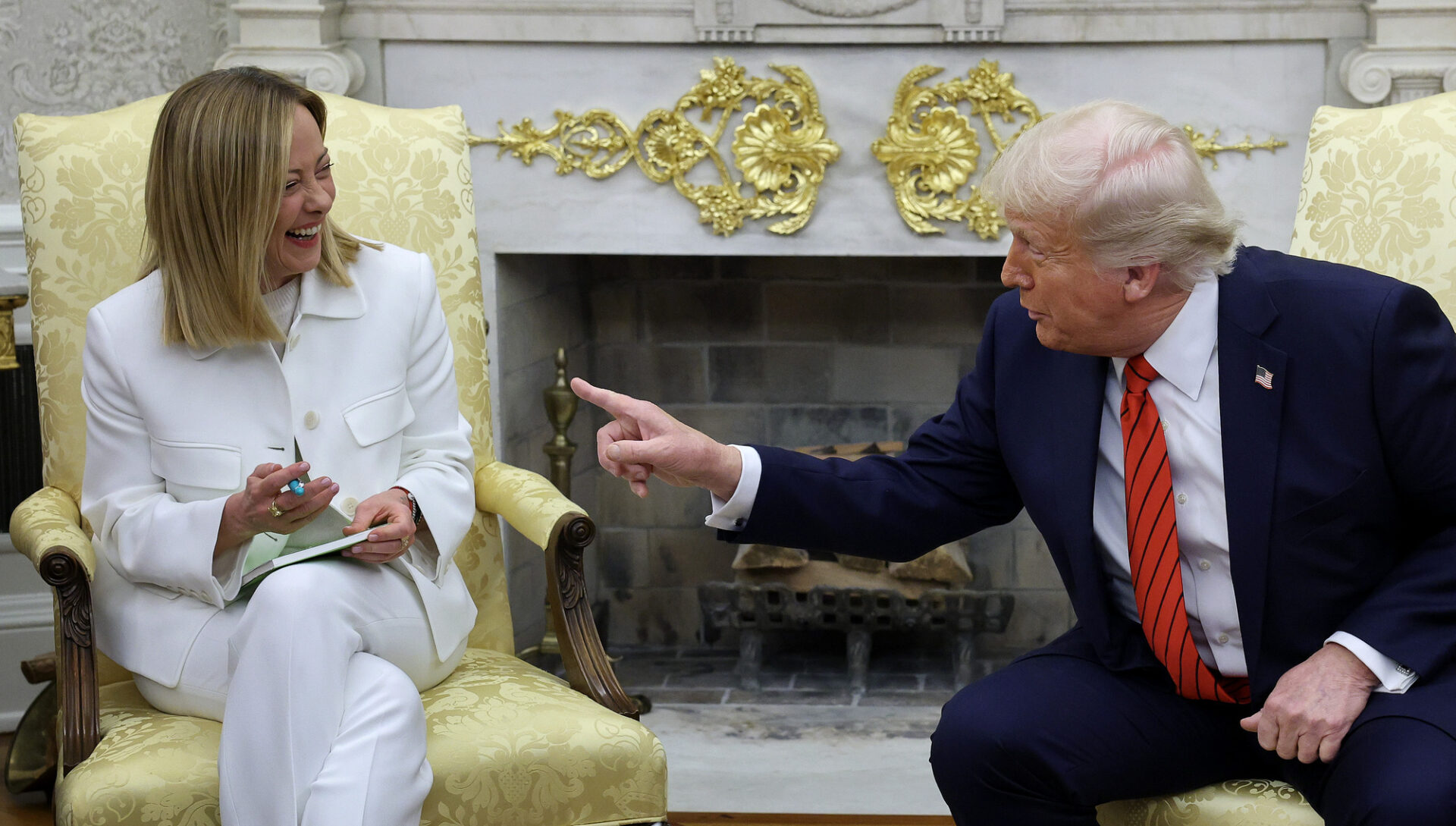
No dice. Credit: Getty

No dice. Credit: Getty

April 18 2025 - 7:00am

Expectations were high for yesterday’s meeting between Trump and Italian prime minister Giorgia Meloni — the first European leader to meet the US president since he announced a 20% tariff on all EU goods last week, subsequently paused and reduced to 10% for 90 days. Meloni’s visit was widely seen as a strategic move to leverage her ideological alignment and personal rapport with Trump, whom she met at Mar-a-Lago and whose inauguration she attended as the only EU leader present. Her goal was clear: to convince Trump to rethink his tariff stance concerning the EU — or at least Italy.

With a trade surplus of nearly €40 billion, Italy ranks as the third-largest EU exporter to the US, behind only Germany and Ireland. As such, it stands to be among the hardest hit by Trump’s proposed tariffs. Earlier this month, Meloni expressed harsh criticism of Trump’s tariff policy, saying his decision to impose 20% tariffs on the EU was “absolutely wrong” and that it would end up damaging the EU “as much as the US”.

Meloni was hoping to convince Trump of the merits of a “zero-for-zero” tariffs deal for the entire EU, but this did not come to fruition. Aside from Trump paying lip service to the fact that he “fully expects” to reach a trade deal with the EU, Meloni came home empty-handed. And that is arguably because, for all the economic and geopolitical shortfalls of Trump’s tariff-driven approach to reindustrialization, if there is a region of the world that truly deserves higher tariffs, that is the EU — and Trump knows it.

Over the past two decades — and especially in the aftermath of the 2010–2011 eurozone crisis — the European Union, despite being one of the wealthiest economic blocs in the world, has systematically suppressed domestic demand through policies of austerity, fiscal restraint and wage compression. This self-imposed deflationary trajectory (which further exacerbated the euro’s inherent deflationary bias) has not been accidental, but rather a deliberate strategy aimed at bolstering price competitiveness on the global stage, while at the same time reducing imports.

In effect, the EU has embraced a hyper-mercantilist, export-driven growth model, prioritizing trade surpluses over internal economic development. This approach has come at the expense of both its own citizens, who face stagnating wages and underfunded public services, and its trading partners — most notably the United States — who have absorbed the EU’s export surpluses as part of an increasingly unbalanced global economic relationship. In 2023, Italy’s export share of GDP was 33.7%, France’s 34.2%, while Germany’s was a staggering 43.4%. These are not normal figures. By way of comparison, China — long considered the export-led economy par excellence — only relies on exports for 19% of its GDP growth.

The reality is that long-running large trade surpluses do not indicate a successful economy. Quite the contrary. The EU has always been an exporting powerhouse precisely because of its sagging economy, caused by a lack of domestic consumption and investment.

The US has been voicing its concern about the EU’s beggar-thy-neighbor mercantilist policies for well before Trump even appeared on the political scene. More than a decade ago, the US Treasury Department lambasted European authorities for dragging down the world economy. “Europe’s overall adjustment is essentially premised on demand emanating from outside of Europe rather than addressing the shortfalls in demand that exist within Europe,” they wrote. Since then, nothing has changed. Trump’s trade war has therefore been a long time coming.

In this sense, his tariffs should be seen not merely as a provocation, but as an opportunity for Europeans to finally confront the deep flaws of the EU’s export-led economic model — a reckoning that is long overdue. Yet instead of sparking a serious debate, the only responses European leaders have mustered are either to lament the injustice of the tariffs — or, like Giorgia Meloni, to plead with Trump for exemptions. That this is the extent of Europe’s reaction speaks volumes about the continent’s political decline — a spectacle of impotence masquerading as diplomacy.


Thomas Fazi is an UnHerd columnist and translator. His latest book is The Covid Consensus, co-authored with Toby Green.

battleforeurope

China is threatening America in the AI race

Reports sugget Zhipu AI  has released a new model that can rival leading US systems. Credit: Getty

Reports sugget Zhipu AI has released a new model that can rival leading US systems. Credit: Getty

July 1 2026 - 10:18am

China is trying to catch up with America on artificial intelligence. The Wall Street Journal has reported that Zhipu AI — one of China’s six “AI tiger” LLMs — has released a new model that can rival leading US systems, including Anthropic’s Mythos, in cybersecurity tasks such as pinpointing security bugs. While this marks a milestone in China’s drive to catch up with Western AI capabilities, strong performance on a single benchmark does not mean it has taken the lead. Chinese models still lag behind their Western counterparts in broader capabilities, such as autonomous operation. Skepticism is therefore warranted before resorting to hysterical conclusions, but complacency about the geopolitical implications of China’s AI advances would be an even greater mistake.

On the infrastructure side, Chinese AI is still constrained by access to advanced chips, with American labs way ahead in computing capacity as well as investment. Analysis from earlier this year suggests that Chinese models are likely to be at least a few months behind those in the US. But they are still continuing to make progress, or that the geopolitical importance of AI will be decided only by whose LLM has ventured deeper into the technological frontier. The practical applications of AI, countries’ to capture foreign markets, and the application of AI into the real economy will matter just as much.

Here, China may hold an advantage. As with its dominance across many critical supply chains, Beijing may not need to produce the most advanced AI systems — only those that are affordable and widely deployable. In doing so, it could consolidate global influence by supplying functional, low-cost AI at scale.

Beijing seems to be pursuing exactly that path, developing an AI “open-source” strategy that offers affordable, widely available AI models for companies and individuals to use and modify as they wish. The production of the DeepSeek AI model, which matched the performance of Silicon Valley tools such as ChatGPT at a fraction of the cost for users, created goodwill among Chinese models with developers.

The four most popular models on OpenRouter, an AI hardware platform for developers, are now all Chinese. The goal for China is not only to win the frontier-model race, but to make its systems the default layer of AI adoption across industries and global markets. For most economies, the choice is increasingly between an affordable tool they can deploy now and a more robust one that may be out of reach.

And while the countries adopting Chinese models may be exposed to political pressure and cyber threats from Beijing, safer and more capable alternatives matter little if they are unaffordable. American AI companies are already under pressure to monetize products whose operating costs are rising. If Chinese open-source models become the cheap default for startups, universities, governments and businesses across the developing world, then America’s AI lead will be eroded from below.

Perhaps more concerning for America in the long run is how AI can give Chinese manufacturing even more strength, through the ongoing integration of AI as a general-purpose technology. China’s new Five-Year Plan mentioned AI more than 50 times and includes an “AI+” action plan aimed at spreading AI across the economy.

Beijing has been pioneering automation of its critical infrastructure for years, with promising recent results in increasing warplane production capacity. In that regard, China’s open-model strategy and manufacturing dominance will reinforce each other. Cheap, adaptable models accelerate deployment across the real economy while those deployments generate real-world data and use cases that can feed back into further model improvement.

The United States should not dismiss the importance of its lead in the AI race. That lead worries Beijing, not least because a more automated Chinese economy would also become more vulnerable to AI-generated cyber threats. But nor should Washington assume that China cannot catch up with American capabilities over time.

This AI competition represents part of a broader struggle over tech supply chains and geopolitical influence. Decisions over whether to adopt US or Chinese models could produce a more fragmented global reality, with different regions relying on different cloud providers, chips and security structures. The result will likely be a global economy which is divided into competing spheres, rather than one which produces a single winner.


Miquel Vila is a political and geopolitical risk consultant focusing on industrial strategy, critical infrastructure and global supply chains.

miquelvilam