




X Close

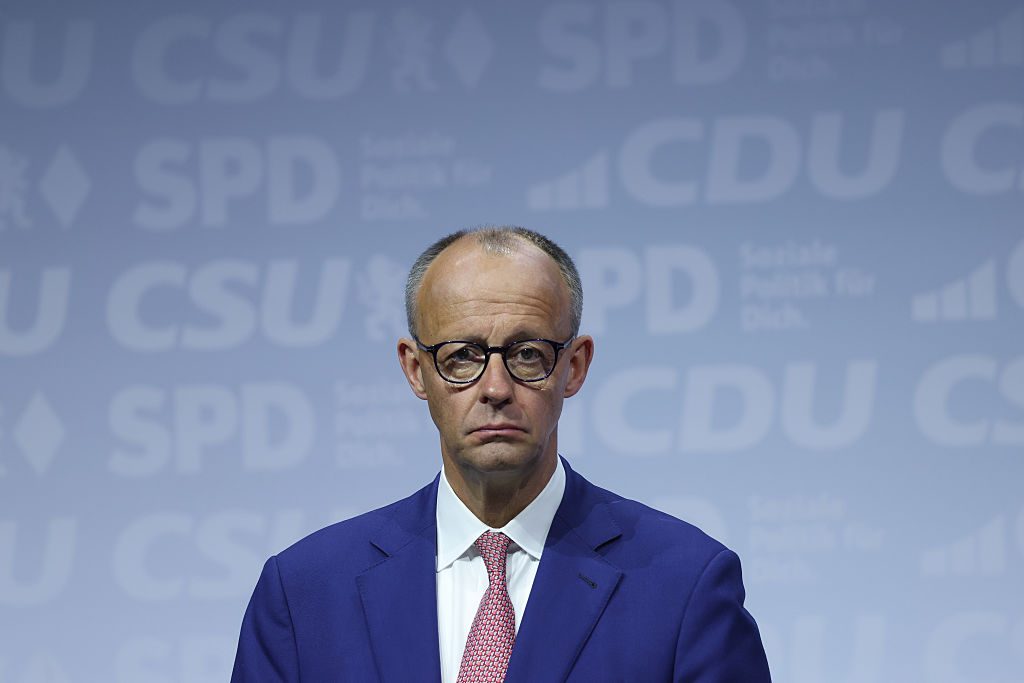
Friedrich Merz has no answer to Germany’s economic crisis

Now what? Credit: Getty

Now what? Credit: Getty

September 20 2025 - 8:00am

“The autumn of reforms has begun,” German Chancellor Friedrich Merz told parliament this week. With the country mired in a structural economic crisis, he promised sweeping change, claiming the moment was about “nothing less than the future of our country”. Yet his rhetoric was short on specifics, and his government’s plans fall far short of fundamental reform. Germans are unlikely to be stirred by Merz’s pep talk.

Most agree with his diagnosis: Germany is in serious economic trouble. A recent survey showed that three-quarters of Germans had “grave” or “very grave” concerns about the economy. But few believe Merz has solutions. Only 22% are satisfied with his government’s work. While he acknowledges the scale of necessary reforms, there’s little sign he’s willing or able to tackle the root problems.

Take welfare spending. Germany spends nearly 28% of its GDP on welfare — more than all comparable countries bar Austria and France. Economic experts warn that this burden is unsustainable. Merz agrees, saying Germany has been “living beyond its means”, but he faces stiff resistance to reform.

Unemployment benefits (Bürgergeld) have become a political flashpoint. Last year, the program cost nearly €47 billion — up almost 10% in a single year. Strikingly, close to half of that money went to non-German citizens, fusing the debate with immigration.

Now, even voters on the Left lean toward tougher sanctions and stricter migration controls. Yet Merz has struggled to mount an effective response. His conservatives govern in coalition with the center-left SPD, which fiercely defends the welfare state as it stands. When Merz pressed for sweeping reform, Labour Minister Bärbel Bas (SPD) dismissed the idea as “bullshit.” Bound by his refusal to work with the AfD, Merz is stuck with the SPD — and unwilling to risk blowing up the coalition over welfare reform.

While Merz highlights a 43% drop in asylum applications in early 2025, the number of refugees in Germany rose to 3.5 million last year — about 4% of the country’s population. As there is no clear plan to integrate these newcomers into the workforce or wean them off state support, Merz’s hands are tied.

Pensions are an even bigger fiscal challenge. Demographic shifts mean they’re increasingly state-subsidized, with last year’s bill exceeding €400 billion. Yet reform here is even trickier. Polls show overwhelming support for stricter welfare rules, but over 80% oppose raising the retirement age. When Economy Minister Katherina Reiche suggested Germans “need to work more and longer”, the backlash was swift. SPD general secretary Tim Klüssendorf declared a higher pension age “out of the question”. Merz told Reiche to rein it in.

Reiche also faces another structural problem: energy policy. With few natural resources beyond brown coal, Germany’s nuclear exit has left it heavily reliant on energy imports to fill the gaps left by inconsistent renewables. Currently, the country imports nearly 70% of its energy needs, an expensive and risky dependency that’s driving away investment. Steel giant ArcelorMittal recently abandoned plans for green steel production in Germany, opting instead for nuclear-powered France due to its reliable and affordable electricity.

Though Reiche acknowledges the issue, there is little she can do. Despite growing public support for a return to nuclear energy, the political elite remains adamantly opposed. Infrastructure from Germany’s once-thriving nuclear sector — which used to provide around 30% of electricity — is being dismantled at speed. In Bavaria, preparations to demolish the Gundremmingen plant towers are underway to ensure they can never be reused.

The government remains committed to three immovable goals: zero emissions by 2045, more public investment in renewables, and a total nuclear exit. In short, Germany’s new energy policy is its old one, alienating traditional industries and deterring new investments that can’t depend on stable, affordable energy.

Welfare and energy are just two major crisis points at the heart of German economic malaise. Merz talks of an “autumn of reforms”, but without bold action on these fronts, it’s more likely to be an autumn of cosmetic tweaks. Unless he has a hidden plan, real structural change seems as distant as ever.


Katja Hoyer is a German-British historian and writer. Her latest book Weimar: Life on the Edge of Catastrophe will be released in May 2026.

hoyer_kat

China is threatening America in the AI race

Reports sugget Zhipu AI  has released a new model that can rival leading US systems. Credit: Getty

Reports sugget Zhipu AI has released a new model that can rival leading US systems. Credit: Getty

July 1 2026 - 10:18am

China is trying to catch up with America on artificial intelligence. The Wall Street Journal has reported that Zhipu AI — one of China’s six “AI tiger” LLMs — has released a new model that can rival leading US systems, including Anthropic’s Mythos, in cybersecurity tasks such as pinpointing security bugs. While this marks a milestone in China’s drive to catch up with Western AI capabilities, strong performance on a single benchmark does not mean it has taken the lead. Chinese models still lag behind their Western counterparts in broader capabilities, such as autonomous operation. Skepticism is therefore warranted before resorting to hysterical conclusions, but complacency about the geopolitical implications of China’s AI advances would be an even greater mistake.

On the infrastructure side, Chinese AI is still constrained by access to advanced chips, with American labs way ahead in computing capacity as well as investment. Analysis from earlier this year suggests that Chinese models are likely to be at least a few months behind those in the US. But they are still continuing to make progress, or that the geopolitical importance of AI will be decided only by whose LLM has ventured deeper into the technological frontier. The practical applications of AI, countries’ to capture foreign markets, and the application of AI into the real economy will matter just as much.

Here, China may hold an advantage. As with its dominance across many critical supply chains, Beijing may not need to produce the most advanced AI systems — only those that are affordable and widely deployable. In doing so, it could consolidate global influence by supplying functional, low-cost AI at scale.

Beijing seems to be pursuing exactly that path, developing an AI “open-source” strategy that offers affordable, widely available AI models for companies and individuals to use and modify as they wish. The production of the DeepSeek AI model, which matched the performance of Silicon Valley tools such as ChatGPT at a fraction of the cost for users, created goodwill among Chinese models with developers.

The four most popular models on OpenRouter, an AI hardware platform for developers, are now all Chinese. The goal for China is not only to win the frontier-model race, but to make its systems the default layer of AI adoption across industries and global markets. For most economies, the choice is increasingly between an affordable tool they can deploy now and a more robust one that may be out of reach.

And while the countries adopting Chinese models may be exposed to political pressure and cyber threats from Beijing, safer and more capable alternatives matter little if they are unaffordable. American AI companies are already under pressure to monetize products whose operating costs are rising. If Chinese open-source models become the cheap default for startups, universities, governments and businesses across the developing world, then America’s AI lead will be eroded from below.

Perhaps more concerning for America in the long run is how AI can give Chinese manufacturing even more strength, through the ongoing integration of AI as a general-purpose technology. China’s new Five-Year Plan mentioned AI more than 50 times and includes an “AI+” action plan aimed at spreading AI across the economy.

Beijing has been pioneering automation of its critical infrastructure for years, with promising recent results in increasing warplane production capacity. In that regard, China’s open-model strategy and manufacturing dominance will reinforce each other. Cheap, adaptable models accelerate deployment across the real economy while those deployments generate real-world data and use cases that can feed back into further model improvement.

The United States should not dismiss the importance of its lead in the AI race. That lead worries Beijing, not least because a more automated Chinese economy would also become more vulnerable to AI-generated cyber threats. But nor should Washington assume that China cannot catch up with American capabilities over time.

This AI competition represents part of a broader struggle over tech supply chains and geopolitical influence. Decisions over whether to adopt US or Chinese models could produce a more fragmented global reality, with different regions relying on different cloud providers, chips and security structures. The result will likely be a global economy which is divided into competing spheres, rather than one which produces a single winner.


Miquel Vila is a political and geopolitical risk consultant focusing on industrial strategy, critical infrastructure and global supply chains.

miquelvilam