




X Close

Charlie Kirk funeral fuses Christian mercy with MAGA populism

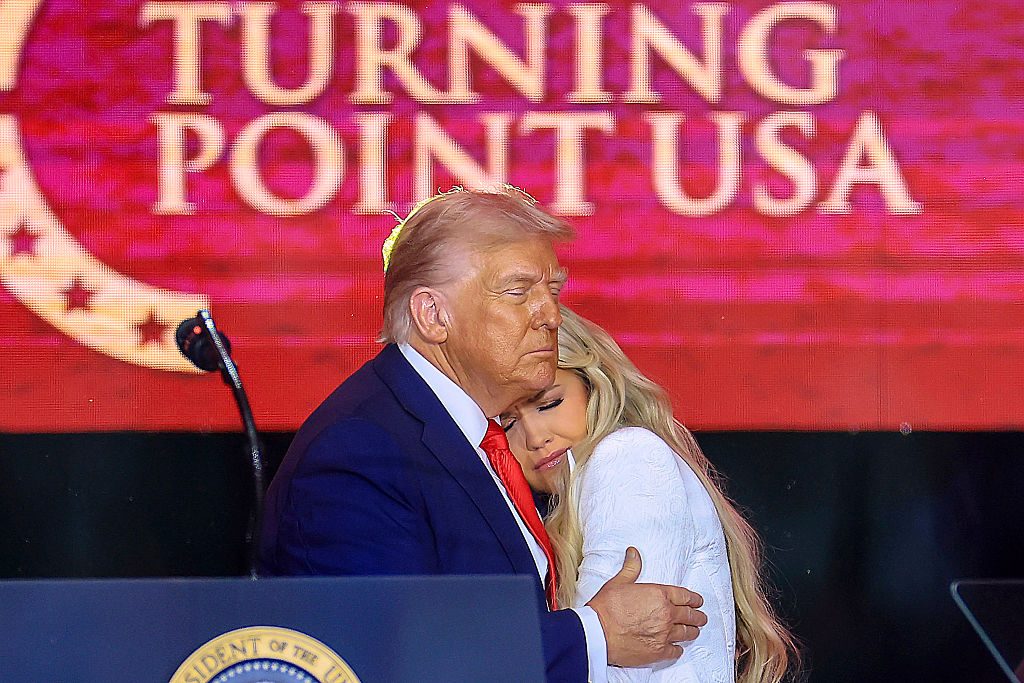
President Trump and Erika Kirk in Arizona on Sunday. Credit: Getty

President Trump and Erika Kirk in Arizona on Sunday. Credit: Getty

September 22 2025 - 4:30pm

It’s the oldest cliché in the book but nevertheless true: US politicians “do God” to an extent that is literally unimaginable for leaders on this side of the Atlantic. This willingness to speak openly and passionately about the Christian faith was on full display at the Charlie Kirk commemoration held in Arizona on Sunday. Part memorial service, part political rally, part revival meeting, it was a uniquely American event. Vice President JD Vance, Secretary of State Marco Rubio and the President himself all took to the stage, alongside Erika Kirk, who stated that she forgave Tyler Robinson, who has been charged with killing her husband.

In stark contrast to Mrs Kirk’s powerful witness to Christian charity, Trump struck a different note. “I hate my opponent, and I don’t want the best for them. I’m sorry,” he said. While he may not have been entirely serious — it’s plausible that he was trying to be self-effacing and emphasize Kirk’s own virtues — some seized on the remark as an illustration of a tension on the American Right, between more serious Christians who genuinely try to practice forgiveness and charity, and those who supposedly either don’t believe, or who use the faith cynically as a kind of rallying cry for conservative politics. On X, other Right-wing anonymous accounts have also expressed unease with the talk of forgiveness and peace-making.

Almost a decade ago, the New York Times conservative columnist and Catholic Ross Douthat tweeted, in response to the rise of Trump, that “If you dislike the religious right, wait till you meet the post-religious right”. What he meant was that with the apparent decline of Christian observance, the faith’s emphasis on mercy, reconciliation and universal morality would lose out to a harder-edged Right-wing: more punitive, more nationalistic, less concerned with protecting the vulnerable, and more willing to embrace white identity politics.

There is truth in that warning. Evangelicals still form a crucial Republican bloc, yet their influence is tempered by broader shifts: the decades-long decline in Christian affiliation appears to have stabilized, but only at a level well below its mid-20th-century peak. Even so, the United States remains unusually religious compared with peer nations, with about a third of Americans still attending church at least once a month.

But even if the secularization of the US Right is underway, it may not be the case that those who seem to favor a more robust response to Kirk’s assassin are simply cynics or closet Nietzscheans impatient with Christianity’s promotion of so-called “slave morality”.

There is no necessary contradiction between forgiving someone, as a personal matter, and still thinking that they ought to face due punishment or sanction. Christians have been debating what forgiveness means for 2,000 years, but it has rarely been understood as a kind of all-purpose “Get Out Of Jail Free” card. Forgiveness is above all a spiritual and communal practice, a command to individuals. It is linked to an awareness of our own faults and the frailty of our own moral judgments; a way to escape the cycle of vendetta and bitterness through a refusal to hold on to grudges or pick at old wounds.

The way in which a society chooses to protect itself and its members from threats — especially deadly threats — is a separate question, involving different considerations and a distinct set of trade-offs. Deciding whether or not we ought to execute political assassins has very little to do with how the assassin’s victims choose to deal with their own situation, and their own grief and anger.

The “split in MAGA”, then, may be more apparent than real. It’s about emphasis, rather than a deep mismatch of values or political aims. There are those who feel more comfortable talking about divine clemency and the world to come, and there are those who are more comfortable focusing on justice and good order here on earth. In practice, both impulses reinforce one another, sustaining a movement that preaches grace while demanding strength. The result is less a fracture than a fusion — one that gives MAGA its unusual resilience.


Niall Gooch is a public sector worker and occasional writer who lives in Kent.

niall_gooch

China is threatening America in the AI race

Reports sugget Zhipu AI  has released a new model that can rival leading US systems. Credit: Getty

Reports sugget Zhipu AI has released a new model that can rival leading US systems. Credit: Getty

July 1 2026 - 10:18am

China is trying to catch up with America on artificial intelligence. The Wall Street Journal has reported that Zhipu AI — one of China’s six “AI tiger” LLMs — has released a new model that can rival leading US systems, including Anthropic’s Mythos, in cybersecurity tasks such as pinpointing security bugs. While this marks a milestone in China’s drive to catch up with Western AI capabilities, strong performance on a single benchmark does not mean it has taken the lead. Chinese models still lag behind their Western counterparts in broader capabilities, such as autonomous operation. Skepticism is therefore warranted before resorting to hysterical conclusions, but complacency about the geopolitical implications of China’s AI advances would be an even greater mistake.

On the infrastructure side, Chinese AI is still constrained by access to advanced chips, with American labs way ahead in computing capacity as well as investment. Analysis from earlier this year suggests that Chinese models are likely to be at least a few months behind those in the US. But they are still continuing to make progress, or that the geopolitical importance of AI will be decided only by whose LLM has ventured deeper into the technological frontier. The practical applications of AI, countries’ to capture foreign markets, and the application of AI into the real economy will matter just as much.

Here, China may hold an advantage. As with its dominance across many critical supply chains, Beijing may not need to produce the most advanced AI systems — only those that are affordable and widely deployable. In doing so, it could consolidate global influence by supplying functional, low-cost AI at scale.

Beijing seems to be pursuing exactly that path, developing an AI “open-source” strategy that offers affordable, widely available AI models for companies and individuals to use and modify as they wish. The production of the DeepSeek AI model, which matched the performance of Silicon Valley tools such as ChatGPT at a fraction of the cost for users, created goodwill among Chinese models with developers.

The four most popular models on OpenRouter, an AI hardware platform for developers, are now all Chinese. The goal for China is not only to win the frontier-model race, but to make its systems the default layer of AI adoption across industries and global markets. For most economies, the choice is increasingly between an affordable tool they can deploy now and a more robust one that may be out of reach.

And while the countries adopting Chinese models may be exposed to political pressure and cyber threats from Beijing, safer and more capable alternatives matter little if they are unaffordable. American AI companies are already under pressure to monetize products whose operating costs are rising. If Chinese open-source models become the cheap default for startups, universities, governments and businesses across the developing world, then America’s AI lead will be eroded from below.

Perhaps more concerning for America in the long run is how AI can give Chinese manufacturing even more strength, through the ongoing integration of AI as a general-purpose technology. China’s new Five-Year Plan mentioned AI more than 50 times and includes an “AI+” action plan aimed at spreading AI across the economy.

Beijing has been pioneering automation of its critical infrastructure for years, with promising recent results in increasing warplane production capacity. In that regard, China’s open-model strategy and manufacturing dominance will reinforce each other. Cheap, adaptable models accelerate deployment across the real economy while those deployments generate real-world data and use cases that can feed back into further model improvement.

The United States should not dismiss the importance of its lead in the AI race. That lead worries Beijing, not least because a more automated Chinese economy would also become more vulnerable to AI-generated cyber threats. But nor should Washington assume that China cannot catch up with American capabilities over time.

This AI competition represents part of a broader struggle over tech supply chains and geopolitical influence. Decisions over whether to adopt US or Chinese models could produce a more fragmented global reality, with different regions relying on different cloud providers, chips and security structures. The result will likely be a global economy which is divided into competing spheres, rather than one which produces a single winner.


Miquel Vila is a political and geopolitical risk consultant focusing on industrial strategy, critical infrastructure and global supply chains.

miquelvilam