








October 12 2025 - 8:00am
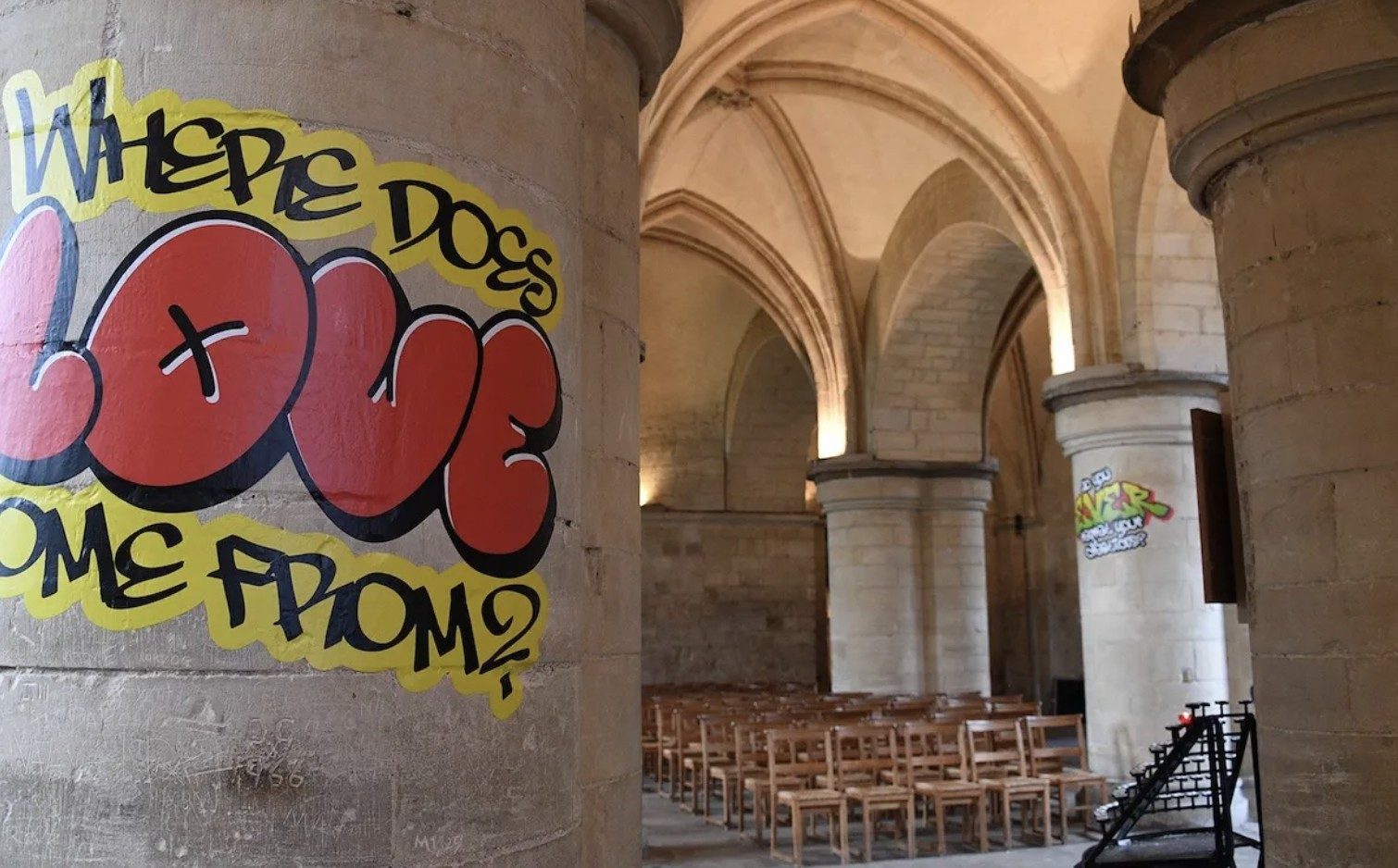
As the site of St Thomas Becket’s martyrdom, Canterbury Cathedral has no shortage of contenders for the title of “most sacrilegious use of a sacred space.” Yet that is the charge now being leveled at England’s oldest cathedral by Anglicans and non-Anglicans alike — including Elon Musk and J.D. Vance — over a new art installation titled Hear Us, conceived by poet Alex Vellis and curator Jacqueline Creswell in collaboration with “marginalized communities.”
The exhibition began with a series of workshops involving members of such marginalized communities, specifically “Punjabi, black and brown diaspora, neurodivergent, and LGBTQIA+ groups”, asking participants to respond to the question “What would you ask God?” The result is a collection of questions, rendered in stock graffiti font and stickered to the walls of the Cathedral’s nave and crypt — questions like “Are you there?” and “Why are you indifferent to suffering?”
Though the canons of the Church of England require that art displayed in churches be “consonant with sound doctrine, and make for the edifying of the people,” obtaining permission to exhibit controversial modern works seems remarkably easy. Ryan Callanan’s sculpture of a crucified stormtrooper sparked complaints when it was displayed at St Stephen Walbrook in 2018, while Luke Jerram’s Gaia, a 3D model of the Earth, has taken over the naves of cathedrals and major churches across the country. Canterbury Cathedral has also courted controversy in the past for hosting a silent disco in its nave.
Debates over the place of modern or contemporary art in churches are nothing new. Yet these installations reveal something deeper about Christianity today: a lack of confidence in its core claims and a more profound loss of faith in the efficacy of grace. Belief demands reverence; it’s hard to imagine plastering Canterbury’s Romanesque crypt, which once held Becket’s tomb, with lurid stickers while maintaining belief in the communion of saints or the presence of Christ in the Reserved Sacrament.
The value of such art installations is often described in terms of facilitating an “encounter with a vague and indistinct notion of spirituality”. For instance, the write-up for Canterbury’s exhibition highlights opportunities for “self-discovery” and “personal growth”. If this is all the Church can offer, young people might just as readily get a therapist or download a mindfulness app.
Cathedral services have been steadily increasing their attendance while parish church attendance has almost halved since 2000, reflecting the continued attraction of Cranmer’s offices, the choral tradition, cathedral architecture and sacred art. The Roman Catholic Church has likewise seen an increase in attendance in the 18-24 demographic, so that young Catholics now outnumber Anglicans two-to-one. Young people want meaning and substance rather than ill-defined spirituality.
When I worked within the Church of England, my role involved helping churches to open up their spaces for art exhibitions and other uses, in line with the aim of building a “simpler, humbler, bolder” Church for the 2020s. Deans and vicars, anxious to supplement their measly stipends, propose projects that meet the Church’s criteria for funding but don’t necessarily get results. There are no errant youths wandering into Canterbury to sit in the pews and contemplate the graffiti, and members of marginalized groups may feel their identities momentarily affirmed before being politely shown the door after services. The artwork isn’t really for them — or for anyone, save the self-satisfied liberal boomers who populate the Steering Committees and collect their share of the Church funding in consultancy fees.
Approaching Canterbury by train, the Cathedral looms over the old town as its natural gravitational center. Up close, however, it disappears behind closed gates, accessible only through the gift shop with a ticket price of £18. The natural resources of the Church can still awaken the seed of faith in those who encounter them — which might happen more often if the Church was less intent on shuttering up its heritage and wasting money on managerial vanity projects.
A “humbler Church” really means a Church which has lost confidence in its authority to teach or even proclaim belief in Christianity’s central tenets. Whereas medieval churches were adorned with bright wall paintings that communicated Christian teachings even to the illiterate, the same walls today can only pose questions without daring to venture answers.
 providenceluvr