




X Close

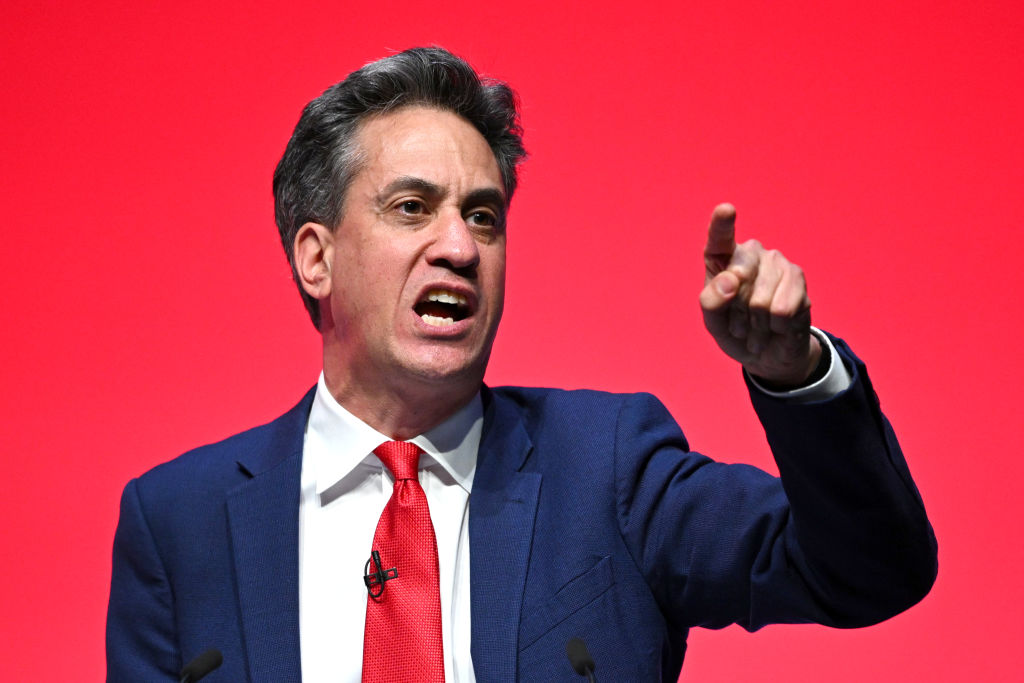
Britain cannot afford an Ed Miliband chancellorship

According to reports, Miliband is pushing for the role of chancellor under Burnham. Credit: Getty

According to reports, Miliband is pushing for the role of chancellor under Burnham. Credit: Getty

June 14 2026 - 8:01am

There is no point in Andy Burnham replacing Keir Starmer as Prime Minister if he makes the same mistakes. Above all, taking power without a properly thought-out plan for using it would be a fatal error. Right now, nothing could provide a more alarming sign of such a lack of seriousness than choosing Ed Miliband as his Chancellor. And yet, according to reports, that’s precisely the plan — though whether it’s quite as firmly fixed in Burnham’s mind as it is in Miliband’s remains to be seen.

In terms of internal party politics, one can understand the temptation. Miliband isn’t just a Cabinet minister; he’s the single most influential figure within Labour’s dominant soft Left faction and a favorite with party members. The very fact of his not making his own run for leader and throwing his weight behind Burnham makes it harder for rival candidates, like Angela Rayner, to stand.

Assuming the soft Left does unite around Burnham, the impending leadership contest will look as if it’s over before it even begins. That could be enough to persuade Keir Starmer to make one final U-turn and not defend his position — as he’s still insisting he will. If Wes Streeting can also be persuaded to stand aside, then it could be a coronation, not a contest. Ed Miliband thus appears to be the key to a smooth transfer of power.

Except that Labour won’t just be choosing a party leader, but a head of government. That’s where a Miliband chancellorship makes less sense.

Allies of the current Chancellor, Rachel Reeves, have suggested that removing her would imperil the country’s financial credibility. This isn’t necessarily true. She has, after all, pushed up UK borrowing costs to record highs — so there’s room for improvement. But if Reeves is to be replaced, the last thing Burnham needs is a less reassuring chancellor.

Unfortunately, Miliband has a track record of not inspiring confidence — except among those eager to believe that socialism isn’t dead. At no point has he stood up for the spending cuts required to secure both Britain’s finances and defense. Indeed, in last week’s political crisis, Starmer was reportedly more worried about Miliband resigning than the defense secretary, John Healey.

Matters may be eased if a new chancellor drives through the pro-growth policies that Reeves has failed to deliver. Unfortunately, Miliband’s most notable contributions to that agenda have been negative. He’s the one who’s insisted on the ban on new North Sea drilling. He’s also doggedly pursued a 2030 target to decarbonize the UK’s electricity supply — an expensive distraction both from achieving Net Zero by 2050 and higher growth anytime soon.

It doesn’t help that Burnham lacks a coherent agenda of his own for a new chancellor to implement. He’s blown hot and cold on freeing the state from dependence on the money markets. On key spending pledges, like compensating the Waspi women, he’s flip-flopped. Furthermore, his “Manchesterism” philosophy is not translatable from local to national government — at least not without the vast sums required to nationalize key utilities. Therefore, he needs a new chancellor to provide him with a viable economic program, not the other way round.

In that respect, the only thing he’s going to get from Miliband is what Starmer already has: a vague commitment to social progress without the money to pay for it.


Peter Franklin is Associate Editor of UnHerd. He was previously a policy advisor and speechwriter on environmental and social issues.

peterfranklin_

China is threatening America in the AI race

Reports sugget Zhipu AI  has released a new model that can rival leading US systems. Credit: Getty

Reports sugget Zhipu AI has released a new model that can rival leading US systems. Credit: Getty

July 1 2026 - 10:18am

China is trying to catch up with America on artificial intelligence. The Wall Street Journal has reported that Zhipu AI — one of China’s six “AI tiger” LLMs — has released a new model that can rival leading US systems, including Anthropic’s Mythos, in cybersecurity tasks such as pinpointing security bugs. While this marks a milestone in China’s drive to catch up with Western AI capabilities, strong performance on a single benchmark does not mean it has taken the lead. Chinese models still lag behind their Western counterparts in broader capabilities, such as autonomous operation. Skepticism is therefore warranted before resorting to hysterical conclusions, but complacency about the geopolitical implications of China’s AI advances would be an even greater mistake.

On the infrastructure side, Chinese AI is still constrained by access to advanced chips, with American labs way ahead in computing capacity as well as investment. Analysis from earlier this year suggests that Chinese models are likely to be at least a few months behind those in the US. But they are still continuing to make progress, or that the geopolitical importance of AI will be decided only by whose LLM has ventured deeper into the technological frontier. The practical applications of AI, countries’ to capture foreign markets, and the application of AI into the real economy will matter just as much.

Here, China may hold an advantage. As with its dominance across many critical supply chains, Beijing may not need to produce the most advanced AI systems — only those that are affordable and widely deployable. In doing so, it could consolidate global influence by supplying functional, low-cost AI at scale.

Beijing seems to be pursuing exactly that path, developing an AI “open-source” strategy that offers affordable, widely available AI models for companies and individuals to use and modify as they wish. The production of the DeepSeek AI model, which matched the performance of Silicon Valley tools such as ChatGPT at a fraction of the cost for users, created goodwill among Chinese models with developers.

The four most popular models on OpenRouter, an AI hardware platform for developers, are now all Chinese. The goal for China is not only to win the frontier-model race, but to make its systems the default layer of AI adoption across industries and global markets. For most economies, the choice is increasingly between an affordable tool they can deploy now and a more robust one that may be out of reach.

And while the countries adopting Chinese models may be exposed to political pressure and cyber threats from Beijing, safer and more capable alternatives matter little if they are unaffordable. American AI companies are already under pressure to monetize products whose operating costs are rising. If Chinese open-source models become the cheap default for startups, universities, governments and businesses across the developing world, then America’s AI lead will be eroded from below.

Perhaps more concerning for America in the long run is how AI can give Chinese manufacturing even more strength, through the ongoing integration of AI as a general-purpose technology. China’s new Five-Year Plan mentioned AI more than 50 times and includes an “AI+” action plan aimed at spreading AI across the economy.

Beijing has been pioneering automation of its critical infrastructure for years, with promising recent results in increasing warplane production capacity. In that regard, China’s open-model strategy and manufacturing dominance will reinforce each other. Cheap, adaptable models accelerate deployment across the real economy while those deployments generate real-world data and use cases that can feed back into further model improvement.

The United States should not dismiss the importance of its lead in the AI race. That lead worries Beijing, not least because a more automated Chinese economy would also become more vulnerable to AI-generated cyber threats. But nor should Washington assume that China cannot catch up with American capabilities over time.

This AI competition represents part of a broader struggle over tech supply chains and geopolitical influence. Decisions over whether to adopt US or Chinese models could produce a more fragmented global reality, with different regions relying on different cloud providers, chips and security structures. The result will likely be a global economy which is divided into competing spheres, rather than one which produces a single winner.


Miquel Vila is a political and geopolitical risk consultant focusing on industrial strategy, critical infrastructure and global supply chains.

miquelvilam