




X Close

Bill Ackman’s tariff tantrum has come too late

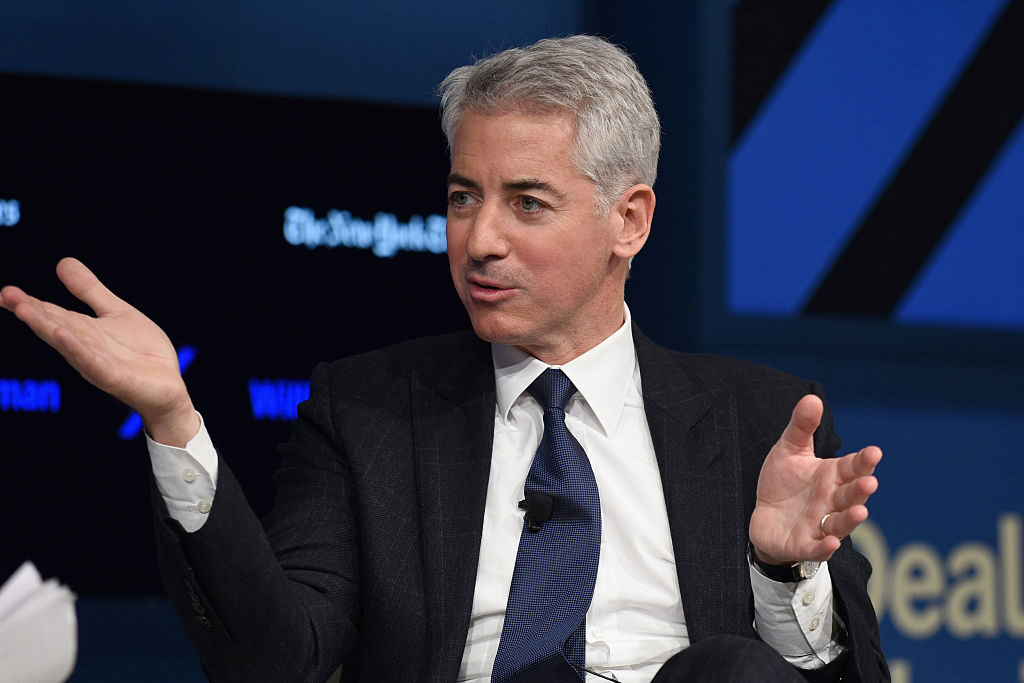
The billionaire hedge fund manager hit out at Commerce Secretary Howard Lutnick. Credit: Getty

The billionaire hedge fund manager hit out at Commerce Secretary Howard Lutnick. Credit: Getty

April 7 2025 - 5:45pm

There’s an old rule in US politics that you know when someone lacks access to the halls of power when they take their complaint to the people. When one of Donald Trump’s biggest Wall Street backers begins using X to criticize the administration, you can assume he failed to get a table at Mar-a-Lago.

Billionaire Bill Ackman went all in on Donald Trump during the election campaign. However, over the weekend, and using guarded language, the fund manager chided the administration for its tariff policy. Subsequently, in much less guarded language, he criticized the Commerce Secretary, Howard Lutnick, for having a conflict of interest. He then reneged, saying “it was unfair for me to lash out”.

Lutnick previously managed a fund which had long bonds — which is to say, it bought treasury bonds in the expectation their price might rise. Lo and behold when his boss’s Liberation Day liberated stock market investors from a good portion of their wealth, much of the money from the sale of stocks flowed into bonds, sending their price sharply higher. Ergo Lutnick allegedly made a killing.

But this is the US, a country where billionaires can donate unlimited money to their favored candidates, members of Congress make stock market gains with a strong whiff of insider trading, presidents launch memecoins and ex-presidents leverage the contacts they made while in office in order to make themselves phenomenally wealthy. And compared to the questions over Elon Musk’s government contracts, Lutnick’s conflict seems, relatively speaking, small beer.

Besides, it would probably be impossible to prove in court. So Ackman going after Lutnick may reveal less about the Commerce Secretary than about himself. Apparently lacking access to the President, he may be trying to reach Trump through the weak link in his administration’s chain. Lutnick was its point man on tariffs over the weekend, and his media appearances inspired little confidence that the administration had much of a game plan. By criticizing Lutnick so vociferously, Ackman may have been trying to get a message through to the top.

It was always expected that this administration would be beset by infighting, since Trump chose his team based not on their coherence but rather their personal loyalty to him. Some of them clearly can’t stand each other. But while in-fighting was thus inevitable, the speed with which it has broken out is striking. Elon Musk, who said last week he would step down from his role at DOGE, is criticizing trade advisor Peter Navarro. The national security team is in disarray after Signalgate while Treasury Secretary Scott Bessent’s vague answers to the press about details over the policy left one wondering if he played much of a role in the decision.

With markets tanking, this is a concern. The US is no stranger to market crashes, and they’ve grown quite frequent: the 1997-98 Asian Crisis, the 2000 dotcom crash, the 2008 Global Financial Crisis, the 2020 Covid panic. During each of them, the administration had a skilled economic team at its disposal, along with a central bank with which it enjoyed good relations. It would be hard to say the same thing today. Apart from Scott Bessent, few in Trump’s economic team would be considered the best in their respective classes, while the President is engaged in a running battle with the Federal Reserve.

Despite deep falls, this year’s selloff remained relatively orderly, with few signs of outright panic through the weekend. But were strains to suddenly emerge in any corner of the financial system, investors would have reason to doubt that the administration has the wherewithal and coherence to manage the crisis. In due course, that awareness alone may suffice to induce panic.


John Rapley is an author and academic who divides his time between London, Johannesburg and Ottawa. His books include Why Empires Fall: Rome, America and the Future of the West (with Peter Heather, Penguin, 2023) and Twilight of the Money Gods: Economics as a Religion (Simon & Schuster, 2017).

jarapley

China is threatening America in the AI race

Reports sugget Zhipu AI  has released a new model that can rival leading US systems. Credit: Getty

Reports sugget Zhipu AI has released a new model that can rival leading US systems. Credit: Getty

July 1 2026 - 10:18am

China is trying to catch up with America on artificial intelligence. The Wall Street Journal has reported that Zhipu AI — one of China’s six “AI tiger” LLMs — has released a new model that can rival leading US systems, including Anthropic’s Mythos, in cybersecurity tasks such as pinpointing security bugs. While this marks a milestone in China’s drive to catch up with Western AI capabilities, strong performance on a single benchmark does not mean it has taken the lead. Chinese models still lag behind their Western counterparts in broader capabilities, such as autonomous operation. Skepticism is therefore warranted before resorting to hysterical conclusions, but complacency about the geopolitical implications of China’s AI advances would be an even greater mistake.

On the infrastructure side, Chinese AI is still constrained by access to advanced chips, with American labs way ahead in computing capacity as well as investment. Analysis from earlier this year suggests that Chinese models are likely to be at least a few months behind those in the US. But they are still continuing to make progress, or that the geopolitical importance of AI will be decided only by whose LLM has ventured deeper into the technological frontier. The practical applications of AI, countries’ to capture foreign markets, and the application of AI into the real economy will matter just as much.

Here, China may hold an advantage. As with its dominance across many critical supply chains, Beijing may not need to produce the most advanced AI systems — only those that are affordable and widely deployable. In doing so, it could consolidate global influence by supplying functional, low-cost AI at scale.

Beijing seems to be pursuing exactly that path, developing an AI “open-source” strategy that offers affordable, widely available AI models for companies and individuals to use and modify as they wish. The production of the DeepSeek AI model, which matched the performance of Silicon Valley tools such as ChatGPT at a fraction of the cost for users, created goodwill among Chinese models with developers.

The four most popular models on OpenRouter, an AI hardware platform for developers, are now all Chinese. The goal for China is not only to win the frontier-model race, but to make its systems the default layer of AI adoption across industries and global markets. For most economies, the choice is increasingly between an affordable tool they can deploy now and a more robust one that may be out of reach.

And while the countries adopting Chinese models may be exposed to political pressure and cyber threats from Beijing, safer and more capable alternatives matter little if they are unaffordable. American AI companies are already under pressure to monetize products whose operating costs are rising. If Chinese open-source models become the cheap default for startups, universities, governments and businesses across the developing world, then America’s AI lead will be eroded from below.

Perhaps more concerning for America in the long run is how AI can give Chinese manufacturing even more strength, through the ongoing integration of AI as a general-purpose technology. China’s new Five-Year Plan mentioned AI more than 50 times and includes an “AI+” action plan aimed at spreading AI across the economy.

Beijing has been pioneering automation of its critical infrastructure for years, with promising recent results in increasing warplane production capacity. In that regard, China’s open-model strategy and manufacturing dominance will reinforce each other. Cheap, adaptable models accelerate deployment across the real economy while those deployments generate real-world data and use cases that can feed back into further model improvement.

The United States should not dismiss the importance of its lead in the AI race. That lead worries Beijing, not least because a more automated Chinese economy would also become more vulnerable to AI-generated cyber threats. But nor should Washington assume that China cannot catch up with American capabilities over time.

This AI competition represents part of a broader struggle over tech supply chains and geopolitical influence. Decisions over whether to adopt US or Chinese models could produce a more fragmented global reality, with different regions relying on different cloud providers, chips and security structures. The result will likely be a global economy which is divided into competing spheres, rather than one which produces a single winner.


Miquel Vila is a political and geopolitical risk consultant focusing on industrial strategy, critical infrastructure and global supply chains.

miquelvilam