




X Close

John Bolton raid exposes America’s descent into tit-for-tat justice

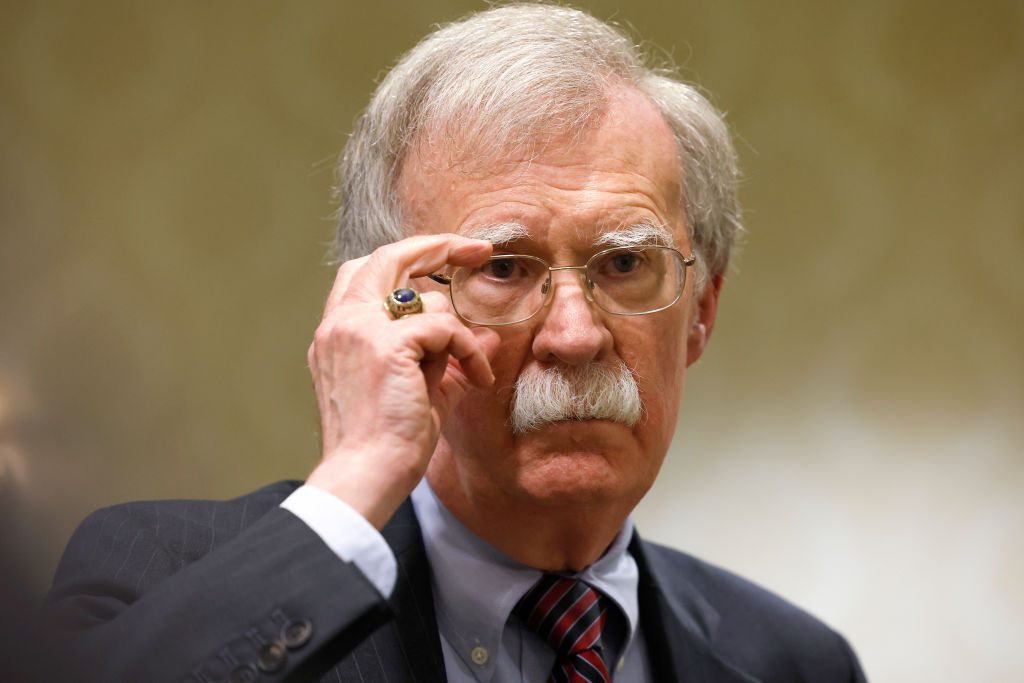
'Nobody has the moral high ground at this point.' Credit: Getty

'Nobody has the moral high ground at this point.' Credit: Getty

August 22 2025 - 7:00pm

“How does it feel to have your home raided at 6 o’clock in the morning?” So said Roger Stone on X today as images of FBI investigators descended on the quaint Bethesda domicile of John Bolton, Donald Trump’s former national security advisor. Stone later captioned a side-by-side image of Bolton, who has since become a bitter critic of the President, and himself: “The man on the left had his home rated [sic] at 6 am because he did something wrong. The man on the right had his home raided at 6 am because he didn’t. Karma is bitch.”

Is the Bolton raid karma, revenge, justice, or a strange brew of all three? In the coming days, we will find out. But here’s what we know: Bolton has not been charged with a crime and is not under arrest. A New York Post report described the raid as part of “a high-profile national security probe involving classified documents,” extending well beyond John Bolton’s 2020 tell-all about his time in the Trump White House. After his dismissal, Bolton broke with the President, prompting the Justice Department to open a criminal investigation into whether he had disclosed classified information in the book.

Trump never made good on his 2016 promise to jail Hillary Clinton. He did not weaponize the DOJ to prosecute her or use his investigative powers to pursue her. In the meantime, people in Trump’s own intelligence community continued to abuse their powers in an effort to topple him. He was the target of intense lawfare, some of which was clearly and intentionally working with thin gruel to prevent a second Trump administration. That pattern of double standards brings us to 2025.

“NO ONE is above the law”, FBI Director Kash Patel posted on X shortly before this week’s raid began. In addition to Bolton, former Bureau director James Comey is under investigation by Trump’s DOJ along with former CIA director John Brennan. Asked by UnHerd at the White House last month whether former president Barack Obama’s actions were being referred to the DOJ for a criminal investigation, Director of National Intelligence Tulsi Gabbard replied affirmatively.

It’s no surprise Stone invoked the 2019 raid on his own home, during which CNN cameras were suspiciously rolling. He was convicted on felony charges related to obstruction of Robert Mueller’s Russian collusion probe, and pardoned by the President before beginning a 40-month sentence. At the time, Trump and others decried “process-based charges” brought only against allies of the White House and not its enemies — including some of the very people now being investigated by Trump’s DOJ.

Allegations that Bolton mishandled classified information inevitably recall similar claims against Trump — which, in turn, evoke the controversy over Joe Biden’s handling of documents, and before that, Hillary Clinton’s private server. None of these cases are identical, but together they chart America’s drift toward banana republicanism, where the pursuit of political opponents is endlessly justified as the only cure for past pursuits. In such a cycle, tit-for-tat justice becomes both the cause and the excuse. The only way out, it seems, is through.

Should sensitive information have been stacked in the bathroom at Mar-A-Lago or stored on a homebrew server? Probably not. If the latter case is not prosecuted, should the former? Should either be prosecuted at all? These are deeply fraught questions which supply no easy answers, except that nobody has the moral high ground at this point. Bolton’s defenders don’t, and nor do Trump’s.


Emily Jashinsky is UnHerd‘s Washington correspondent.

emilyjashinsky

China is threatening America in the AI race

Reports sugget Zhipu AI  has released a new model that can rival leading US systems. Credit: Getty

Reports sugget Zhipu AI has released a new model that can rival leading US systems. Credit: Getty

July 1 2026 - 10:18am

China is trying to catch up with America on artificial intelligence. The Wall Street Journal has reported that Zhipu AI — one of China’s six “AI tiger” LLMs — has released a new model that can rival leading US systems, including Anthropic’s Mythos, in cybersecurity tasks such as pinpointing security bugs. While this marks a milestone in China’s drive to catch up with Western AI capabilities, strong performance on a single benchmark does not mean it has taken the lead. Chinese models still lag behind their Western counterparts in broader capabilities, such as autonomous operation. Skepticism is therefore warranted before resorting to hysterical conclusions, but complacency about the geopolitical implications of China’s AI advances would be an even greater mistake.

On the infrastructure side, Chinese AI is still constrained by access to advanced chips, with American labs way ahead in computing capacity as well as investment. Analysis from earlier this year suggests that Chinese models are likely to be at least a few months behind those in the US. But they are still continuing to make progress, or that the geopolitical importance of AI will be decided only by whose LLM has ventured deeper into the technological frontier. The practical applications of AI, countries’ to capture foreign markets, and the application of AI into the real economy will matter just as much.

Here, China may hold an advantage. As with its dominance across many critical supply chains, Beijing may not need to produce the most advanced AI systems — only those that are affordable and widely deployable. In doing so, it could consolidate global influence by supplying functional, low-cost AI at scale.

Beijing seems to be pursuing exactly that path, developing an AI “open-source” strategy that offers affordable, widely available AI models for companies and individuals to use and modify as they wish. The production of the DeepSeek AI model, which matched the performance of Silicon Valley tools such as ChatGPT at a fraction of the cost for users, created goodwill among Chinese models with developers.

The four most popular models on OpenRouter, an AI hardware platform for developers, are now all Chinese. The goal for China is not only to win the frontier-model race, but to make its systems the default layer of AI adoption across industries and global markets. For most economies, the choice is increasingly between an affordable tool they can deploy now and a more robust one that may be out of reach.

And while the countries adopting Chinese models may be exposed to political pressure and cyber threats from Beijing, safer and more capable alternatives matter little if they are unaffordable. American AI companies are already under pressure to monetize products whose operating costs are rising. If Chinese open-source models become the cheap default for startups, universities, governments and businesses across the developing world, then America’s AI lead will be eroded from below.

Perhaps more concerning for America in the long run is how AI can give Chinese manufacturing even more strength, through the ongoing integration of AI as a general-purpose technology. China’s new Five-Year Plan mentioned AI more than 50 times and includes an “AI+” action plan aimed at spreading AI across the economy.

Beijing has been pioneering automation of its critical infrastructure for years, with promising recent results in increasing warplane production capacity. In that regard, China’s open-model strategy and manufacturing dominance will reinforce each other. Cheap, adaptable models accelerate deployment across the real economy while those deployments generate real-world data and use cases that can feed back into further model improvement.

The United States should not dismiss the importance of its lead in the AI race. That lead worries Beijing, not least because a more automated Chinese economy would also become more vulnerable to AI-generated cyber threats. But nor should Washington assume that China cannot catch up with American capabilities over time.

This AI competition represents part of a broader struggle over tech supply chains and geopolitical influence. Decisions over whether to adopt US or Chinese models could produce a more fragmented global reality, with different regions relying on different cloud providers, chips and security structures. The result will likely be a global economy which is divided into competing spheres, rather than one which produces a single winner.


Miquel Vila is a political and geopolitical risk consultant focusing on industrial strategy, critical infrastructure and global supply chains.

miquelvilam