




X Close

Why South Park hurts Trump more than SNL

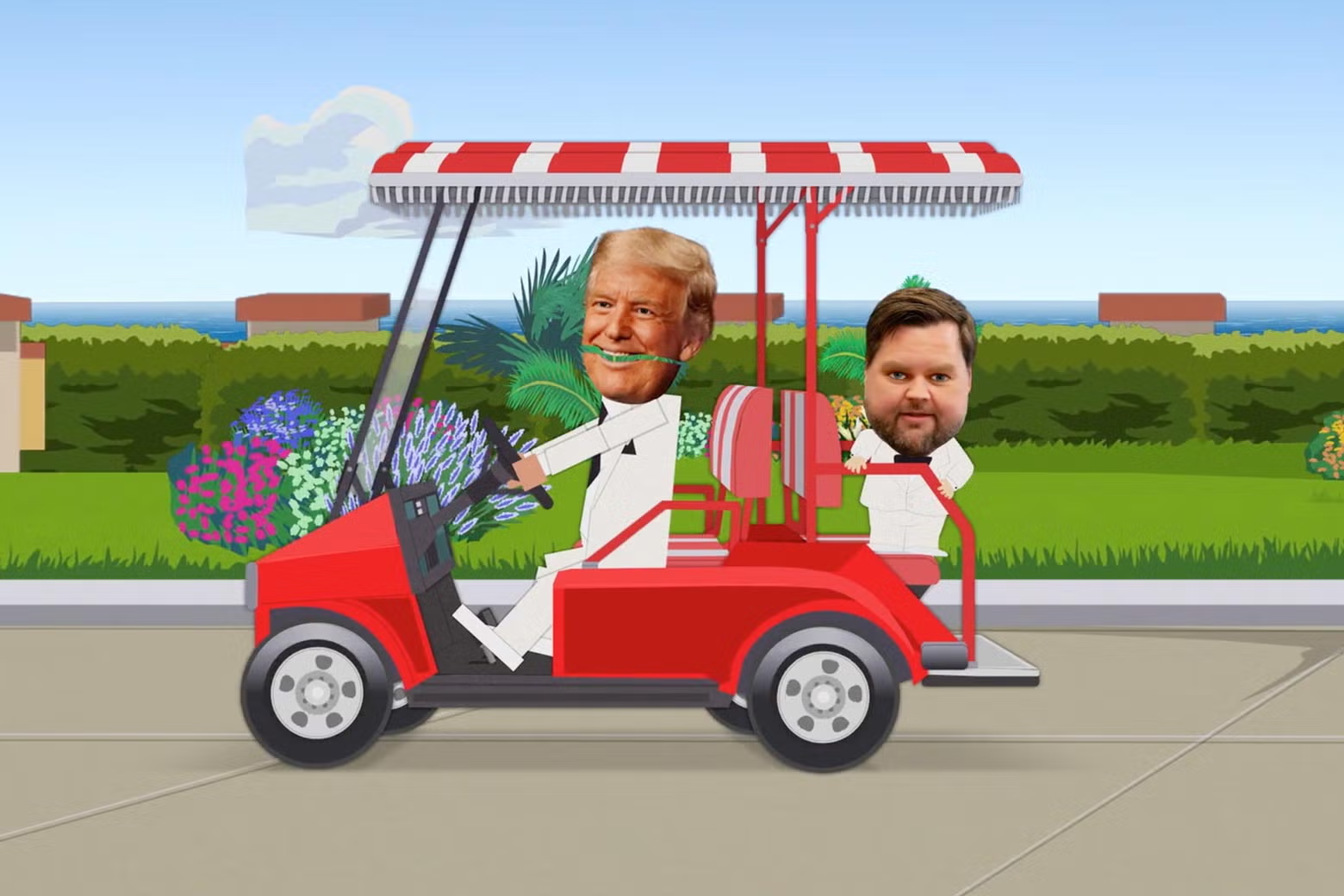
Respect my authority. Credit: South Park

Respect my authority. Credit: South Park

August 10 2025 - 12:30pm

Matt Stone and Trey Parker spent the better part of two decades building South Park into something rare in American comedy: a show that actually offended everyone equally. They went after smug liberals, conservative culture warriors, celebrities, religions, and anyone else who took themselves too seriously. Now they’ve turned their attention to Donald Trump’s second presidency, and the results suggest something more significant than just another comedy show taking shots at the MAGA figurehead.

The second episode of South Park‘s 27th season, which aired earlier this week, features Vice President JD Vance offering to apply baby oil to Satan’s posterior so Trump can have sex with him. Secretary of Homeland Security Kristi Noem shoots puppies by the dozen, while ICE agents raid a Dora the Explorer set and arrest Latino angels in heaven. Trump’s micropenis gets animated screentime at Mar-a-Lago, which the show depicts as a gaudy Fantasy Island populated by nursing-home residents in bikinis.

This matters because South Park occupies different cultural real estate than Saturday Night Live or Stephen Colbert’s Late Show. Those programs speak to steadfastly liberal audiences who already despise Trump. South Park built its reputation savaging those same liberals for their sanctimony about diversity casting, Covid vaccines, and political correctness.

The first episode of the new season went after Paramount for bending the knee to Trump over a poorly-edited Kamala Harris interview, suggesting corporate America’s swift genuflection to the new administration was more about money — in this case, receiving government approval for a merger — than principles. This wasn’t the predictable “Trump is a fascist” messaging you get from late-night hosts reading off writers’ room manifestos. It was sharper, more cynical, and focused on the system that enables Trump rather than just the President himself.

Comedy’s relationship with Trump has always been complicated. During his first term, liberal comedians treated him like a gift: endless material, easy laughs, righteous indignation. But their constant hammering produced diminishing returns. Alec Baldwin’s Trump impression on SNL was never especially innovative, while Colbert’s nightly takedowns became background noise. The #resistance comedy-industrial complex spat out content that preached to the converted, changing nobody’s mind about anything.

Meanwhile, a different comedy ecosystem emerged. Shane Gillis, kicked off SNL for using slurs about Asians and gay people in podcast clips, built a massive following with stand-up routines appealing across political lines. In the run-up to last year’s election, Theo Von hosted Trump on his podcast to chat about cocaine. These comics don’t necessarily support Trump, but they’re not reflexively opposed to him either. They represent comedy’s libertarian streak — suspicious of authority, allergic to preaching, and committed to getting laughs.

South Park sits at the intersection of these worlds. The show that once satirized social justice warriors now depicts Trump literally making deals with the Devil. But unlike SNL‘s approach, which assumes the President’s evil is self-evident, South Park shows him as pathetic, surrounded by sycophants and running a tacky Florida compound for geriatrics.

The response from Trump’s orbit has been telling. After the season premiere, the White House gave a statement condemning South Park’s “uninspired ideas” and “desperate attempt for attention”. The president who once obsessed over SNL sketches now governs with less concern for mainstream media mockery. But South Park, despite its popularity, is different from the crowd. It’s the show that shaped the sensibilities of millions of men who came of age in the late Nineties and 2000s — many of whom voted for Trump in 2024. When Parker and Stone mock something, that audience pays attention in ways they never would to someone like John Oliver.

The same irreverent energy that carried Trump to the White House now threatens to turn on him if he becomes too much like the establishment he claimed to oppose. Every political movement eventually faces this problem. The rebels become the rulers. The insurgents become incumbents. The cutting edge becomes cringe. With corporate America falling in line and tech billionaires kissing the ring, he risks losing the quality that made him different.

Now, by treating Trump as mockable rather than terrifying, South Park is doing something more subversive than any earnest liberal comedian with his silly “Vax Scene” performance could manage. It’s making him uncool.


Oliver Bateman is a historian and journalist based in Pittsburgh. He blogs, vlogs, and podcasts at his Substack, Oliver Bateman Does the Work

MoustacheClubUS

China is threatening America in the AI race

Reports sugget Zhipu AI  has released a new model that can rival leading US systems. Credit: Getty

Reports sugget Zhipu AI has released a new model that can rival leading US systems. Credit: Getty

July 1 2026 - 10:18am

China is trying to catch up with America on artificial intelligence. The Wall Street Journal has reported that Zhipu AI — one of China’s six “AI tiger” LLMs — has released a new model that can rival leading US systems, including Anthropic’s Mythos, in cybersecurity tasks such as pinpointing security bugs. While this marks a milestone in China’s drive to catch up with Western AI capabilities, strong performance on a single benchmark does not mean it has taken the lead. Chinese models still lag behind their Western counterparts in broader capabilities, such as autonomous operation. Skepticism is therefore warranted before resorting to hysterical conclusions, but complacency about the geopolitical implications of China’s AI advances would be an even greater mistake.

On the infrastructure side, Chinese AI is still constrained by access to advanced chips, with American labs way ahead in computing capacity as well as investment. Analysis from earlier this year suggests that Chinese models are likely to be at least a few months behind those in the US. But they are still continuing to make progress, or that the geopolitical importance of AI will be decided only by whose LLM has ventured deeper into the technological frontier. The practical applications of AI, countries’ to capture foreign markets, and the application of AI into the real economy will matter just as much.

Here, China may hold an advantage. As with its dominance across many critical supply chains, Beijing may not need to produce the most advanced AI systems — only those that are affordable and widely deployable. In doing so, it could consolidate global influence by supplying functional, low-cost AI at scale.

Beijing seems to be pursuing exactly that path, developing an AI “open-source” strategy that offers affordable, widely available AI models for companies and individuals to use and modify as they wish. The production of the DeepSeek AI model, which matched the performance of Silicon Valley tools such as ChatGPT at a fraction of the cost for users, created goodwill among Chinese models with developers.

The four most popular models on OpenRouter, an AI hardware platform for developers, are now all Chinese. The goal for China is not only to win the frontier-model race, but to make its systems the default layer of AI adoption across industries and global markets. For most economies, the choice is increasingly between an affordable tool they can deploy now and a more robust one that may be out of reach.

And while the countries adopting Chinese models may be exposed to political pressure and cyber threats from Beijing, safer and more capable alternatives matter little if they are unaffordable. American AI companies are already under pressure to monetize products whose operating costs are rising. If Chinese open-source models become the cheap default for startups, universities, governments and businesses across the developing world, then America’s AI lead will be eroded from below.

Perhaps more concerning for America in the long run is how AI can give Chinese manufacturing even more strength, through the ongoing integration of AI as a general-purpose technology. China’s new Five-Year Plan mentioned AI more than 50 times and includes an “AI+” action plan aimed at spreading AI across the economy.

Beijing has been pioneering automation of its critical infrastructure for years, with promising recent results in increasing warplane production capacity. In that regard, China’s open-model strategy and manufacturing dominance will reinforce each other. Cheap, adaptable models accelerate deployment across the real economy while those deployments generate real-world data and use cases that can feed back into further model improvement.

The United States should not dismiss the importance of its lead in the AI race. That lead worries Beijing, not least because a more automated Chinese economy would also become more vulnerable to AI-generated cyber threats. But nor should Washington assume that China cannot catch up with American capabilities over time.

This AI competition represents part of a broader struggle over tech supply chains and geopolitical influence. Decisions over whether to adopt US or Chinese models could produce a more fragmented global reality, with different regions relying on different cloud providers, chips and security structures. The result will likely be a global economy which is divided into competing spheres, rather than one which produces a single winner.


Miquel Vila is a political and geopolitical risk consultant focusing on industrial strategy, critical infrastructure and global supply chains.

miquelvilam