








June 19 2025 - 1:00pm
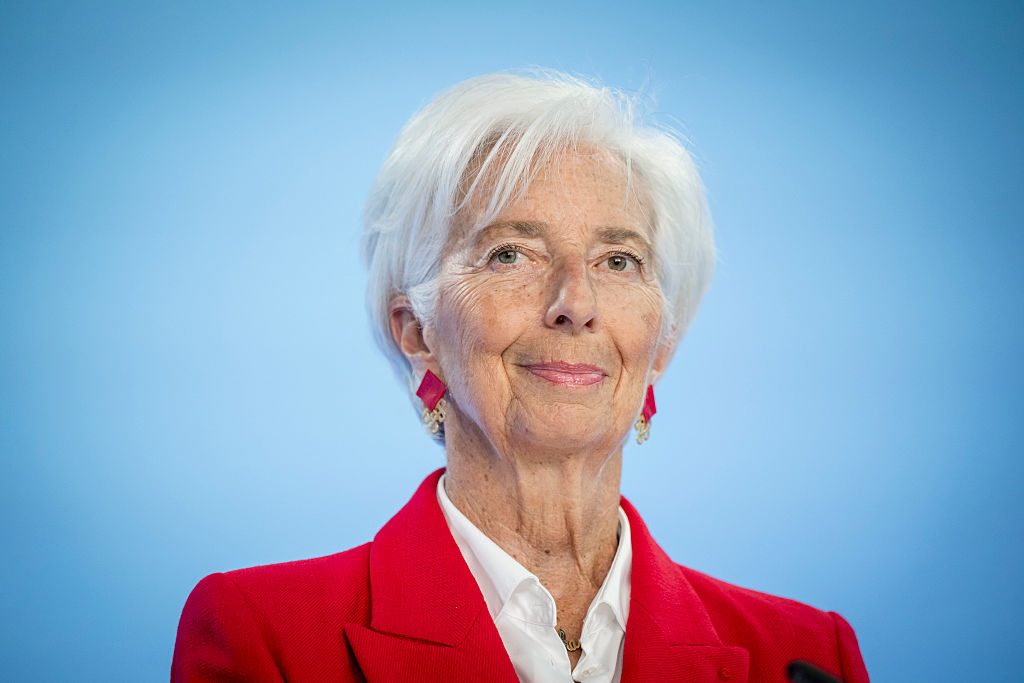
In a Financial Times op-ed on Tuesday, European Central Bank President Christine Lagarde argued that the “dominant role of the dollar” was “no longer certain”, suggesting the euro could rise to “global prominence”. But this is wishful thinking at best.
Since its inception, the euro’s global footprint has barely exceeded the aggregate use of the national currencies it replaced — roughly 20% of global foreign exchange reserves. Meanwhile, the dollar’s share has indeed declined, from over 70% to under 60%, but the euro hasn’t been the beneficiary. Instead, currencies including the Swiss franc, British pound, and Japanese yen have picked up the slack. There’s little reason to believe the euro’s status will now improve.
The euro remains plagued by structural flaws: chronic financial fragmentation, sluggish growth, and opaque institutions. Despite years of integration, the EU has fallen behind other advanced economies, particularly in innovation and productivity. This is largely due to underinvestment in R&D, weak consumption, a bias against industrial policy, and a labyrinthine governance model that stifles agility and accountability.
These issues have only deepened in recent years. Soaring energy costs — driven by the EU’s decision to decouple from Russian gas — have pushed much of Western Europe into recession and even deindustrialization, with Germany particularly hard-hit. This self-inflicted energy crisis has further widened the gap between Europe and more dynamic economies such as the United States.
Factor in the EU’s increasingly volatile geopolitical posture, and the appeal of the euro as a safe reserve currency fades even further. Investors do not flock to politically unstable or strategically erratic jurisdictions.
There’s also a fundamental economic contradiction which Lagarde ignores. A dominant reserve currency must meet global demand, which typically requires running large current account deficits in order to satisfy the world’s demand for the currency. The US has long done this by design, though Trump is now trying to reverse course. Brussels, on the other hand, has built its economic model around trade surpluses. There’s no sign EU leaders are prepared to flip that model on its head.
Lagarde acknowledges some of these challenges, while insisting they can be solved with deeper integration: completing the single market, reducing regulation, building a capital markets union. But this reflexive call for “more Europe” is hardly new. For decades, the EU elite has presented further centralization as the cure-all for Europe’s problems. Yet after years of deeper integration, outcomes have only worsened.
The real problem isn’t too little integration: it’s integration itself. The euro has stripped member states of the ability to respond flexibly to crises based on their domestic needs. It has diminished national democratic control, while centralizing power in opaque and unaccountable institutions such as the European Commission and Lagarde’s own ECB.
These institutions have repeatedly championed policies which benefit a narrow elite: austerity at home, alignment with Nato abroad, and aggressive sanctions that have boomeranged on the European economy. Giving more power to this apparatus, as Lagarde proposes, would only entrench failure.
But the most glaring flaw in Lagarde’s argument is her misunderstanding of the forces driving de-dollarization. She notes that concern over dollar dominance hasn’t triggered a full shift toward alternatives, but misses why de-dollarization is happening in the first place.
The primary driver is the US government’s weaponization of the dollar via sanctions, asset seizures and financial coercion. Countries are seeking to hedge against this risk, but that doesn’t mean they’ll hand the same power to another Western bloc. The EU has been even more eager than the US to use economic tools for geopolitical ends. Why would nations shift from one punitive system to another?
This is also why the Chinese yuan won’t replace the dollar. The future is not another hegemonic currency, but instead a more decentralized system in which nations settle transactions in their own currencies, exactly the direction being pursued by the Brics bloc. As China’s central bank governor Pan Gongsheng recently put it, the global monetary system is evolving towards a multipolar model of “coexistence, competition, and mutual checks and balances”.
Which raises the final, most fundamental question: why would the EU even want the euro to become a major reserve currency? While such status brings certain “exorbitant privileges” — such as effectively paying for imports with printed money — it also entails chronic trade deficits which hollow out domestic industry. The US experience makes this clear. Europe, already struggling with industrial decline, should be wary of following that path.
In the end, Lagarde’s proposal is less about global strategy and more about justifying greater EU centralization. But what Europe needs is not “more Europe”: it’s a different Europe altogether.
Thomas Fazi is an UnHerd columnist and translator. His latest book is The Covid Consensus, co-authored with Toby Green.
 battleforeurope