




X Close

EU trade deal can’t hide Starmer’s failures

European integration is not a magic bullet. Credit: Getty

European integration is not a magic bullet. Credit: Getty

April 30 2025 - 2:40pm

In advance of the UK-EU summit scheduled for 19 May, Britain’s Labour government has indicated that the occasion will be used to reboot its relationship with the EU, marking a “new strategic partnership”. The summit is being presented as Britain seeking shelter from the Trumpian storms currently sweeping through the world economy. The message is that liberal states will pool their collective strength in order to withstand global crises, and make good some of the damage supposedly wreaked by Brexit.

The leaked draft declaration taps into a “common understanding” on a number of shared interests, such as defense and “youth experience” programs. The document pledges “unwavering commitment to providing political, financial, economic, humanitarian, military and diplomatic” backing for Ukraine, as well as support of “multilateralism”. A day after this news, Donald Trump reportedly deemed a trade deal with the UK a lesser priority.

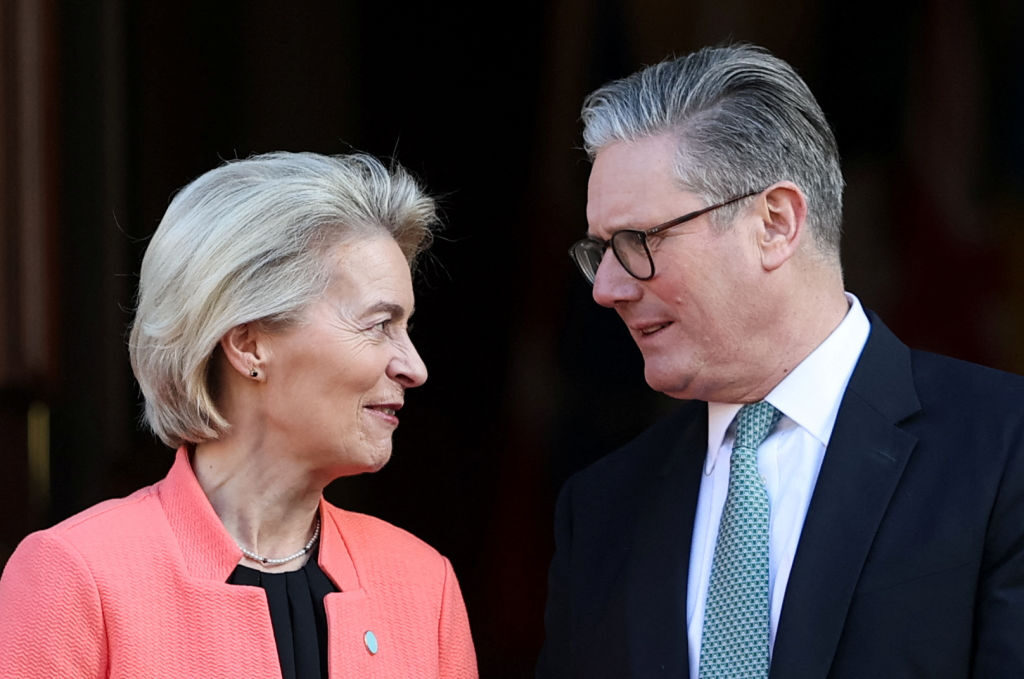
British Prime Minister Keir Starmer and European Commission President Ursula von der Leyen want to project an image of a united Europe. They want to show that the continent is uniting to defend liberal stability and free trade in a world scarred by populist irruptions, hardening trade barriers, and autocratic challengers in China and Russia.

Although the new partnership will be presented as a response to the challenges of the outside world, Britain’s effort to restart European integration, in truth, is driven at least as much by domestic pressures. In this, it is in keeping with the historic pattern behind Britain’s European integration. For years, it has used Europe as a hinterland in which political elites can retreat from British voters. The great advantage offered by the EU and its predecessors is that it allows political leaders and state elites to compensate for domestic weakness: whether that be through grandstanding at conferences, deferring decisions to meetings with European partners, seeking economic and financial assistance, or simply imposing agreements on the grounds that our continental allies demand it.

This was the pattern of European integration reaching right back to 1973, when then-Tory Prime Minister Ted Heath joined Britain to the European Economic Community (EEC), the precursor of today’s EU. At the time, the EEC appeared to be a dynamic cosmopolitan hub, growing more vigorously than Britain and offering our political leaders respite from inflation and industrial unrest.

The UK was nonetheless still an industrial and military power, with manufacturing constituting roughly one third of the national economy, and the military 349,000 strong. Despite the macroeconomic strains of the time — the energy shock, inflation, declining productivity, growing international competition — the economy was still growing on average nearly 3% per year across the decade. Such figures would seem miraculous today. Many will be familiar with the dismal litany of contemporary decline: declining public services, wages stagnant for decades, flatlining productivity. As for the military, it is the smallest since the Napoleonic Wars, each branch under-recruiting.

Yet even the gross figures on GDP or military strength mask the real and most important decline of all: the collapsing authority of the UK state and its political elites. For all the strife and unrest associated with the Seventies, industrial militancy was also a marker of civic health and political vitality. It indicated a confident working class and a vigorous civil society that was densely interwoven not only through unions but also large and powerful political parties. The very fact that there was such strong contention for power helped give the state its authority.

It is this crisis that the Labour Party hopes the EU will rescue it from. But closer cooperation will offer no economic salvation. After all, unlike the Seventies, the EU is economically lagging even by comparison to Starmerite Britain, with German factories shuttering and the Iberian power grid collapsing. Nor will declarations about free and open trade, restoring “youth mobility”, and championing Ukraine’s defense against Russia restore the credibility of the central UK state or Labour in its old electoral heartlands. The evasion of responsibility is all too plain.


Philip Cunliffe is Associate Professor of International Relations at the Department of Risk and Disaster Reduction, University College London. He is the author of seven books, including, most recently: The National Interest: Politics after Globalization.

thephilippics

China is threatening America in the AI race

Reports sugget Zhipu AI  has released a new model that can rival leading US systems. Credit: Getty

Reports sugget Zhipu AI has released a new model that can rival leading US systems. Credit: Getty

July 1 2026 - 10:18am

China is trying to catch up with America on artificial intelligence. The Wall Street Journal has reported that Zhipu AI — one of China’s six “AI tiger” LLMs — has released a new model that can rival leading US systems, including Anthropic’s Mythos, in cybersecurity tasks such as pinpointing security bugs. While this marks a milestone in China’s drive to catch up with Western AI capabilities, strong performance on a single benchmark does not mean it has taken the lead. Chinese models still lag behind their Western counterparts in broader capabilities, such as autonomous operation. Skepticism is therefore warranted before resorting to hysterical conclusions, but complacency about the geopolitical implications of China’s AI advances would be an even greater mistake.

On the infrastructure side, Chinese AI is still constrained by access to advanced chips, with American labs way ahead in computing capacity as well as investment. Analysis from earlier this year suggests that Chinese models are likely to be at least a few months behind those in the US. But they are still continuing to make progress, or that the geopolitical importance of AI will be decided only by whose LLM has ventured deeper into the technological frontier. The practical applications of AI, countries’ to capture foreign markets, and the application of AI into the real economy will matter just as much.

Here, China may hold an advantage. As with its dominance across many critical supply chains, Beijing may not need to produce the most advanced AI systems — only those that are affordable and widely deployable. In doing so, it could consolidate global influence by supplying functional, low-cost AI at scale.

Beijing seems to be pursuing exactly that path, developing an AI “open-source” strategy that offers affordable, widely available AI models for companies and individuals to use and modify as they wish. The production of the DeepSeek AI model, which matched the performance of Silicon Valley tools such as ChatGPT at a fraction of the cost for users, created goodwill among Chinese models with developers.

The four most popular models on OpenRouter, an AI hardware platform for developers, are now all Chinese. The goal for China is not only to win the frontier-model race, but to make its systems the default layer of AI adoption across industries and global markets. For most economies, the choice is increasingly between an affordable tool they can deploy now and a more robust one that may be out of reach.

And while the countries adopting Chinese models may be exposed to political pressure and cyber threats from Beijing, safer and more capable alternatives matter little if they are unaffordable. American AI companies are already under pressure to monetize products whose operating costs are rising. If Chinese open-source models become the cheap default for startups, universities, governments and businesses across the developing world, then America’s AI lead will be eroded from below.

Perhaps more concerning for America in the long run is how AI can give Chinese manufacturing even more strength, through the ongoing integration of AI as a general-purpose technology. China’s new Five-Year Plan mentioned AI more than 50 times and includes an “AI+” action plan aimed at spreading AI across the economy.

Beijing has been pioneering automation of its critical infrastructure for years, with promising recent results in increasing warplane production capacity. In that regard, China’s open-model strategy and manufacturing dominance will reinforce each other. Cheap, adaptable models accelerate deployment across the real economy while those deployments generate real-world data and use cases that can feed back into further model improvement.

The United States should not dismiss the importance of its lead in the AI race. That lead worries Beijing, not least because a more automated Chinese economy would also become more vulnerable to AI-generated cyber threats. But nor should Washington assume that China cannot catch up with American capabilities over time.

This AI competition represents part of a broader struggle over tech supply chains and geopolitical influence. Decisions over whether to adopt US or Chinese models could produce a more fragmented global reality, with different regions relying on different cloud providers, chips and security structures. The result will likely be a global economy which is divided into competing spheres, rather than one which produces a single winner.


Miquel Vila is a political and geopolitical risk consultant focusing on industrial strategy, critical infrastructure and global supply chains.

miquelvilam