




X Close

Oscars’ acceptance of AI films will make Hollywood lazy

AI could soon do much of the film industry's heavy lifting. Credit: Getty

AI could soon do much of the film industry's heavy lifting. Credit: Getty

April 25 2025 - 4:15pm

Modern cinema is awash with tedious legacy sequels and too much garish CGI. The last thing we need is another excuse for Hollywood to be lazy. Whether it’s Star Wars or Ghostbusters, moviegoers are tired of endless reboots and just want something fresh — without getting hit by popcorn from overexcited Minecraft fans.

To add insult to injury, the Academy of Motion Picture Arts and Sciences issued new rules this week which said the use of AI and other digital tools would “neither help nor harm the chances of achieving a nomination” for awards at the Oscars. This will likely pave the way for broader AI use in filmmaking.

Meanwhile, our social media news feeds are overflowing with AI slop; hyper-real, queasy images of celebrities hugging their younger selves or a Beatles photo with two Paul McCartneys and Ringo with 15 fingers. Soon, one might be greeted by this sort of nonsense on the big screen, rather than just on one’s phone. AI has already crept into productions; last year The Brutalist used AI to enhance Adrian Brody’s Hungarian accent. It feels inevitable that the AI sewage gates are about to burst open. Hollywood loves to cut corners, as evinced by how the quality of its CGI has degraded over the last two decades.

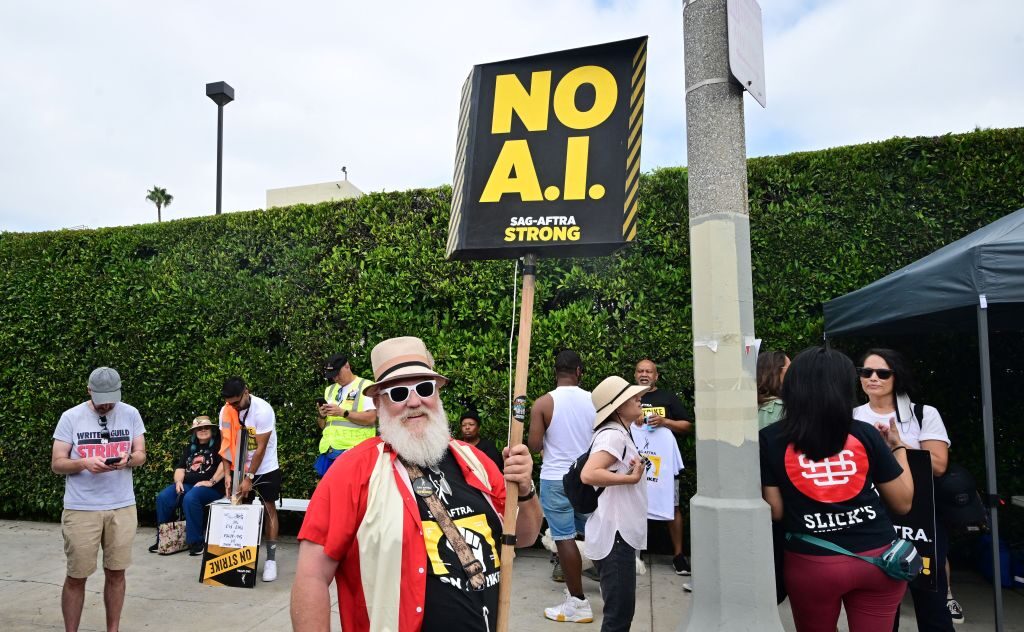
AI proponents claim it could be used merely for cosmetic enhancement as opposed to screwing people out of a job. The Directors Guild of America (the DGA) did secure AI-related protections in their 2023 contract with the Alliance of Motion Picture and Television Producers (AMPTP). It ensures AI can’t replace human roles and requires studios to consult with directors before using it, though the director doesn’t have veto power.

The DGA was right to be concerned about job losses. As Parmy Olson notes in her book about ChatGPT, Supremacy, Jeffrey Katzenberg, the co-founder of DreamWorks and the producer of Shrek and Kung Fu Panda, said in November 2023 that generative AI would cut the cost of animated movies by 90%. He also said that animators would be reduced to around 10% compared to “the good old days”.

AI will need to be contractually constrained to stop the hyperreal bull being let loose in the animation shop. There needs to be a framework of what’s allowable with AI. Making Brody sound more Hungarian doesn’t seem like a serious crime, but deepfaking dead actors or extras seems pretty godless. Likewise, using AI to tighten up an already-written third act just speeds up the grunt work, but using large language models (LLMs) to generate a premise and a script should be scorned, even if such a script doesn’t turn out to be totally insipid.

There are parallels in the music industry. People used to bristle at autotune; now it’s an industry standard to use pitch correction, even for live shows. The Beatles using AI to eliminate background noise on John Lennon’s vocals seems like a great use of AI, however limp the song might have been. There is a world where it could be just used to help artists be better artists.

But keep dreaming. That’s not the world we live in. We live in Yanis Varoufakis’s world of techno-feudalism, where online overlords like Amazon bypass markets and hoard cash that doesn’t get recirculated in society. Vassal businesses have to pay Amazon, a third-party platform, to get access to their customers because its service is frictionless. Convenience usually trumps ethics and restraint is in short supply in Hollywood, whether it’s cosmetic surgery or the CGI denouement of a mindless action movie. Like Amazon with commerce and distribution, AI will make things almost too frictionless to resist.

The one crumb of comfort is this: there is something aesthetically repugnant about full-blown AI. It looks like what it is: soulless. Hayao Miyazaki, director and Studio Ghibli co-founder, calls it an insult to life. Will audiences start to miss the human touch? Polling would suggest people are suspicious of AI. Reality has been under threat for a long time and it keeps retreating with every technological innovation. But warping the means of escapism may be enough for people to reject the inevitable march of progress en masse.


Rory Kiberd is a freelance writer. He has written book reviews for the Irish Times, the Irish Independent, and the Sunday Business Post, as well as film reviews for Totally Dublin.

KiberdRory

China is threatening America in the AI race

Reports sugget Zhipu AI  has released a new model that can rival leading US systems. Credit: Getty

Reports sugget Zhipu AI has released a new model that can rival leading US systems. Credit: Getty

July 1 2026 - 10:18am

China is trying to catch up with America on artificial intelligence. The Wall Street Journal has reported that Zhipu AI — one of China’s six “AI tiger” LLMs — has released a new model that can rival leading US systems, including Anthropic’s Mythos, in cybersecurity tasks such as pinpointing security bugs. While this marks a milestone in China’s drive to catch up with Western AI capabilities, strong performance on a single benchmark does not mean it has taken the lead. Chinese models still lag behind their Western counterparts in broader capabilities, such as autonomous operation. Skepticism is therefore warranted before resorting to hysterical conclusions, but complacency about the geopolitical implications of China’s AI advances would be an even greater mistake.

On the infrastructure side, Chinese AI is still constrained by access to advanced chips, with American labs way ahead in computing capacity as well as investment. Analysis from earlier this year suggests that Chinese models are likely to be at least a few months behind those in the US. But they are still continuing to make progress, or that the geopolitical importance of AI will be decided only by whose LLM has ventured deeper into the technological frontier. The practical applications of AI, countries’ to capture foreign markets, and the application of AI into the real economy will matter just as much.

Here, China may hold an advantage. As with its dominance across many critical supply chains, Beijing may not need to produce the most advanced AI systems — only those that are affordable and widely deployable. In doing so, it could consolidate global influence by supplying functional, low-cost AI at scale.

Beijing seems to be pursuing exactly that path, developing an AI “open-source” strategy that offers affordable, widely available AI models for companies and individuals to use and modify as they wish. The production of the DeepSeek AI model, which matched the performance of Silicon Valley tools such as ChatGPT at a fraction of the cost for users, created goodwill among Chinese models with developers.

The four most popular models on OpenRouter, an AI hardware platform for developers, are now all Chinese. The goal for China is not only to win the frontier-model race, but to make its systems the default layer of AI adoption across industries and global markets. For most economies, the choice is increasingly between an affordable tool they can deploy now and a more robust one that may be out of reach.

And while the countries adopting Chinese models may be exposed to political pressure and cyber threats from Beijing, safer and more capable alternatives matter little if they are unaffordable. American AI companies are already under pressure to monetize products whose operating costs are rising. If Chinese open-source models become the cheap default for startups, universities, governments and businesses across the developing world, then America’s AI lead will be eroded from below.

Perhaps more concerning for America in the long run is how AI can give Chinese manufacturing even more strength, through the ongoing integration of AI as a general-purpose technology. China’s new Five-Year Plan mentioned AI more than 50 times and includes an “AI+” action plan aimed at spreading AI across the economy.

Beijing has been pioneering automation of its critical infrastructure for years, with promising recent results in increasing warplane production capacity. In that regard, China’s open-model strategy and manufacturing dominance will reinforce each other. Cheap, adaptable models accelerate deployment across the real economy while those deployments generate real-world data and use cases that can feed back into further model improvement.

The United States should not dismiss the importance of its lead in the AI race. That lead worries Beijing, not least because a more automated Chinese economy would also become more vulnerable to AI-generated cyber threats. But nor should Washington assume that China cannot catch up with American capabilities over time.

This AI competition represents part of a broader struggle over tech supply chains and geopolitical influence. Decisions over whether to adopt US or Chinese models could produce a more fragmented global reality, with different regions relying on different cloud providers, chips and security structures. The result will likely be a global economy which is divided into competing spheres, rather than one which produces a single winner.


Miquel Vila is a political and geopolitical risk consultant focusing on industrial strategy, critical infrastructure and global supply chains.

miquelvilam