




X Close

French Jews are abandoning the Left

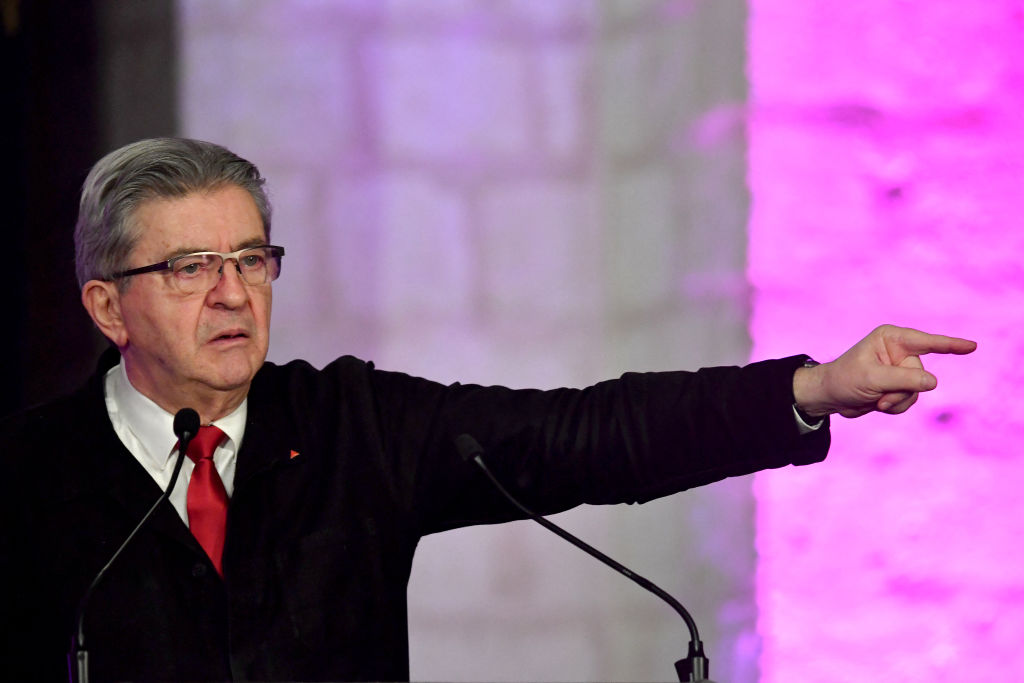
Jean-Luc Mélenchon has proved an unlikely ally for Marine Le Pen. Credit: Getty

Jean-Luc Mélenchon has proved an unlikely ally for Marine Le Pen. Credit: Getty

March 28 2025 - 1:00pm

When Jean-Marie Le Pen referred to the Holocaust as a “detail” of the Second World War in 1987, he probably didn’t know that it would cast a dark shadow over his party, the Front National. For decades, accusations of antisemitism played a large role in his political marginalization — accusations which he never did much to brush away.

Nearly four decades later, his granddaughter Marion Maréchal and the leader of the rechristened Rassemblement National Jordan Bardella have both headed to Israel at the invitation of Israel’s Minister of Diaspora Affairs, Amichai Chikli.

The two nationalist leaders visited some of the areas targeted during the Hamas terrorist attacks of 7 October 2023, and warned against the rise of antisemitism. Bardella was quick to point out that France and Israel were both victims of “Islamic fundamentalism”, the “biggest threat” they face. The parallels between the attack on the Nova festival in Israel in 2023 and the Bataclan in Paris in 2015 are obvious to many French citizens. It is with this shared sense of danger that Bardella is trying to appeal to his Jewish compatriots.

Pilgrimages to Israel and meetings with Israeli leaders are common in nationalist European politics. Hungary’s Viktor Orbán has met Benjamin Netanyahu several times, while Geert Wilders from the Netherlands has met and lavishly praised the Israeli Prime Minister.

In France, Marine Le Pen went further and purged from the RN ranks any members deemed to be too toxic, starting with her own father, who was expelled in 2015 after reiterating his infamous “point of detail” argument.

In her efforts to clean up the party, she has been helped by an unlikely ally: La France Insoumise, the radical Left party of Jean-Luc Mélenchon. Over the last few years, and even more so since the 7 October attacks, Mélenchon and his allies have refused to condemn Hamas as a terrorist organization and engaged in antisemitic dogwhistles, such as leaning on stereotypes about Jews and banking.

The staunch defense of Palestine has largely paid off politically in France’s suburbs, which host large Muslim communities. On the flip side, however, a staggering 92% of French Jews now consider La France Insoumise to be a driver of antisemitism, well ahead of the RN at 49%. Even the center-left publication Le Monde ran an editorial blasting Mélenchon for his party’s use of antisemitic tropes.

The consequence of this is that many French Jews, if forced to choose between Mélenchon and Le Pen, are willing to look past the RN’s unseemly past. Take Serge Klarsfeld, the “Nazi-hunter” who discovered that Adolf Eichmann was in Argentina. “Marine Le Pen is the head of a party which supports Israel and supports the Jews,” he said last year. “So we gave this advice to those who will be faced with this runoff between the far-Left and what used to be the far-Right, which for us is now a populist party, to vote for the Right.”

Bardella’s trip to Israel this week also reflects a larger evolution in France, and in much of Europe, of nationalist politics. Now presenting themselves as muscular defenders of standard liberal values against the external threat of Islamism, the old battles of the traditionalist Right against Jews and sexual minorities are in the rear-view mirror. In fact, many of Le Pen’s arguments against mass migration are framed as a protection of women’s rights, freedom of speech and the defense of minorities.

The normalization continues, as Bardella visits Yad Vashem, Israel’s official Holocaust memorial. His break from Jean-Marie Le Pen’s reticence about the Holocaust could not be more pronounced. “The concentration camps were the height of barbarism,” he posted on Wednesday. As political chaos continues to engulf a splintered French parliament without a majority, Bardella’s party has worked hard to remove any electoral barriers. Israel, clearly, is an important stop on the RN’s road to the Elysée.


Pierre-Louis Bodman is an independent French politics analyst.


China is threatening America in the AI race

Reports sugget Zhipu AI  has released a new model that can rival leading US systems. Credit: Getty

Reports sugget Zhipu AI has released a new model that can rival leading US systems. Credit: Getty

July 1 2026 - 10:18am

China is trying to catch up with America on artificial intelligence. The Wall Street Journal has reported that Zhipu AI — one of China’s six “AI tiger” LLMs — has released a new model that can rival leading US systems, including Anthropic’s Mythos, in cybersecurity tasks such as pinpointing security bugs. While this marks a milestone in China’s drive to catch up with Western AI capabilities, strong performance on a single benchmark does not mean it has taken the lead. Chinese models still lag behind their Western counterparts in broader capabilities, such as autonomous operation. Skepticism is therefore warranted before resorting to hysterical conclusions, but complacency about the geopolitical implications of China’s AI advances would be an even greater mistake.

On the infrastructure side, Chinese AI is still constrained by access to advanced chips, with American labs way ahead in computing capacity as well as investment. Analysis from earlier this year suggests that Chinese models are likely to be at least a few months behind those in the US. But they are still continuing to make progress, or that the geopolitical importance of AI will be decided only by whose LLM has ventured deeper into the technological frontier. The practical applications of AI, countries’ to capture foreign markets, and the application of AI into the real economy will matter just as much.

Here, China may hold an advantage. As with its dominance across many critical supply chains, Beijing may not need to produce the most advanced AI systems — only those that are affordable and widely deployable. In doing so, it could consolidate global influence by supplying functional, low-cost AI at scale.

Beijing seems to be pursuing exactly that path, developing an AI “open-source” strategy that offers affordable, widely available AI models for companies and individuals to use and modify as they wish. The production of the DeepSeek AI model, which matched the performance of Silicon Valley tools such as ChatGPT at a fraction of the cost for users, created goodwill among Chinese models with developers.

The four most popular models on OpenRouter, an AI hardware platform for developers, are now all Chinese. The goal for China is not only to win the frontier-model race, but to make its systems the default layer of AI adoption across industries and global markets. For most economies, the choice is increasingly between an affordable tool they can deploy now and a more robust one that may be out of reach.

And while the countries adopting Chinese models may be exposed to political pressure and cyber threats from Beijing, safer and more capable alternatives matter little if they are unaffordable. American AI companies are already under pressure to monetize products whose operating costs are rising. If Chinese open-source models become the cheap default for startups, universities, governments and businesses across the developing world, then America’s AI lead will be eroded from below.

Perhaps more concerning for America in the long run is how AI can give Chinese manufacturing even more strength, through the ongoing integration of AI as a general-purpose technology. China’s new Five-Year Plan mentioned AI more than 50 times and includes an “AI+” action plan aimed at spreading AI across the economy.

Beijing has been pioneering automation of its critical infrastructure for years, with promising recent results in increasing warplane production capacity. In that regard, China’s open-model strategy and manufacturing dominance will reinforce each other. Cheap, adaptable models accelerate deployment across the real economy while those deployments generate real-world data and use cases that can feed back into further model improvement.

The United States should not dismiss the importance of its lead in the AI race. That lead worries Beijing, not least because a more automated Chinese economy would also become more vulnerable to AI-generated cyber threats. But nor should Washington assume that China cannot catch up with American capabilities over time.

This AI competition represents part of a broader struggle over tech supply chains and geopolitical influence. Decisions over whether to adopt US or Chinese models could produce a more fragmented global reality, with different regions relying on different cloud providers, chips and security structures. The result will likely be a global economy which is divided into competing spheres, rather than one which produces a single winner.


Miquel Vila is a political and geopolitical risk consultant focusing on industrial strategy, critical infrastructure and global supply chains.

miquelvilam