




X Close

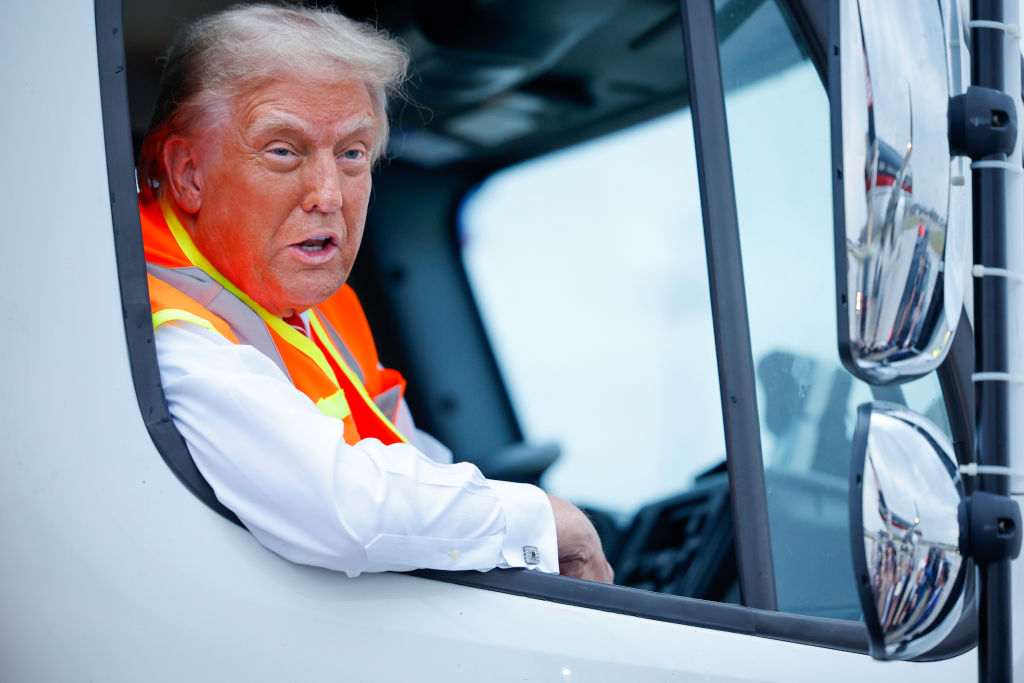
Garbage stunt confirms Trump is America’s meme king

Taking out the trash. Credit: Getty

Taking out the trash. Credit: Getty

October 31 2024 - 8:00pm

With American election fever now at a deafening pitch, there’s something dizzying about stepping from one filter bubble to another and seeing how differently the same event can be treated. Yesterday, for instance, Donald Trump staged a photoshoot in a branded garbage collection truck, in response to Joe Biden calling his supporters “garbage”. This in turn was in response to a stand-up comic at Trump’s recent New York City rally describing Puerto Rico as “a floating island of garbage”.

The Independent reported the garbage truck stunt as a “total fail”. The New York Times employed the “editorialising by proxy” strategy beloved of officially-still-objective newsrooms such as the BBC, in which they don’t so much report the stunt as report the reactions of people who didn’t like the stunt, so as to criticise it while preserving the appearance of merely reporting the news. Meanwhile, Trump-backing billionaire Elon Musk deemed it “genius-level trolling”, and the New York Post called it “a big, beautiful MAGA garbage truck”.

To say that I’ve been able to follow this story at all, despite having no direct stake in the US election, is an admission that I spend way too much time on the internet. But as such I have come to appreciate the power of a well-judged meme. And on this front Trump has consistently been head and shoulders above his opponents.

The visual of Trump in a hi-vis vest, behind the wheel of a Trump-branded garbage truck (bin lorry, in English) carries potent connotations. Momentarily, the former president became the working man, doing the smelly, arduous but socially indispensable work of collecting everyone’s rubbish. He became the practical man, doing tangible work in the real world. It is difficult to think of another politician capable of such a stunt — not even Trump’s own running mate J.D. Vance.

I’ve argued elsewhere that postmodern politics retrieves “representation” in a more medieval than liberal-democratic sense. And from this perspective, we can read Trump’s “garbage” stunt as representing — in archetype, if not yet in policy — a swathe of the American electorate that in recent decades has been largely abandoned by the Left which once voiced its interests.

Embodying archetypes in this way is a gift, not a learned achievement. Garbage Trump is only the latest in a string of memetically potent Trumpian images and utterances. When he visited a McDonald’s, made some fries and “served” from the drive-thru window, his enemies protested that it was all staged. But it made little difference, because the resulting images were simply too symbolically dense for such details to matter.

This in turn offers a clue as to why Trump consistently outclasses his opponents in meme warfare. He seems to understand at an instinctive level that dominating internet discourse isn’t about whether everyone thinks you’re a good person or not. The images, ideas, and phrases that make it beyond partisan filter bubbles do so not by being persuasively good across the board, but by transcending “good” and “bad” altogether.

There is no reconciling the filter bubbles now. But rather than viewing opposing filter bubbles as locked in a slide toward mutually assured destruction, to my eye the dialectic is more about mutual amplification and interdependence. Think of what happens every time one side or the other peels away to a social media ecosystem where they’re not confronted by their enemies, for example Mastodon or Bluesky. Without opponents, the conversation swiftly becomes boring, and defectors usually sidle back in the end.

In this context, true memetic power doesn’t rest in making everyone like you. Really, the entertainment value of the whole system rests on images and ideas strong enough to cross the containment barrier between filter bubbles, and drive discourse across the political spectrum. And in this game, nobody matches Trump. “Brat” and “joy” were good efforts, but ultimately weak. Meanwhile, it doesn’t matter if you’re lauding the Garbage Trump appearance as a supporter, or condemning it as a hater. Either way, you’re still sharing the image.

This raises many questions about how any of this maps onto the nitty-gritty of power. What role can serious policy debate possibly play in a battle for viral cut-through? What relation does meme power even have to real-world, institutional clout, and does the former ever influence the latter? Does going viral actually achieve anything?

I am not qualified to predict what will happen over the next few days. But whichever way the election goes, the result will be instructive on all these fronts.


Mary Harrington is a contributing editor at UnHerd.

moveincircles

China is threatening America in the AI race

Reports sugget Zhipu AI  has released a new model that can rival leading US systems. Credit: Getty

Reports sugget Zhipu AI has released a new model that can rival leading US systems. Credit: Getty

July 1 2026 - 10:18am

China is trying to catch up with America on artificial intelligence. The Wall Street Journal has reported that Zhipu AI — one of China’s six “AI tiger” LLMs — has released a new model that can rival leading US systems, including Anthropic’s Mythos, in cybersecurity tasks such as pinpointing security bugs. While this marks a milestone in China’s drive to catch up with Western AI capabilities, strong performance on a single benchmark does not mean it has taken the lead. Chinese models still lag behind their Western counterparts in broader capabilities, such as autonomous operation. Skepticism is therefore warranted before resorting to hysterical conclusions, but complacency about the geopolitical implications of China’s AI advances would be an even greater mistake.

On the infrastructure side, Chinese AI is still constrained by access to advanced chips, with American labs way ahead in computing capacity as well as investment. Analysis from earlier this year suggests that Chinese models are likely to be at least a few months behind those in the US. But they are still continuing to make progress, or that the geopolitical importance of AI will be decided only by whose LLM has ventured deeper into the technological frontier. The practical applications of AI, countries’ to capture foreign markets, and the application of AI into the real economy will matter just as much.

Here, China may hold an advantage. As with its dominance across many critical supply chains, Beijing may not need to produce the most advanced AI systems — only those that are affordable and widely deployable. In doing so, it could consolidate global influence by supplying functional, low-cost AI at scale.

Beijing seems to be pursuing exactly that path, developing an AI “open-source” strategy that offers affordable, widely available AI models for companies and individuals to use and modify as they wish. The production of the DeepSeek AI model, which matched the performance of Silicon Valley tools such as ChatGPT at a fraction of the cost for users, created goodwill among Chinese models with developers.

The four most popular models on OpenRouter, an AI hardware platform for developers, are now all Chinese. The goal for China is not only to win the frontier-model race, but to make its systems the default layer of AI adoption across industries and global markets. For most economies, the choice is increasingly between an affordable tool they can deploy now and a more robust one that may be out of reach.

And while the countries adopting Chinese models may be exposed to political pressure and cyber threats from Beijing, safer and more capable alternatives matter little if they are unaffordable. American AI companies are already under pressure to monetize products whose operating costs are rising. If Chinese open-source models become the cheap default for startups, universities, governments and businesses across the developing world, then America’s AI lead will be eroded from below.

Perhaps more concerning for America in the long run is how AI can give Chinese manufacturing even more strength, through the ongoing integration of AI as a general-purpose technology. China’s new Five-Year Plan mentioned AI more than 50 times and includes an “AI+” action plan aimed at spreading AI across the economy.

Beijing has been pioneering automation of its critical infrastructure for years, with promising recent results in increasing warplane production capacity. In that regard, China’s open-model strategy and manufacturing dominance will reinforce each other. Cheap, adaptable models accelerate deployment across the real economy while those deployments generate real-world data and use cases that can feed back into further model improvement.

The United States should not dismiss the importance of its lead in the AI race. That lead worries Beijing, not least because a more automated Chinese economy would also become more vulnerable to AI-generated cyber threats. But nor should Washington assume that China cannot catch up with American capabilities over time.

This AI competition represents part of a broader struggle over tech supply chains and geopolitical influence. Decisions over whether to adopt US or Chinese models could produce a more fragmented global reality, with different regions relying on different cloud providers, chips and security structures. The result will likely be a global economy which is divided into competing spheres, rather than one which produces a single winner.


Miquel Vila is a political and geopolitical risk consultant focusing on industrial strategy, critical infrastructure and global supply chains.

miquelvilam